February 2026

Surviving Grief With An Unrelenting Mindset With Brian Francis

Widowhood Real Talk with Tina | Brian Francis | Unrelenting Mindset

  Abuse and grief may leave you with deep wounds, but the path to healing will always be open. With an unrelenting mindset, Brian Francis managed to endure a childhood of domestic abuse and the trauma of his father’s death. He tells how he embraced unwavering resilience to write a memoir about his experiences, insights, and realizations to spread inspiration to people who are going through the same struggles. Brian also shares how he gained deeper empathy as a psychiatric nurse, his decision to seek reclassification as a conscientious objector in the Navy, and how he connected with his readers who now feel less alone because of his truth. I am sharing my experience of loving the same man for 32 years, a mother to two adult children, a retired military officer, a breast cancer survivor, and my connections with others.   Anyone experiencing suicidal thoughts should reach out to a suicide hotline or local emergency number in their country: Psychology Today Suicide Hotlines and Prevention Resources Around the World. — Watch the episode here   Listen to the podcast here   Surviving Grief With An Unrelenting Mindset With Brian Francis Grief and pain come in many different packages. What happens when you’re a young boy, and your family is destroyed when one parent kills the other? How do you handle your grief when you’re always pushed to the side and told to be quiet, to be seen and not heard? How do you relate to pain differently in your life? In all of that, you decide to tell your story in a book for the world to see. This conversation with Brian Francis is going to answer those questions and more. Let’s get into this conversation.       Brian, welcome to the Widowhood. Thank you. Thank you. With, “Welcome to the Widowhood,” when you first hear those words, what does it mean for you? I understand you’re not a widower as it relates to this, but when you hear those words, what does that mean for you? The first connotation I get from it is loss. It’s interesting that you have formed a community around loss. I think that’s needed, especially in our society. No matter what our pain or our experience is, I’ve learned that there’s value in connecting with other people, and that understanding can relate to your loss. It’s not in a trauma-bonding, unhealthy way, but a way that’s validating and can be empowering. I have found that through what I’ve done here, there’s been a lot of validation. Writing The Book Unrelenting: When Safe was the Exception When you say what you’ve done here, I’m guessing you’re relating to this book that came out in August 2025. Correct. Tell us about the cover and the title. The cover is based on a watercolor painting that a friend of mine did specifically for this project. It was designed to indicate the sense of loneliness and powerlessness involved in domestic abuse. For her original painting, they couldn’t use it for whatever reason, but it had a black cloud moving through the figure of the young boy. That was her emoting that trouble, that negative connotation we necessarily get with abuse, and how it affects the person. It goes right through them, and yet still lingers. The title is a double-edged sword. The title has to do with my mother’s unrelenting need to control and the abuse that resulted. It also has to do with my unrelenting desire not to be victimized. I don’t think anybody wants to be controlled. We are autonomous people. We want to act and live out that resilience of individuality. What moved you to finally put your story on paper? Was there a moment when you knew it had to be written? How did that go for you? It’s an interesting and long slog. Back in the ‘90s, I wrote a one-act play based on this, and I submitted it for a playwrights’ festival. One of the judges came to me before they had decided, and she said, “This is a little too fantastic. Why don’t you tone it down a little bit?” I said, “That’s real. That’s my life.” She said, “Oh.” It was then selected for production in that playwright’s festival. That gave me a hint that I could tell the story, but at that time, it was still raw and painful, so I shelved it. Back in 2014, a series of events unfolded with somebody that I had not spoken with for a long time coming back into my life. They wanted to know what was going on. I said, “There’s this idea I have to write a memoir,” and they encouraged me to do that. I started that, and it has been a long process. There was a lot of self-editing. It was dealing with it again, dealing with the pain, dealing with all of those negative memories, and especially dealing with the loss of my father. It was a very difficult thing, but writing this was cathartic. What part of this journey surprised you the most in writing this story? The validation that people have given me since they’ve read this and said, “I had no idea.” These are people who lived close to me, school chums and so forth. Once it was on paper, I felt like I was finally not free of it, but I had let go enough to let this all go out into the world. Somebody said, “I didn’t realize, and I’m sorry.” That probably was the greatest impact on my life as an adult for this whole thing. Here, I get to be the first show that you’re continuing to share this story with the entire world. We connected in, I believe, a Facebook group for people who have written books. I asked people if they had a book that they had written that relates to grief or pain. Even though this is predominantly for grief as it relates to widows and widowers,

Surviving Grief With An Unrelenting Mindset With Brian Francis Read More »
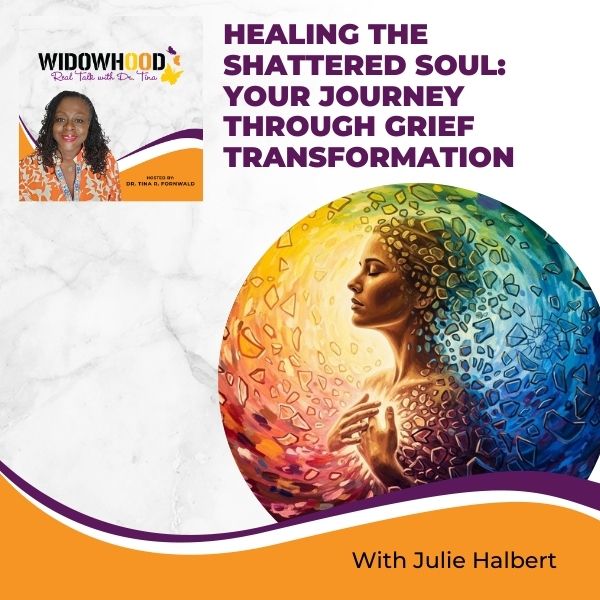
Healing The Shattered Soul: Your Journey Through Grief Transformation with Julie Halbert

Widowhood Real Talk with Tina | Julie Halbert | Grief Transformation

  Moving through the unimaginable pain of loss is the beginning of a profound grief transformation and conscious new life. Tina Fornwald sits down with Julie Halbert, a Transformational Soul Coach, Death Doula, and former lawyer, to explore the powerful journey from victimhood to light, discussing her upcoming book, Divine Ashes Ascending. They speak the raw truth about the guttural reality of grief, the importance of building community, and how spiritual practice can move us from mere survival to a state of being and profound peace. Julie also sheds light on the often-overlooked emotional needs of grieving sons and the crucial role of the 504 plan in providing accommodations for children in school. I am sharing my experience of loving the same man for 32 years, a mother to two adult children, a retired military officer, a breast cancer survivor, and my connections with others.  Anyone experiencing suicidal thoughts should reach out to a suicide hotline or local emergency number in their country: Psychology Today Suicide Hotlines and Prevention Resources Around the World. — Watch the episode here   Listen to the podcast here   Healing The Shattered Soul: Your Journey Through Grief Transformation with Julie Halbert Oftentimes, the children who have lost the parents, going back to school is not easy, but a 504 plan can help them. This conversation with Julie is going to give you very detailed information on how to execute a 504 plan for your child. At the same time, have you been curious about the term death doula or transformation soul coach? This conversation’s going to give you insight to that too. Julie and I have some things that are very similar to the passing of our husbands that I did not know until this conversation. Let’s get into this discussion now. It’s going to bless your soul.       Julie, welcome to the Widowhood. Thank you for having me, Tina. I’m happy to be here. Redefining Widowhood: Finding Transformation Through Grief Thank you. Happy to be in the widowhood. If you were to like the subtitles that was not shown, what would that look like when you hear the word widowhood the first time? You’re asking me a very big question and I’m glad that we’re starting here. Okay, so I’m with you. I practiced law for 30 years. When Jim died, which was December 6th, 2018, and I’d like to honor his birthday, October 24th. I wanted to honor doing this with you and honor his birthday. Just calling in the energy of his spirit to be with us and just being present in a beautiful way. My first experience with the word widow, I was at literally at the OBGYN and I guess at that point in time, the GYN for myself. I remember seeing it on the form and I started to cry and I was like, “This word does not sit well with me.” It’s very interesting. Jim died at 51 and I was 50 and I just didn’t identify with it. I didn’t identify with the word and the language. As I was preparing for you, I said, “I don’t know how Tina’s going to feel about this.” I really was doing a lot of research into the root of the word, the historical patriarchy, where it came from, the whole idea of being bereft and empty and lost. I really have taken it to a place of transformation. I was playing with a new word. Actually, luminara, and being the whole idea of like yes, we have this deep painful loss and we all are shattered in the space of it in different ways in our grief. It’s so real and it’s so painful. I guess the question is how do we go through it? You said a lot there, and I almost could throw away all my questions here, but I’m just going to pause. My husband Mark was 51 when he passed. I was 50 when Mark passed. Mark passed in 2017. I think as the concept of a death doula, ushering people through their loved ones and then those remaining through this transition process, there is a lot of illumination that happens. Our society, I believe, has made death such a horrible, dark, unwanting instead of welcoming the process of the transition of life that is inevitable. If we go into it afraid and scared, that’s not a good way to go into the next version of our life. I miss Mark dearly. I happen to wear his gym shoes because we wore the same size shoe, but at the same time, I’ve come into a place that I know his life, his journey was over. Mine continues. There’s a difference with that that I think requires someone to a spark of light because we are so alienated from the idea what good could ever come from this. I’m with you 1,000%. I could echo every single word that you said. First off, I just want to honor that we were both 50 and 51. I find that intriguing. I think we should just honor that as a factual truth. They’re always with us. We carry them with us everywhere. It’s like their journey was over and I think they continue with us in our journey. You are doing amazing work with the work you’re doing with widows and others and children and just amazing giving back. For me, I do believe, as a Death Doula, we have this sacred breath at the end of life and that it should be celebrated the same way we celebrate the sacred breath at birth. We do so much around birthdays, but we don’t honor that sacred final breath. Our society avoids and denies it. I’m with you. It’s a problem. It is. Thank you. The work that I do is, one, to normalize the thing that we’ve been doing since the beginning of time. How dare we have been a spouse to someone and they

Healing The Shattered Soul: Your Journey Through Grief Transformation with Julie Halbert Read More »

The Power Of Setting Healthy Boundaries With Regina Hiremath

Widowhood Real Talk with Tina | Regina Hiremath | Healthy Boundaries

  Setting healthy boundaries should never restrict you from living your best life, but protect you from getting hurt by external forces out of your control. Author and speaker Regina Hiremath experienced a rough childhood and got into an unhappy marriage, but she handled the wounds of her journey by doing the inner work and creating boundaries in the right places. She shares how overcoming her fear of public speaking and undergoing a self-discovery allowed her to share her story of trauma, domestic violence, and divorce to the world. Regina also explains how to find your own “onesome” and learn to ride the huge waves of life’s challenges. I am sharing my experience of loving the same man for 32 years, a mother to two adult children, a retired military officer, a breast cancer survivor, and my connections with others.   Anyone experiencing suicidal thoughts should reach out to a suicide hotline or local emergency number in their country: Psychology Today Suicide Hotlines and Prevention Resources Around the World. — Watch the episode here   Listen to the podcast here   The Power Of Setting Healthy Boundaries With Regina Hiremath What happens when you don’t feel like you’re enough as an individual? What happens when your confidence has been snatched? What happens when you lay down boundaries and you realize it’s protection and not restriction? These are the questions and more that we’re going to learn from our conversation with Regina. Let’s get into this episode now.     Regina, welcome to the Widowhood. Thank you so much for having me on, Tina. When you hear that, if I were to see the ticker tape in your head, “Welcome to the Widowhood,” what would be the backstory that you would not have wanted to tell me? Especially reaching out and the whole idea of the Widowhood, what were you thinking or thinking now about that concept? Widowhood typically means a sisterhood of people who have lost a spouse, and someone has died. I feel like I lost a spouse. For a period of time, I died, but I came back to life. What It Feels Like To Share Your Story Of Grief To The World Thank you for making that correlation. The idea is that in grief, we experience very similar paths when we’re going through grief. Understanding my community is based on people who have experienced a profound loss of a spouse who will not come back. What I have spoken to people, in the world, resilient or people enduring harsh experiences, it is some of those same building blocks that we use to be able to figure out why I want to keep living after experiencing X, Y, Z. What motivated you to finally say yes to sharing your story publicly? How did it feel the first time you did? As I was going through my divorce, I started a divorce blog because my journal writings were very therapeutic and cathartic for me. Therefore, I started Alimonia Life, the divorce blog. After doing that for some time, I realized that I wanted to have a greater impact. For me to do that, I was going to have to speak, but there was a big hurdle between me and speaking because of my past. I had a lifelong fear of public speaking. I had to really work hard to overcome the fear of public speaking to get out there, to put a face and a voice to the story that I was sharing. You described your book, Lessons On The Way To Onesome, as more than a domestic violence story. It’s about overcoming adversity. When we had our pre-show conversation, it was important for that to resonate. When I thought about it, sometimes, we can get so lost in our pain, which deserves its recognition. It deserves saying, “This is why I’m here.” I believe the goal is to live more of our lives outside of that painful experience, on how to leverage it to live. That’s why I knew it was important for you to share your journey, because there are also people in my community who have suffered through domestic violence. That has compounded their grief because people can hardly listen to one thing we’ve experienced that’s difficult, let alone to hear the person who is now deceased. They lived in the pain of their hand for so many years, but never said anything. They never articulate it. Going back to you actually sharing your story, how did it feel inside to finally say it out? I can remember when that first occurred. I had been writing for some time and made the decision to step out and use my face and voice. Shortly after, I said, “Yes. I’m saying yes to using my voice to help others.” I was asked to speak at an abuse symposium. After I agreed to it, I went home, and it hit me. “You’re going to speak. You said yes, and you have a lot of work to do to be prepared. You’re capable of doing that, but it’s happening. What you’ve spoken to existence is happening now.” I remember the months leading up to it. I remember being directed to read a book that someone handed me one day. It sat on my nightstand for months. I picked it up prior to this event and discovered that this was a person sharing their story of domestic violence. In that moment, I knew why this book had been handed to me and why it sat on my nightstand. That particular moment I picked it up was completely to prepare me for speaking about coming out and sharing my story, which I had never done before. Everything that happened that day, I attribute to preparation, passion, and purpose aligning. For me, when those three things come together, I’m moving in my element. All of the fears and things that used to choke me up and have me stumbling and fumbling over my words

The Power Of Setting Healthy Boundaries With Regina Hiremath Read More »

Honoring The Empty Spaces Where Grief And Faith Meet With Kirk Byron Jones

Widowhood Real Talk with Tina | Kirk Byron Jones | Grief And Faith

  When profound loss shakes the very foundation of your spirit, causing grief and faith to feel like opposites, where do you turn for a candid conversation? Pastor, spiritual director, and author Kirk Byron Jones joins to share his decades of wisdom on God and spirituality amidst the pain of loss. Dr. Jones advocates for the powerful concept of ‘healthy doubt’ as an avenue for spiritual growth, and he shares his own personal journey through burnout and struggles with divine trust. He offers essential practices, like his ‘Morning Brew’ ritual and ‘Peace Pockets,’ encouraging listeners to embrace rest, ‘self-gracing,’ and sacred stillness to transform solitude from isolation into a wellspring of compassionate presence. I am sharing my experience of loving the same man for 32 years, a mother to two adult children, a retired military officer, a breast cancer survivor, and my connections with others.  Anyone experiencing suicidal thoughts should reach out to a suicide hotline or local emergency number in their country: Psychology Today Suicide Hotlines and Prevention Resources Around the World. — Watch the episode here    Listen to the podcast here   Honoring The Empty Spaces Where Grief And Faith Meet With Kirk Byron Jones Thank you for being along for this mini series, Voices of Widowhood: Healing through the Holidays. Our last guest for this conversation, Dr. Jones, has some nuggets for you. We’re going to talk about what fills you and what drains you. He also has a great acronym to start the day called BREW. The first B is Be still. The R is Receive grace. I’ll let him explain the rest of them to you in this conversation. Let’s jump into it.       Dr. Jones, welcome to the Widowhood. Greetings. It’s good to be with you. I’ve been looking forward to talking with you. When you hear, “Welcome to the Widowhood,” what comes to mind? What a first question. We’re here to talk. First of all, I take the word welcome very seriously in a lighthearted way. When you say, “Welcome,” I see from your face and from the invitation that you mean it, so I don’t take welcomes for granted. Thank you for the welcome. To the Widowhood, I celebrate community amid a missing or a losing. Yet, you found each other, which, to me, speaks of life continuing on amid loss, grief, hurt, and pain. We oftentimes find that in each other. There are resources within, but there are resources without. When you say, “Welcome to the sisters of the Widowhood,” it’s a layered blessing. When Grief Makes God Feel Distant: Honoring The Empty Spaces Thank you. You have spent decades working with pastors and caregivers on the idea of slowing down the pace, having a better relationship with God. I want to start there for the people who are grieving. They’d love to understand what that looks like in their grief because they’re not hearing God. They feel like God is distant. I can tell this conversation is going to be a slow conversation. I hope that people appreciate the pauses as much as they do the words, because the spaces in between this conversation, something tells me, are going to be very important. I would attest to that. This mini series that you agreed to participate in, Voices of Widowhood: Healing through the Holidays, I believe this is going to be the last conversation in this series. It is important as this conversation will air in the last week of January 2026. People have read from different people giving them information about encouragement, how to make it through, and how to breathe. What I’ve often found lingering in the back of those conversations is that missing piece of that candid discussion about God, their faith, and what that looks like in their grief. Understanding that every reader has a different faith that they may resonate with, but the overall concept of how this level of loss impacts one’s faith. Going to your question about how we honor, I hear it as how you honor the empty spaces. Being honest about the distance of divinity is important because often, God feels gone if we’re honest about it. Maybe not so much on a Sunday morning. I’m in the Baptist tradition. When the choir gets going, and there’s a whole lot of hallelujah going on, the assumption is that the spirit is in the place, but I’ve pastored long enough to know that even in such moments, there are people who feel the opposite. They’re maybe clapping to not be detected because it’s habitual. The real truth of the matter is, in any given moment in a worship or anywhere else, God feels gone. I’ve never experienced the loss that the sisters of the widowhood are experiencing. I preached a scripture where it’s post-resurrection. It’s the last chapter in Matthew. The disciples are gathered on the mountain. They’ve gotten word from this alleged resurrected Jesus for them to meet him on the mountain. There’s this interesting passage that says that they’re there. Some doubted. Though they had gathered post-resurrection, some doubted. The promise comes that Jesus says, “I’ll be with you always.” He didn’t separate the crowd before He made the promise, which means to me that the shouters, those who affirmed the resurrection and believed in it, and the doubters received the same promise. I may have been tempted to separate those who believed from those who doubted and said to the believers, “I’m with you,” and ignored those who were doubting. The moral of the story is that God’s being with us does not depend on our being with God. When God seems gone, it seems to me is when we need God the most, even though we may not feel God’s presence. We don’t have to feel God’s presence. God need not be invited to be present. I may have some folks who come at me on this. I don’t believe God needs to be named to

Honoring The Empty Spaces Where Grief And Faith Meet With Kirk Byron Jones Read More »

Widowhood Secret Santa Program Application

Step 1 of 2

Bringing Joy & Support to Widowed Families

This application is open to all widows and widowers with children between the ages of newborn to 18 years old. Special needs children over the Age of 18 are also eligible.

Parent/Guardian Information

Address(Required)

Child(ren) Information

Do you have a special needs child over the Age of 18?(Required)
Click the plus (+) icon to add more names.(Required)
Child's Name
Age
 
Click the plus (+) icon to add more names.

Please share a little about your situation, what this program would mean to you, and any special circumstances.
What Type of Support Would Be Most Helpful?(Required)
  • All gifts will be handled through your Amazon Wish List link.
  • A completed consent form must be submitted for consideration with this application.
  • Nominations will be announced on September 1st.

Walk For Love 2025

Support grief awareness and Walk For Love in style. Proceeds help fund free grief support programs. Merchandise is available now, with new batches printing every 15 days — so order early to ensure you receive your items before the August kickoff on August 3,  2025

🛍️ How It Works

- Order anytime — Bonfire prints new merchandise every 15 days

- First shipping window: Orders placed by July 11 ship between July 1–11

- All items ship directly from Bonfire

- Order early to wear your gear for Walk For Love in August!

👕 Apparel – T-Shirts, Sweatshirts & Hoodies

🛒 Order here: https://www.bonfire.com/walk-for-love-2025-1

💲 Price: $23–$42

📏 Sizes: Youth to 3XL

Over 20 different colors

📝 Notebook

🛒 Order here: https://bonfire.com/walk-for-love-2025-notebook-1

💲 Price: $22.99

Great for journaling, writing affirmations, or gift-giving.

☕ Mug

🛒 Order here: https://bonfire.com/walk-for-love-2025-mug

💲 Price: $19.99

Sip your morning coffee with a message of love and remembrance.

🚶‍♀️ Travel Mug

🛒 Order here: https://bonfire.com/walk-for-love-2025-travel-mug-1

💲 Price: $24.99

Keep your drinks hot or cold while walking for love.

💧 Water Bottle

🛒 Order here: https://bonfire.com/walk-for-love-2025-water-bottle-2

💲 Price: $29.99

Hydration meets heart — perfect for walkers everywhere.

📣 Additional Notes

At checkout, encourage shoppers to select your board member's name from the referral dropdown to help us track outreach.

Use and promote hashtags: #WFL2025 and #WRTWT

Perfect for walking during the event or repping all year long.

Mental Health Walkathon to provide encouragement and inspiration for the grieving struggling with depression and isolation.

During the Walkathon, we walk together, united in our mission to support mental health. From August 3 - 9, 2025 we encourage you to walk one mile daily. Share your journey by posting a picture on your favorite social media platform with #WRTWT #WALKFORLOVE, and let’s inspire others to join us.

Funds from the Walkathon will allow Widowhood Real Talk With Tina to conduct an Annual Grief Garden and a Butterfly release ceremony and provide participants journals & pens.

Three ways to participate

Purchase merchandise ~ In Development

Donate: https://app.99pledges.com/fund/walkforlov

Make your pledge, 1-mile daily day August 4 – 10, and post #WRTWT #WALKFORLOVE: https://app.99pledges.com/fund/walkforlov

To Start your pledge team, email widowhoodrealtalk@gmail.com for details.

Register on Eventbrite: https://www.eventbrite.com/e/1223004923649?aff=oddtdtcreator