Podcast

The Conversations About Rebuilding Life After Loss With Anita Coyle And Mel Shore

Widowhood Real Talk with Tina | Anita Coyle and Mel Shore | Rebuilding Life After Loss

  Navigating spousal loss can leave you feeling disoriented, exhausted, and completely isolated in survival mode. Rebuilding life after loss isn’t about rushing to feel okay, but about discovering compassionate space to honor your pain at your own pace. In this heartfelt conversation, host Dr. Tina Fornwald welcomes Anita and Mel, hosts of the podcast Widow We Do Now. Together, they discuss the physical reality of trauma, passive suicidality, and why dark humor often becomes a vital lifeline. They reveal practical ways to support a grieving friend without offering shallow platitudes that do more harm than good. You’ll learn how small daily choices and authentic community connections can slowly restore hope. Tune in to discover why honoring your own timeline is the kindest choice you can make today. I am sharing my experience of loving the same man for 32 years, a mother to two adult children, a retired military officer, a breast cancer survivor, and my connections with others. Anyone experiencing suicidal thoughts should reach out to a suicide hotline or local emergency number in their country: Psychology Today Suicide Hotlines and Prevention Resources Around the World. Watch the episode here — Listen to the podcast here   The Conversations About Rebuilding Life After Loss With Anita Coyle And Mel Shore The Absurdity And Camaraderie Of Early Grief This conversation is what I’ve genuinely been looking forward to. My guests have been an amazing voice in the widow community. Their show, Widow We Do Now, is amazing. These young widows have been a voice in Camp Widow, personal communities, and other things that they have been doing for widowhood. I invite you to this conversation with Mel and Anita now. Let’s get into the discussion.     Mel and Anita, welcome to the widowhood. Thank you. Thank you. What’s the ticker tape on the back of welcome to the widowhood? What would be the thing that would be going on in the background in your mind? It’s like, “I’m not going to say that out loud.” Mine would be a groan. I would say, “No, thank you.” Is it, “Can I decline?” That ship has said. Is it optional? Yes. Can we unsubscribe? No one said that, but that’s what you would want. Some people try to, but you’re always widowed. If it’s happened to you, it’s happened. Now you’ve got me interested. How would some people try to unsubscribe short of taking themselves out of this world? They don’t want to participate in widowed spaces. We’ve gotten emails from people before where they’ve been guests on our podcast, which we have. They say, “Will you remove our episode because we’re no longer identifying with the widow space?” It’s happened for a couple of people. I was like, “What?” You almost derailed me. I feel like we need to have a private conversation because I have so many questions that I’m going to need a private call because I have stuff. I’m going to make this about you because I almost went someplace. Coffee or tea? N either. I like some tea. It tastes like grass. It depends on the tea. It all does. Anita, have you had boba milk tea? You might like that. It’s all sugar. I like it, except for the tea undertone makes it taste like grass. She’s stronger than grass. The bobas are like little boogers slurping down. Have you had boba? It’s a texture. My daughter lives in California. Yes. I can’t. I had my first boba tea months ago and it felt like I was eating slugs. No offense. Mountain or beach? Mountain. Norway, so I can have beaches and mountains. We’re from the mountains, though. I need the mountains. Anita, there’s different types of beaches, warm beaches. Norway’s beaches are not warm. In the summer, maybe. Favorite comfort food. Pizza and tacos. This is so hard. It could be more than one. I love candy. What kinds? Chocolate or sour? Pie chew. She loves licorice. I inherited a five-pound bag of gummy bears that melted in somebody’s car. They didn’t want them anymore. I was like, “I’ll take them.” I have lost a whole tube to the gummy bears and have to get it. That was $500. I’m not trying to do it again. I love that, but the dental work, not good. There might be an option for you. Have you seen those newer candies called Peelerz? They’re so weird. I avoided them for months and then I finally got them because I didn’t understand what they were and they’re good. They’re in the gummy family. They’re very weird. I love them. I like them better than gummy bears. They’re not sticky like that to the teeth? They’re not that sticky. I’ll have to look into that. You have me interested. What is one thing people would never guess about you? I can do a pretty good handstand. Straight? Are you leaning on the wall? How’s it going It’s just like in a handstand contest. I often win and you wouldn’t guess that. I wouldn’t guess that. She also can ride a unicycle. She’s a clown. Is this a part-time gig? Are there secrets? I cannot disclose my clown identity. Mine’s boring. I know that it surprises people because it happens on the daily. They ask how old I am and I say, “I’m 44.” They say, “You’re not 44,” because I don’t look 44. Whatever. That’s a boring one. I would say a more fun one would be that I played college rugby with no experience. It was terrifying. I’m sorry. The flex is looking good at 40 because when you’re getting older. My daughter is constantly saying, “My mom looks the way she looks at 60. That’s why she looks the way she looks at 30.” You do look good. That is the real flex. Mel texted me that. She was like, “Tina looks so young.” Thank you. We’re both 25, I think. Exactly. What is something

The Conversations About Rebuilding Life After Loss With Anita Coyle And Mel Shore Read More »

The Silent Burden: Understanding Grief Through The Eyes Of Black Women With Natasha Smith

Widowhood Real Talk with Tina | Natasha Smith | Black Woman Grief

  Host Dr. Tina Fornwald welcomes author and grief educator Natasha Smith to discuss how loss impacts individuals through a distinct cultural lens. Why is grief experienced differently by Black women, and what do we need to understand that we’ve been missing. Natasha Smith shares her personal story of carrying decades of unspoken loss, including family deaths, pregnancy loss, and silent caregiving. Together, they break down the cultural expectations of being the strong Black woman and explore how faith communities can create safer places for emotional healing. This powerful conversation offers practical guidance for releasing internal pressure and giving yourself full permission to feel seen. I am sharing my experience of loving the same man for 32 years, a mother to two adult children, a retired military officer, a breast cancer survivor, and my connections with others.  Anyone experiencing suicidal thoughts should reach out to a suicide hotline or local emergency number in their country: Psychology Today Suicide Hotlines and Prevention Resources Around the World. — Watch the episode here     Listen to the podcast here   The Silent Burden: Understanding Grief Through The Eyes Of Black Women With Natasha Smith Welcome to the show. This show features a conversation, practical tools, and inspiring stories to help you understand where grief gets stuck and how to move forward with hope. This conversation is one I believe everyone needs to hear. Grief is universal, but isn’t it always experienced the same way? Culture, race, community, expectations, faith, and life experience all shape how we grieve and whether we feel safe enough to express our grief. Joining me is the author and grief advocate, Natasha Smith, whose work shines a light on the unique grief experience of Black women through her own story, including profound loss, including the death of several loved ones, pregnancy loss, and years of caring for grief silently. She is helping others understand that grief begins when we finally give ourselves permission to be seen. Welcome, Natasha, to the Widowhood.      Natasha, welcome to the Widowhood. Thank you so much for having me. Thank you. If you would think of like the ticker tape that is in your head, like Welcome to The Widowhood. What would be the thing that really comes to mind when you hear that? That a loss has occurred to hold that highly. Now, a loss has occurred. I love how you phrased that, because you have been experiencing loss, my sister, over decades of different things. What made you finally say, “I cannot do this quietly?” Confronting Unprocessed Loss 2020 happened literally up until that moment. Up to that point, I was holding it all, stuffing it, just trying to outrun and run from grief. Primarily because I didn’t know how to process it and didn’t know what to do with it. 2020, we were shut in our homes with ourselves to deal with ourselves. That was really the pivotal point for me. Really saying I have to do something with this. Every time you turn on the news, death is staring everyone in the face. We were all experiencing loss at that time. It was really so in our faces, like death, loss, dying. There was so much chaos in the world, a political year on top of a lot of racial things that were going on. It was like, I couldn’t hide from grief even though I was running from it. That was my time to confront it. You say all of the things, when you think of your grief, what are all those things that you were trying to run from, the experiences you had? Exactly. The loss of half of my immediate family. The death of my dad and two of my older sisters. My older sister passed away when I was a sophomore in college. It was at a young age, or still in my teenage years. Also in my teenage years, I had a teen pregnancy that I placed the child for adoption. That was a loss that I really never talked about, that I stuffed away and really didn’t process at all. That was a loss that I had started to begin to unravel and process in 2020, along with miscarriages and the death of babies by stillbirth. A lot of loss that they came and they went, and I did not deal with them at all. I wrote this down because I want to make sure I say this correctly. You often say that while grief is universal, Black women experience it differently. What do most people outside of that experience understand versus what it is? That’s a beautiful question because often when I’m asked about Black Woman Grief, it comes from one of two places. One from curiosity and then another place of offense. To answer your question, someone outside of it, it may seem as if our grief is being compared to everyone else’s, and that it demeans or diminishes other people’s experience. However, that’s really not the case. Black Woman Grief is not about anyone else. It’s about us and our experiences. Pause right there. Say that again a little bit slower. Honoring Distinct Grief Experiences For Black Woman Grief, it is about us and not other people’s experiences. It is about what we experience. It’s not about them, but it’s about us. It does not diminish or take away from other people’s experiences. Instead, it makes space for ours. That right there is something people need to sit with. It’s not about comparison. My bad English has got nothing to do with anybody else but the person that’s dealing with it. It would be like having a conversation about people who are amputees. It has nothing to do with a conversation about people who have legs. This is the amputee experience. I cannot say anything that they’re going to say about that because I have both of my legs. I can choose to listen. I can choose to

The Silent Burden: Understanding Grief Through The Eyes Of Black Women With Natasha Smith Read More »

How To Dream Again After Losing Your Spouse: Finding Hope, Healing & Purpose With Chanoa Inez

Widowhood Real Talk with Tina | Chanoa Inez | Dream Again After Grief

  In this inspiring episode of Widowhood Real Talk with Dr. Tina, Dr. Tina welcomes Chanoa Inez, author of Dream On: How to Create the New Life of Your Dreams After Upheaval or Loss. Chanoa shares her remarkable journey after the sudden loss of her partner while traveling abroad and the long road of healing that followed. Together, they discuss what it takes to move beyond survival mode, rediscover hope, and intentionally create a meaningful life after devastating loss. Whether you’re newly widowed or years into your grief journey, this conversation offers practical strategies, heartfelt encouragement, and the reminder that while grief changes your life forever, it doesn’t have to end your dreams. If you’ve been wondering whether joy, purpose, and hope are still possible, this episode is for you. I am sharing my experience of loving the same man for 32 years, a mother to two adult children, a retired military officer, a breast cancer survivor, and my connections with others.  Anyone experiencing suicidal thoughts should reach out to a suicide hotline or local emergency number in their country: Psychology Today Suicide Hotlines and Prevention Resources Around the World. — Watch the episode here   Listen to the podcast here     How To Dream Again After Losing Your Spouse: Finding Hope, Healing & Purpose With Chanoa Inez Our conversation with Chanoa Inez is going to be something you will remember for quite a while. Chanoa talks about being stuck in a cloud of grief and feeling like she can never get herself out of it. There was the moment where she realized she deserved more, and she realized she could and deserved and had the capacity to dream on. Let’s get into this conversation now.       Chanoa, welcome to the Widowhood. Thank you, Dr. Tina. When you hear Welcome to The Widowhood, what do you think? Rethinking the Definition of Widowhood To Widowhood, even though technically a part of it, I’ve never used that word. I guess first because I was not married, but second because I always think of it more like someone who’s maybe in the last chapter in their life, or they feel like they’re the last chapter of their lives, and they decided I’m never going to try. I’m never going to grow for love again. That was it. Now I will be alone forever. That is never something I’ve heard in the context of this show, but there are a lot of people that feel like that in widowhood. That word makes you feel like I’m done. I do not have anything to hope for. That life has completed itself. That’s because widowhood is often connected to someone older, someone who is way past in their life and has done all the different things, but yet they’re not done. It’s never. People do not feel like it’s connected to someone younger. Now you mentioned you’re part of it, but not part of it. Can you elaborate on that a little bit more? I would say because, when my boyfriend passed away, we had plans to get married. He even wanted to start having children shortly before he passed away. I delayed it because I said, “We’re moving to another country.” Obviously I had some guilt about that, as you can imagine. It would not have, it was not supposed to be that way. We were not married. Everyone considered us like, that’s it. I was the stepmother basically to his son, and we lived together. I would say technically, I think they usually reserve it for people who are married. Do you think that’s unfair considering the level of commitment that you had and how invested you were, and people are not seeing what you’ve lost for what you have because of a term? Yes, thankfully, like family and friends, nobody looked at it that way. They knew how we were. They were inseparable, and everyone knew our commitment to each other. It was complicated, in some ways, like, for example, we pulled our funds and moved to a foreign country, and he passed away within 24 hours. We were not married. I had no access to the funds. Thankfully, I had friends who helped me out. Protecting Assets in Unmarried Relationships Eventually, his family was able to get that money out. It was just able to be like, let that be for his son. Those are the kinds of things you do not think about. You’re like young people, and you’re like, “We’re moving and we need a foreign bank account,” and all these things. There are so many technical ways, like even if somebody ends up in a hospital and they have not passed away, where if you’re not married, then it’s very difficult because technically that paperwork, they’re going to see things differently and you’ll lose access to certain privileges, I’d say. I did not think about this when we had our pre-episode conversation, but hearing you talk about it now, what advice would you give to someone who’s in between? We’re married, and we’re in this committed relationship that would be a good safeguard for them and their partner. It really depends on the nuances of what they need to protect. I would definitely say some paperwork, for example, us deciding, “Let’s put our money together and put it in this account. My name should have been on the account. There should have been some there.” We’re just thinking. We’re young, of course. We’re waking up tomorrow, and everything’s fine. There’s nothing to do there. Just that, like, see what nuances you have together. You live together, and one of you owns the house? If something happened, would you want the other person to have that house? This is paperwork that needs to be taken care of because you’re completely shut out if anything happens, regardless of family’s efforts. Thank you for that. That is going to ring true to people because people that are tuning in

How To Dream Again After Losing Your Spouse: Finding Hope, Healing & Purpose With Chanoa Inez Read More »

The Wise Widow: Finding Hope, Healing, And Identity After Losing Your Spouse With Yulonda Hill

Widowhood Real Talk with Tina | Yulonda Hill | Healing After Loss

  In this heartfelt episode of Widowhood Real Talk with Dr. Tina, Dr. Tina welcomes Yulonda Hurst Hill—speaker, author, storyteller, life coach, and Director of The Widowed Well. Together, they explore the emotional, spiritual, and practical decisions widows face after loss, how to rediscover identity, and what it means to build a meaningful life while honoring the love that came before. Yulonda shares insights from her digital guide, The Wise Widow: The First 7 Decisions After Loss, along with her passion for helping widows heal through storytelling, faith, and legacy. This conversation offers compassionate encouragement, practical guidance, and hope for anyone navigating grief after the death of a spouse. I am sharing my experience of loving the same man for 32 years, a mother to two adult children, a retired military officer, a breast cancer survivor, and my connections with others.  Anyone experiencing suicidal thoughts should reach out to a suicide hotline or local emergency number in their country: Psychology Today Suicide Hotlines and Prevention Resources Around the World. — Watch the episode here   Listen to the podcast here   The Wise Widow: Finding Hope, Healing, And Identity After Losing Your Spouse With Yulonda Hill What happens when purpose slowly creeps in where all you thought you had was pain? What happens when your pain is so intense and someone thinks that they’re giving you comforting words and all they’re doing is adding to your pain? What happens when your grief shows up in church and you’re not sure if this is the place where you can say it out loud, but your pastor notices what’s going on? This conversation is what we’re going to talk about with Yulonda Hill. Let’s get into the discussion now.     Yulonda, welcome to widowhood. Thank you so much. I’m excited to be here. Thank you for having me and asking me. Redefining Your Space After Sudden Loss You are welcome. When you hear, “Welcome to the widowhood,” what’s the ticker tape in the back of your mind? If someone were to look and say, “Welcome to the widowhood,” what’s in there? Hearing, “Welcome to the widowhood,” is a group that you never necessarily wanted to be in. I had this conversation with someone. This is the person. This is the thing on the other side of the room. Initially, it was rough. Welcoming to widowhood says to me, “Welcome to the other side of what was devastating and what was horrible.” It no longer has that meaning and that connotation behind it. I know it’s to help other people who are going through a dark night of the soul as well because we walk that path. You say walk that path. Let’s begin with your story. Who was Yulonda before widowhood? Who is this incredible man that you shared your life with? Unforeseen Love And Surrendering Control I love to have this conversation about this man anytime I get a chance to talk about him. Yulonda was the person who she knew at twelve years old, she didn’t want to be married. She didn’t want children. She wanted to live in New Zealand. The twelve-year-old, in the seventh grade. Mr. Stuart Nelson asked what we wanted to do. I said, “I want to live in New Zealand, and I want to be the first Supreme Court justice at about 27. When I walk in a room, they’ll say, “There she is.” He said, “Really?” That’s how vivid. It sounds like it could have been a detailed plan, but go ahead. That’s what I wanted. When I was a kid, I never did play with Barbie and Ken. I never did play house. I always thought about what was I going to do to make the world know who I was. Getting married was never in the plan. Having children was never in the plan. I never thought about it. When I met James and we started talking about life with a partner. He said, “Marriage can be beautiful if you have the right person.” I was thinking, “Okay.” She’s not me. The more that I talked with him and one day, I realized that I was in love with him. I did not know that God could love me in such a way that he freed me to relax. He freed me to love. I tell people this when I’m teaching on talking to women about submitting to their husbands. I said, “When the Bible talks about husbands and wives, wives submit to your husband and husbands to love your wife like Christ loved the church. You realize that if I can trust Him the way I can trust him, if He frees me up to love him the way I want to love him.” I got married at 35. I was older when I got married and I had bought my house already. I was paying bills already. I was in a corporate job. I was doing well. Things were great, but then this man. It was amazing. I could not imagine waiting so long after I found out what love could be. We finally got married and it was great. I was looking forward to getting up and cooking. The day after the wedding, I said to my friend, “I can’t wait to cook breakfast for him.” She said, “Is that what you’re looking forward to?” I said, “It is.” This man was amazing. He was brilliant. He was very articulate. He was over this program called SARE, or Sustainable Agriculture and Research Education. He was the director of it. He was over thirteen Southeastern states, Puerto Rico and the Virgin Islands. Out of 100% of his job, he traveled for about 70% and he loved it. He loved working and he loved me. That life we had was beautiful. I never thought that we’d be in this place. We’re trying to hear the love story. I want to hear about this story. It takes so long to

The Wise Widow: Finding Hope, Healing, And Identity After Losing Your Spouse With Yulonda Hill Read More »

What A Hospice Chaplain Wants Every Widow To Know About Grief With Phil Allen

Widowhood Real Talk with Tina | Phil Allen | Grief And Faith

  In this episode of Widowhood Real Talk with Dr. Tina, Dr. Tina welcomes Phil Allen, a hospice chaplain and author who has spent more than three decades walking alongside people facing loss, death, and life’s most difficult seasons. Together, they discuss what grief really looks like, why healing cannot be rushed, and how faith can become a source of comfort rather than pressure during widowhood. Drawing from his book, The Ache in the Ordinary, Phil shares gentle wisdom about finding God’s presence in everyday moments, embracing honest conversations about pain, and discovering hope even when answers are hard to find. Whether you’re newly widowed, supporting someone who is grieving, or seeking encouragement in your own journey, this conversation offers compassionate insight and practical hope. I am sharing my experience of loving the same man for 32 years, a mother to two adult children, a retired military officer, a breast cancer survivor, and my connections with others.   Anyone experiencing suicidal thoughts should reach out to a suicide hotline or local emergency number in their country: Psychology Today Suicide Hotlines and Prevention Resources Around the World. — Watch the episode here   Listen to the podcast here   What A Hospice Chaplain Wants Every Widow To Know About Grief With Phil Allen Our guest is Mr. Phil Allen. He’s worked as a lawyer, a pastor, a counselor, and now as a hospice chaplain. His book grew out of that winding path. Let’s get into this conversation now.     Philip, welcome to widowhood. Thank you. It is an honor for me to be here. Honor, thank you, welcome. People usually don’t gravitate that way towards the whole grief thing. Why is that an honor for you in welcome? Naming The Reality Of Universal Pain It’s because we all have it. Often, we think of people in the major seasons of life where it’s just horrible. Certainly, a lot of your readers are in that or have come through that, going through it. The reality is, whether we’re in one of those huge losses or it’s just the pain of life, we all have it. There’s part of me that wonders if somehow culturally, we’re trying to condition ourselves to not admit pain. Probably many years ago, I would not have said if it’s an honor to be on a grief show, but now I do just because so many of us are experiencing it. Having the freedom to talk about it and name it is an honor. What if the world was more welcoming to reality? Life and pain go together. Instead, my life is only amazing when it looks fabulous and airbrushed. Everything is perfect. Can perfection be part of pain in grief? Pain and grief lead to perfection. I suppose that I’d probably need to condition that by saying, I think that so much of perfection is connection. It’s ultimately through connection to God, but connection to each other as well. We most fully become the people we were intended to be. Yes, certainly in this life. Grief is part of perfection. A path to perfection. What a great question. What if the world were open to it? I feel like we’d all be more complete. We’d all be more whole human beings. We’d have space for each other and for ourselves that we don’t always have. For the person that heard everything you said, and was like, “Yes,” and then you said that God word. That’s the part that they wrestle with and feel like, “I’m not sure if that’s part of my story.” Do I understand that? To give you a little bit of my background. I was a pastor for a church for 30 years. I got burned out entirely and it was a spot where I didn’t think I believed anything. I didn’t honestly care if I believed anything or not. I went through a process where the only thing I can say is, from my vantage point, God gradually reintroduced himself to me. Finding Acceptance Through Spiritual Wrestling As he did that, I found a freedom, an acceptance, and an invitation in him that I hadn’t before. I’m a hospice chaplain now. One of the things that I will talk about with patients who don’t believe, but who will let me visit still is, “It’s okay to wrestle with whether you believe, what you believe, or how you believe. God’s bigger than that.” There’s a freedom also in just allowing ourselves the questions and the doubt and saying, “That doesn’t disqualify me from anything.” It can be a place of greater intimacy. Other clergy that are reading and can resonate with the words that you said but they’ve yet to say it out loud or share even come to terms in their own mind that they are there. What would you share with them? On one hand, I’d shared with them a caution because that was part of my burnout. I do have the sense that there are times and places where the church demands an unfair certainty from the clergy. Clergy are expected to have the answers, for their belief to be solid, their family to be healthy, and not to have doubts. I would caution them in maybe recognizing that in themselves that there are probably doubts there. Removing The Burden Of Certainty For Caregivers There’s probably anger and uncertainty. It’s okay. I was a human being 30 years ago, 20 years ago, 10 years ago, but I didn’t let myself be. I didn’t let myself have doubts, anger, and uncertainty that I was so willing to affirm and embrace in other people but not in me. I’m something greater. I’d just like to say it’s okay for you to genuinely feel lost at times, angry at times, mad and uncertain. It’s okay. What is the difference between being a hospice chaplain and a pastor? Someone looking from the outside is like, “Clergy is the same thing.” Share and help educate the

What A Hospice Chaplain Wants Every Widow To Know About Grief With Phil Allen Read More »

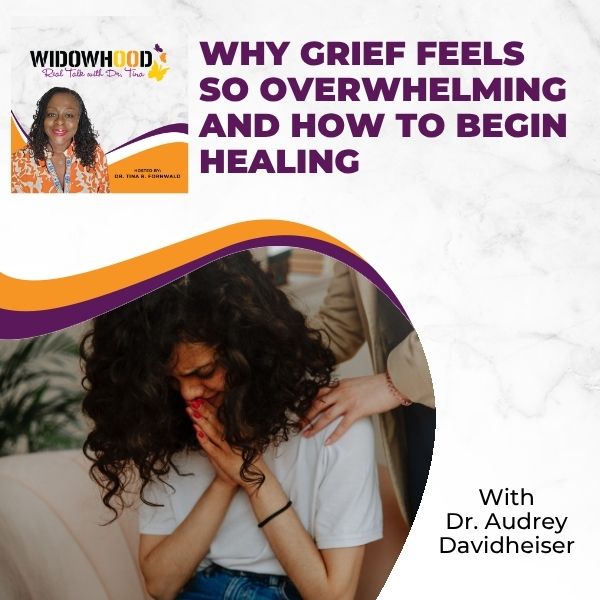
Why Grief Feels So Overwhelming And How To Begin Healing With Dr. Audrey Davidheiser

Widowhood Real Talk with Tina | Dr. Audrey Davidheiser | Grieving Wholeheartedly

  In this episode of Widowhood Real Talk with Dr. Tina, Dr. Tina welcomes Dr. Audrey Davidheiser, licensed clinical psychologist and author of Grieving Wholeheartedly: Bringing Healing to Every Part of Your Soul. Together, they explore why grief can feel so overwhelming, how emotions deserve compassion rather than suppression, and practical ways widows can begin healing after the death of a spouse. Dr. Audrey combines psychological expertise with a deeply compassionate approach to help grieving people navigate loss with greater understanding and hope. Whether you’re newly widowed, years into your grief journey, or supporting someone through loss, this conversation offers practical insight, emotional validation, and evidence-based tools for moving toward healing one wholehearted step at a time. I am sharing my experience of loving the same man for 32 years, a mother to two adult children, a retired military officer, a breast cancer survivor, and my connections with others. Anyone experiencing suicidal thoughts should reach out to a suicide hotline or local emergency number in their country: Psychology Today Suicide Hotlines and Prevention Resources Around the World. — Watch the episode here

Why Grief Feels So Overwhelming And How To Begin Healing With Dr. Audrey Davidheiser Read More »

Through Grief-Colored Glasses: Finding Hope After The Unthinkable With Vicky Edgerly

  In this moving episode of Widowhood Real Talk with Dr. Tina, Dr. Tina welcomes grief educator, author, and speaker Vicky Edgerly, whose life was forever changed by the loss of her son to suicide, her daughter to cancer, and her husband to suicide. Rather than allowing grief to define her future, Vicky discovered a path toward healing that transformed her pain into purpose. Today, she helps others navigate life’s most difficult losses with compassion, wisdom, and hope. Together, Dr. Tina and Vicky discuss surviving complex grief, supporting widows and bereaved parents, finding meaning after unimaginable heartbreak, and why healing doesn’t mean forgetting; it means learning to carry love forward. Vicky also shares insights from her memoir, Through Grief-Colored Glasses: A Life Reinvented by Devastating Loss, and the lessons that continue to inspire grieving families worldwide. I am sharing my experience of loving the same man for 32 years, a mother to two adult children, a retired military officer, a breast cancer survivor, and my connections with others. Anyone experiencing suicidal thoughts should reach out to a suicide hotline or local emergency number in their country: Psychology Today Suicide Hotlines and Prevention Resources Around the World. — Watch the episode here   Listen to the podcast here   Through Grief-Colored Glasses: Finding Hope After The Unthinkable With Vicky Edgerly Widowhood, our conversation with Vicky, she is going to share about suicide. That’s the conversation that people try to shy away from. They do not know what to do when we have no choice but to talk about it, but to experience it and to give you hope of what life can look like. In Vicky’s words, if you choose to, Vicky has dealt with the suicide of her son, her husband, and the cancer death of her daughter. Yet she has found a way to have hope and provide encouragement and support to other grievers. Let’s get into this conversation now.     Vicky, welcome to widowhood. Tina, thanks for having me. I’m grateful and humbled to be here. Your story, your life has a lot of layers. When you hear, “Welcome to the Widowhood,” what’s the backstory? What are you thinking about when you hear that? To be honest with you, Tina, I pushed back against that title when it first was applied to me. I want to say maybe 2 or 3 months after my husband Leo died, I went to attend his mother’s funeral. She passed away. I was surrounded by his family members, and one of his sisters started walking me around the room, introducing me as Leo’s widow. I hadn’t had that experience yet. It slammed into me. I wasn’t sure what I felt about it. I cried about it in my hotel room that night. I wore it like one of his old shimmy shirts that I used to put on just so I could smell the wood smoke from our fire pit, the forest that he always walked in. Evolving Beyond The Identity Of Loss I wore the title, Widowhood, as a warm blanket for a while until there came a time and a chapter in my life, about right after the second year, at the end of the second year, that there was an occurrence in my life that made me realize I had to let go of the marital relationship. I dropped the name Widow at that point as well. It still applies to me. I’m not Leo’s wife. I am his widow, but I am no longer approaching the world wearing that title upfront. It just comes out naturally in organic conversation. Thank you for sharing the evolution of that. I know for myself, when someone identified me for the first time, it was shocking. It took my breath away. Someone who has not become a widow, I think it’s hard to understand. It’s just a word. Why does it matter? It’s just like everything encompassing in that. I was like, “That’s where I am. That’s my life right now.” I can appreciate how you shared that over time your connection with that word changed. For someone tuning into this conversation, to realize the way you feel now versus the way it may change later, it has the potential to shift. That is important because some people feel like their death is final, but the way in which we engage it has the opportunity to adjust over time.     That is correct. Absolutely true. Your life is layered, and we have an amazing book, Through Grief-Colored Glasses: A Life Reinvented by Devastating Loss, and devastating loss indeed. Before we dive into the book, can you tell us about all three of the people in your life that have brought you to this place? Reframing Devastating Heartbreak Into Love It was a crazy ride for sure. Devastating in the beginning, but by the time I traveled through it all, I learned to actually love my story. It is, I think, a romantic story. Think about movies like The Notebook, which is centered around death. Is it not? However, it celebrates all of life. We all come away with tears, but our hearts are cracked wide open after witnessing such a beautiful story. I feel, just as a caveat to the readers or the audiences, that my story is beautiful. This is the place I’ve come to at this point in my life. It didn’t start out that way. In 2002, my eighteen-year-old son, Adam, took his own life. Unfortunately, twenty minutes after wishing me a happy Mother’s Day on the phone and telling me he loved me, he was gone. That was devastating. I will not get too deep into it, because we could be here all day with that particular story, but it rocked my world. I had no inner compass. I had no guidance for how to deal with grief, pain, and loss. Growing up, religion was just something we dabbled in on Easter and Christmas. It wasn’t

Through Grief-Colored Glasses: Finding Hope After The Unthinkable With Vicky Edgerly Read More »

From Widower to Hope Again: Jack Church on Surviving Grief, Healing After Loss & Finding Love Again

Widowhood Real Talk with Tina | Jack Church | Healing After Loss

  Dr. Tina Fornwald welcomes author and broadcaster Jack Church for an honest conversation about finding healing after loss following the passing of his wife. Jack shares how writing daily letters became the foundation for his book, Year One of Grief, and offers honest insight into navigating sorrow, stepping out of isolation, and opening your heart to new possibilities. Whether you’re newly widowed, years into your grief journey, or supporting someone who has experienced profound loss, this conversation offers compassion, practical encouragement, and hope that healing is possible. They address common misunderstandings about how men grieve, the physical release found in tears, and why taking simple steps outdoors can help rebuild daily life. Together, Dr. Tina and Jack explore faith, resilience, and the courage to embrace a new chapter while honoring the past. I am sharing my experience of loving the same man for 32 years, a mother to two adult children, a retired military officer, a breast cancer survivor, and my connections with others. Anyone experiencing suicidal thoughts should reach out to a suicide hotline or local emergency number in their country: Psychology Today Suicide Hotlines and Prevention Resources Around the World. — Watch the episode here   Listen to the podcast here   From Widower To Hope Again: Jack Church On Surviving Grief, Healing After Loss & Finding Love Again Our conversation is with Jack Church from K-Love. Jack is a widower. Jack has 30 years of experience walking on this journey. What Jack also has is showing us how to hope again, how to walk back into the light, and entertain the possibility of love. Let’s get into this conversation now.     Jack, welcome to the Widowhood. Thank you so much. It’s a pleasure to join you. It really is. For somebody that’s tuning in and they’re going, “Pleasure to join you to the Widowhood,” what would make you say that? What would be the backstory to say that’s welcoming? The backstory. See, the front story was you’re warm and inviting. We’ll stick with the front story. As far as the backstory, I know a lot has happened in your life. Take us back to how the moment in your life shifted in the path that you’re on now. Understanding The Sudden Weight Of Spousal Loss As you know, I lost my first wife of over 30 years. It was October of 2019. For those of us who have experienced loss like that, it’s incomprehensible the amount of grief that you will experience. It was hard. I was working in local television as a TV weather guy in Oregon at the time. I was her full-time caregiver as well for about eight months leading up to her passing. I’m doing that in the day and the evening and doing the weather at night and praying and praying that she’s going to be fine. It didn’t work out that way. I lost her. I’m like, “This hurts way more than I ever thought it could. I will never forget, Tina. I do not know why this popped into my head. She and I used to talk about which one of us would go first. I now realize I would say, “Hopefully I’ll go first. I want you to live a full life.” Now, knowing the pain of the loss, it’s like that’s an unfair statement. It really is because it is so hard. I would never wish that upon anyone to go through this, but for any of us that have been married for any length of time, it’s inevitable. It’s going to happen. I mean, it really is, unless you go down in a plane crash, a car crash, something like that, one of us in a relationship will experience that loss. Thank you for sharing that, Jack. Let’s go back a little bit further. First of all, what is her name? Her name is Pam. What was life like meeting Pam and before her passing? I met her in high school. We went to two different high schools, two different counties. My dad had an industrial supply company. Her dad was a bivocational preacher, but he was also a purchasing agent for a local factory. My dad called on him, and they mentioned that my parents had a son. Reverend Prince, Claude Prince, said, “I’ve got a daughter.” The parents went out to dinner, and they said maybe they should meet. An arranged relationship, basically. The thing is, my parents gave me her number and I waited like six months to ever call her. I was very shy. I was getting ready to be a senior in high school, and I finally called her. Our first date, I still remember. We went to Jackson, Tennessee. We saw the movie Star Wars, and we ate at a restaurant called Skeeter’s. It was magical. She was great. We just had a lot of fun. We laughed a lot. We had fun, and we dated. Roll forward, though. Senior year high school, senior prom night. I’m getting ready to go off to college in Jackson, where we would go on our dates, which is like 40 miles from the town we lived in, which to high school kids, that seems like an eternity. She wasn’t sure what she was going to do. I suggested on our prom night, said, “We probably should break up since I’m going to be going to Jackson.” I know we broke up. What was her response? It’s funny. I could probably cry thinking about it. She was shattered. She was like, “Really?” I went, “Yeah. I’m going to be in Jackson. You do not know where you’re going to be. We probably should do this.” Roll forward, though. The other thing is different. She was a Christian. I was not a practicing Christian at the time. Not really a true believer. I think God had his hand in that as well because sometimes I felt a little pressure because her dad was

From Widower to Hope Again: Jack Church on Surviving Grief, Healing After Loss & Finding Love Again Read More »

Can Grief Become Your Friend? Finding Hope After Loss With Patricia J. Williams

Widowhood Real Talk with Tina | Patricia J. Williams | Faith After Loss

  Dr. Tina Fornwald welcomes author, minister, and prophetess Patricia J. Williams to explore faith after loss and navigating the deepest seasons of grief. Walking through devastating bereavement requires immense spiritual strength, community, and trusting that God meets us in our pain. Together, they discuss Patricia’s book, How to Flourish in Spiritual Seasons of Your Life, and how widows can discover renewed hope, healing, and purpose. Patricia’s ministry focuses on helping people experience spiritual freedom and breakthrough through God’s Word. Whether you’re newly widowed, supporting a grieving loved one, or searching for encouragement, this powerful conversation provides practical guidance and biblical wisdom for taking the next step forward. I am sharing my experience of loving the same man for 32 years, a mother to two adult children, a retired military officer, a breast cancer survivor, and my connections with others.  Anyone experiencing suicidal thoughts should reach out to a suicide hotline or local emergency number in their country: Psychology Today Suicide Hotlines and Prevention Resources Around the World. — Watch the episode here   Listen to the podcast here   Can Grief Become Your Friend? Finding Hope After Loss With Patricia J. Williams Redefining Widowhood And Community Support Our guest is Patricia J. Williams, a minister of the gospel, psalmist, and motivational speaker. She writes to inspire, encourage, and motivate. Let us get into this conversation now. Patricia is going to share with us from her book, How to Flourish in Spiritual Seasons of Your Life.     Patricia, welcome to The Widowhood. Thank you for having me on. When you hear, Welcome to the Widowhood, what is the first thing that comes to mind for you? A deceased spouse. The one who has lost a spouse and they are trying to get more encouragement any way they can. Just forming a group with, per se, other people that are widows as well. You really do not have to be a widow, but just trying to find someone else that will share the same thing. You went through, or that you all happened to go through? I like that you made the point of not having to be a widow. I’m from Chicago, so hood means family to me. Widowhood is that community. Oftentimes, what the widow or widower is missing are the people that were in their community before their spouse died. They need them now more than ever to be entrenched in their life. That’s a worthy conversation. It’s not that you have your spouse’s past, but if this is your family member, your friend, someone that you care about, they are suffering, and they’re needing that community to embrace them Even not a person per se, it could be like a loss of a marriage, a job. Something you were married to, because people are married to their job, their careers. Something can just come in, and just, everything just lost. You just wipe it out. It goes in many forms. That would be the broader scope of grief itself. The widowhood itself would be the direct loss of your spouse. You’re correct that when you think of grief on a broader spectrum, it’s dealing with your own body suffering, having to relocate unexpectedly, problems with your children, loss. The thing that I have seen, and tell me about your experience, people may have some of those lower losses that they may say, “My pet is important,” and then you may have lost the job, your health. The passing of a loved one has a different implication than that of some of these other things because we feel like those are fixable. Those are things that we can adjust, but your child passes, your mom passes, a close cousin or neighbor. Those are not fixable. Learning To Adjust To Life Without Physical Presence They are not fixable because we are learning how to live without them being here. Even though they have passed on, we are trying to adjust how to live without the physical being. Even though we have the memories and everything we used to do with them, we love them unto death. Now we are trying to fix our hearts to say, “They are not here no more.” How do we adjust when we see every little thing, say, like you are in Walmart and you just passed by something they like to eat, and then bam. Here comes the memory again. How do we adjust to that? That’s what we’re going through day by day. How to live without it, without them. I would also add that we love them currently. Oftentimes people go, “loved one,” ED, as if it’s a past tense. Some of the conflict or trauma. We love them currently. The love does not stop because they stop breathing.     It’s just a continuation. It’s just how do we adjust to love them without seeing their physical being? That’s why we have to learn how to get past that stage. As you said, it would never stop. You say we, so that leads me to believe you have a personal experience with grief or someone no longer being here. Would you mind sharing about that? Moving Beyond Titles To Acknowledge Personal Pain I had gone through a season where I lost my mother, my sister, actually two siblings, two first cousins within a three-year span, and my dad too. Me being a minister of the gospel, we tend to always encourage someone else, and we give them like they are in a better place or something like that. I had to learn how to, per se, take off a title and be like, “God, how do I hear?” We have a tight-knit family. I had to learn how to adjust to them leaving me, just going on because I didn’t know how to handle grief because I was in a place where grief wanted to succumb to me. Just wanted me to be in the house, not talk

Can Grief Become Your Friend? Finding Hope After Loss With Patricia J. Williams Read More »

Healing Traumatic Loss And Death Scenes With Kelly Daugherty

Widowhood Real Talk with Tina | Kelly Daugherty | Traumatic Grief Recovery

  Navigating spousal loss often exposes deep emotional wounds that require practical tools and a genuine community. Dr. Tina Fornwald connects with licensed clinical social worker, grief specialist, and one of the hosts of GRIEF Ladies, Kelly Daugherty, to discuss traumatic grief recovery and effective healing modalities. Many grieving individuals find themselves stuck on the painful death scene of their loved one, which prevents them from accessing fond memories. Processing trauma first allows you to clear the emotional roadblocks that keep you trapped in survival mode. Kelly shares her personal story of losing her mother at fourteen, navigating life with an alcoholic parent, and finding her calling as a grief therapist. Together, they explore how modalities like EMDR and progressive counting help reframe painful memories so you can move forward with love rather than pain. I am sharing my experience of loving the same man for 32 years, a mother to two adult children, a retired military officer, a breast cancer survivor, and my connections with others. Anyone experiencing suicidal thoughts should reach out to a suicide hotline or local emergency number in their country: Psychology Today Suicide Hotlines and Prevention Resources Around the World. — Watch the episode here Listen to the podcast here Healing Traumatic Loss And Death Scenes With Kelly Daugherty Welcome back to the show. Our conversation with Kelly is going to open your mind to the idea you don’t have to stay stuck at the moment the person you love died. Hear me again. Sometimes your memories, sometimes what you’re thinking has kept you in the place in the moment in which they died. The memories of the love and the experience and everything you have are so hard to reach. This conversation with Kelly is going to empower you to think beyond that moment in what is possible for you. Let’s get into this discussion now.     Kelly, welcome to widowhood. Thank you so much for having me. “Thank you for having me to the widowhood.” What’s the backstory when you think about it deeply? What comes to mind? A lot of my clients. That’s what I think about. I think about what I’ve witnessed with them, what I’ve seen them go through, but also the transformations that I’ve seen with them. The ups and downs of grief are not linear and predictable. It’s a bit of a hot mess. That’s true. Going from there, let’s start with your story and your personal experience as it relates to grief. Overcoming Early Loss and Unspoken Family Struggles My mom died when I was fourteen. She died from breast cancer and I was struggling a great deal after that. My sisters moved out shortly after my mom died, so it was just my dad and I. My dad was an alcoholic at the time, so things were not good at home. My mom did it all and my dad just worked. I didn’t have a relationship with my dad to be completely honest. The good news is, my dad recognized I was having a hard time. He basically forced me to go to a hospice grief group for teens. The way he got me there was, I went to an all-girls Catholic High School and fifteen years old, being a little boy crazy. All it took was him saying there would be boys in the group. That’s what got me to go, but I walked into that room and my life changed. I met an amazing social worker. I knew I wasn’t alone in my grief anymore, and that’s how I had felt up into that point. Doing work with the hospice social worker and then also doing a lot of family with my dad. My dad did get sober. I threatened to run away and told him if he didn’t get sober, that’s what I was going to do. I was very determined to do that and he did. He didn’t get into AA for about two years after that, but he did. My dad died a few years ago. At the time of his death, he had been sober for almost 30 years and in AA for almost 28 years. Because of that, and because of his push, I’m talking to you. If he hadn’t had me go to that group and hadn’t had me meet Renee, the social worker, I would have never even known what to expect, and what to understand about grief. Renee, after a while, asked me to start volunteering with the Children’s Program. Slow down. We need to circle back a little bit. Growing up with a father, your mom passed. Was your dad an alcoholic before your mom died? Yes, for my entire childhood. That’s something to grieve along with everything else. Absolutely. When I talked with my sisters about it, they were 7 and 9 years older. The oldest has the most memories. My mom sheltered me a lot. I was still young enough that I didn’t realize what it was all. There were some memories that I’ve worked on in therapy. I’m grateful I have because they were difficult and hard. Especially the last Christmas with my mom. My dad was drunk. There was a situation with the Christmas tree. It was something that always eat and bothered me. When I got trained to EMDR, I was like, “I’m going to work on this memory,” and I did. I’m grateful I did that work because I was able to have a very different relationship with my dad because of doing that. Thank you. You mentioned EMDR. Can you share a little bit? I don’t want to make an assumption that everyone reading knows different acronyms, modalities and things. I want to always make sure we slow down and unpack. Reprocessing Traumatic Death Scenes With Clinical Modalities EMDR is eye movement desensitization and reprocessing. It’s like the gold standard of trauma therapy. It’s been around since the early 1990s. Francine Shapiro developed it. It uses bilateral

Healing Traumatic Loss And Death Scenes With Kelly Daugherty Read More »

Widowhood Secret Santa Program Application

Step 1 of 2

Bringing Joy & Support to Widowed Families

This application is open to all widows and widowers with children between the ages of newborn to 18 years old. Special needs children over the Age of 18 are also eligible.

Parent/Guardian Information

Address(Required)

Child(ren) Information

Do you have a special needs child over the Age of 18?(Required)
Click the plus (+) icon to add more names.(Required)
Child's Name
Age
 
Click the plus (+) icon to add more names.

Please share a little about your situation, what this program would mean to you, and any special circumstances.
What Type of Support Would Be Most Helpful?(Required)
  • All gifts will be handled through your Amazon Wish List link.
  • A completed consent form must be submitted for consideration with this application.
  • Nominations will be announced on September 1st.

Walk For Love 2025

Support grief awareness and Walk For Love in style. Proceeds help fund free grief support programs. Merchandise is available now, with new batches printing every 15 days — so order early to ensure you receive your items before the August kickoff on August 3,  2025

🛍️ How It Works

- Order anytime — Bonfire prints new merchandise every 15 days

- First shipping window: Orders placed by July 11 ship between July 1–11

- All items ship directly from Bonfire

- Order early to wear your gear for Walk For Love in August!

👕 Apparel – T-Shirts, Sweatshirts & Hoodies

🛒 Order here: https://www.bonfire.com/walk-for-love-2025-1

💲 Price: $23–$42

📏 Sizes: Youth to 3XL

Over 20 different colors

📝 Notebook

🛒 Order here: https://bonfire.com/walk-for-love-2025-notebook-1

💲 Price: $22.99

Great for journaling, writing affirmations, or gift-giving.

☕ Mug

🛒 Order here: https://bonfire.com/walk-for-love-2025-mug

💲 Price: $19.99

Sip your morning coffee with a message of love and remembrance.

🚶‍♀️ Travel Mug

🛒 Order here: https://bonfire.com/walk-for-love-2025-travel-mug-1

💲 Price: $24.99

Keep your drinks hot or cold while walking for love.

💧 Water Bottle

🛒 Order here: https://bonfire.com/walk-for-love-2025-water-bottle-2

💲 Price: $29.99

Hydration meets heart — perfect for walkers everywhere.

📣 Additional Notes

At checkout, encourage shoppers to select your board member's name from the referral dropdown to help us track outreach.

Use and promote hashtags: #WFL2025 and #WRTWT

Perfect for walking during the event or repping all year long.

Mental Health Walkathon to provide encouragement and inspiration for the grieving struggling with depression and isolation.

During the Walkathon, we walk together, united in our mission to support mental health. From August 3 - 9, 2025 we encourage you to walk one mile daily. Share your journey by posting a picture on your favorite social media platform with #WRTWT #WALKFORLOVE, and let’s inspire others to join us.

Funds from the Walkathon will allow Widowhood Real Talk With Tina to conduct an Annual Grief Garden and a Butterfly release ceremony and provide participants journals & pens.

Three ways to participate

Purchase merchandise ~ In Development

Donate: https://app.99pledges.com/fund/walkforlov

Make your pledge, 1-mile daily day August 4 – 10, and post #WRTWT #WALKFORLOVE: https://app.99pledges.com/fund/walkforlov

To Start your pledge team, email widowhoodrealtalk@gmail.com for details.

Register on Eventbrite: https://www.eventbrite.com/e/1223004923649?aff=oddtdtcreator