Grief Healing

Can Grief Become Your Friend? Finding Hope After Loss With Patricia J. Williams

Widowhood Real Talk with Tina | Patricia J. Williams | Faith After Loss

  Dr. Tina Fornwald welcomes author, minister, and prophetess Patricia J. Williams to explore faith after loss and navigating the deepest seasons of grief. Walking through devastating bereavement requires immense spiritual strength, community, and trusting that God meets us in our pain. Together, they discuss Patricia’s book, How to Flourish in Spiritual Seasons of Your Life, and how widows can discover renewed hope, healing, and purpose. Patricia’s ministry focuses on helping people experience spiritual freedom and breakthrough through God’s Word. Whether you’re newly widowed, supporting a grieving loved one, or searching for encouragement, this powerful conversation provides practical guidance and biblical wisdom for taking the next step forward. I am sharing my experience of loving the same man for 32 years, a mother to two adult children, a retired military officer, a breast cancer survivor, and my connections with others.  Anyone experiencing suicidal thoughts should reach out to a suicide hotline or local emergency number in their country: Psychology Today Suicide Hotlines and Prevention Resources Around the World. — Watch the episode here   Listen to the podcast here   Can Grief Become Your Friend? Finding Hope After Loss With Patricia J. Williams Redefining Widowhood And Community Support Our guest is Patricia J. Williams, a minister of the gospel, psalmist, and motivational speaker. She writes to inspire, encourage, and motivate. Let us get into this conversation now. Patricia is going to share with us from her book, How to Flourish in Spiritual Seasons of Your Life.     Patricia, welcome to The Widowhood. Thank you for having me on. When you hear, Welcome to the Widowhood, what is the first thing that comes to mind for you? A deceased spouse. The one who has lost a spouse and they are trying to get more encouragement any way they can. Just forming a group with, per se, other people that are widows as well. You really do not have to be a widow, but just trying to find someone else that will share the same thing. You went through, or that you all happened to go through? I like that you made the point of not having to be a widow. I’m from Chicago, so hood means family to me. Widowhood is that community. Oftentimes, what the widow or widower is missing are the people that were in their community before their spouse died. They need them now more than ever to be entrenched in their life. That’s a worthy conversation. It’s not that you have your spouse’s past, but if this is your family member, your friend, someone that you care about, they are suffering, and they’re needing that community to embrace them Even not a person per se, it could be like a loss of a marriage, a job. Something you were married to, because people are married to their job, their careers. Something can just come in, and just, everything just lost. You just wipe it out. It goes in many forms. That would be the broader scope of grief itself. The widowhood itself would be the direct loss of your spouse. You’re correct that when you think of grief on a broader spectrum, it’s dealing with your own body suffering, having to relocate unexpectedly, problems with your children, loss. The thing that I have seen, and tell me about your experience, people may have some of those lower losses that they may say, “My pet is important,” and then you may have lost the job, your health. The passing of a loved one has a different implication than that of some of these other things because we feel like those are fixable. Those are things that we can adjust, but your child passes, your mom passes, a close cousin or neighbor. Those are not fixable. Learning To Adjust To Life Without Physical Presence They are not fixable because we are learning how to live without them being here. Even though they have passed on, we are trying to adjust how to live without the physical being. Even though we have the memories and everything we used to do with them, we love them unto death. Now we are trying to fix our hearts to say, “They are not here no more.” How do we adjust when we see every little thing, say, like you are in Walmart and you just passed by something they like to eat, and then bam. Here comes the memory again. How do we adjust to that? That’s what we’re going through day by day. How to live without it, without them. I would also add that we love them currently. Oftentimes people go, “loved one,” ED, as if it’s a past tense. Some of the conflict or trauma. We love them currently. The love does not stop because they stop breathing.     It’s just a continuation. It’s just how do we adjust to love them without seeing their physical being? That’s why we have to learn how to get past that stage. As you said, it would never stop. You say we, so that leads me to believe you have a personal experience with grief or someone no longer being here. Would you mind sharing about that? Moving Beyond Titles To Acknowledge Personal Pain I had gone through a season where I lost my mother, my sister, actually two siblings, two first cousins within a three-year span, and my dad too. Me being a minister of the gospel, we tend to always encourage someone else, and we give them like they are in a better place or something like that. I had to learn how to, per se, take off a title and be like, “God, how do I hear?” We have a tight-knit family. I had to learn how to adjust to them leaving me, just going on because I didn’t know how to handle grief because I was in a place where grief wanted to succumb to me. Just wanted me to be in the house, not talk

Can Grief Become Your Friend? Finding Hope After Loss With Patricia J. Williams Read More »

Share Your Story: The Healing Power Of Writing With Romana Hasenöhrl

Widowhood Real Talk with Tina | Romana Hasenöhrl | Share Your Story

   Learning to share your story after loss can feel daunting—but it’s also one of the most powerful ways to heal. Writing coach Romana Hasenöhrl joins Dr. Tina Fornwald to explore how creative expression helps us navigate grief, remember our loved ones, and rediscover joy. Through her own experience of losing her grandmother, Romana found comfort in writing, eventually transforming her pain into purpose by helping others find their voices. Together, they discuss the emotional release that comes from storytelling, why joy and sorrow can coexist, and how sharing your story can bring light, connection, and meaning back into your life. I am sharing my experience of loving the same man for 32 years, a mother to two adult children, a retired military officer, a breast cancer survivor, and my connections with others.  Anyone experiencing suicidal thoughts should reach out to a suicide hotline or local emergency number in their country: Psychology Today Suicide Hotlines and Prevention Resources Around the World. — Watch the episode here   Listen to the podcast here   Share Your Story: The Healing Power Of Writing With Romana Hasenöhrl Voices Of Widowhood: Healing Through The Holidays Finding Joy & Healing: Navigating Grief And The Holidays Has grief told you that you’re not allowed to be happy, you’re not allowed to laugh, and you’re not allowed to have purpose anymore? Our conversation with Romana, a writing coach, is going to blow past those negative myths. We’re going to talk about how you are allowed to be happy. At the same time, you’re allowed to cry. You’re allowed to have purpose. You’re allowed to miss your loved one. The duality of those is not a choice between one or the other. Let’s get into this conversation now.       Romana, welcome to the Widowhood. Thanks for having me. I’m so happy to be on your show. Thank you. When you hear “Welcome to the Widowhood,” what’s the invisible ticker tape that goes across your head, thinking about this community and having this conversation? One of my best friends is Marie Alessi, and you’re connected already. I know what she’s doing, and I have quite positive feelings. I have to tell the truth. If this conversation had been years ago, I would be like, “What?” The more you get into the topic and talk to people, the better you understand what it means. Where are you located? I’m in Salzburg, Austria, which is The Sound of Music city. Thank you. I am glad that you were able to join this series, Voices of Widowhood: Healing through the Holidays. This conversation is intended, knowing that the holidays and grief are not good partners. They can be very difficult. You mentioned that years ago, this conversation would have been different for you. Can you share what’s happened in that five-year timeline? Why does it make it different? First of all, I got to know Marie. She’s working with widows in Sydney, Australia, and not only widows, but with the topic of grief in general. We met via the internet, through Facebook. She saw my name. “She’s Austrian, too.” I got to write her some lines. We got in contact. In 2021, my grandma died. I grew up with her. I never expected that this would hit me so hard. My grandma was a very happy and lucky person. She was 94. I went into those childhood feelings and behavior. I yelled out, “You promised me you would get to 100. Now you died at 94.” I was devastated. I felt out of my body, watching myself acting. I’ve never had that before. After two or three months, I called Marie and said, “Is that normal?” In my family, it’s not normal to talk about death, grief, what comes after, and how to behave. There’s nothing. That’s like a white landscape. I got into that conversation on what’s normal and why it’s not necessary to act normal because you are an individual. You’re grieving. You’re dealing with it, and especially with the holidays. That’s your individual phase. My granny died in September. When Christmas was coming up, I always spent Christmas with her. That was a hard time. I was very glad I had someone who guided me, like you guide people in those situations. The Power Of Community: Finding Solace In Shared Grief Thank you for sharing that. I understand, and I know from you, working with Marie, that all grief is the same. At the same time, grief is different, depending on the relationship. I know a lot of people who are tuning in to this conversation may have lost their spouse. By you losing your grandmother, it sounds as if it’s giving you a concept of how profound and more extreme a loss could be of losing their spouse, someone that they’ve mended their life together with and done those different things. Speaking with Marie, having that community, but being in a family where that was not permitted or allowed, how did that make you feel to be someplace that you could talk freely about your grandmother and the grief that you were experiencing? For me, there was a big release. It is allowed to cry. In my family, it was like, “She got to 94. What are you crying about?” This is unbelievable for me. It is allowed to cry. It is allowed to share. There were people in the group. I was invited to join a group that had lost their spouse and had lost their kids. We all shared what our feelings are, how we think the future will be, how hard it is, or how we might make it a little bit easier, first of all, by sharing. As I’m a writer, also in writing. For me, it was that clue to write it down. Maybe someday, a story will come up with all the thoughts. Maybe a novel, or maybe not, but keep on writing. This was very important for me as

Share Your Story: The Healing Power Of Writing With Romana Hasenöhrl Read More »

Healing Through Grief: How To Survive After Losing Your Husband And Best Friend With Yvette Lloyd

Widowhood Real Talk with Tina | Yvette Lloyd | Grief Healing

  Grief, trauma, and self-worth collide in this raw and empowering conversation on healing through grief. Yvette Lloyd—podcaster, businesswoman, and survivor—opens up about the compounding losses that shaped her, from the death of her husband and mother to the betrayal of friends and the weight of domestic violence. She shares not only what broke her, but how she rebuilt herself with faith, resilience, and a deep commitment to self-love. This is more than a story of loss—it’s a journey of rebirth and reclaiming power in the face of unimaginable pain. I am sharing my experience of loving the same man for 32 years, a mother to two adult children, a retired military officer, a breast cancer survivor, and my connections with others. Anyone experiencing suicidal thoughts should reach out to a suicide hotline or local emergency number in their country: Psychology Today Suicide Hotlines and Prevention Resources Around the World — Watch the episode here     Listen to the podcast here   Healing Through Grief: How To Survive After Losing Your Husband And Best Friend With Yvette Lloyd Our guest is Ms. Yvette Lloyd, and you are in for a treat. Yvette is going to give you tips on how to deal with domestic violence, how to deal with it when you are stuck in your grief, and third, and most importantly, how the process of loving yourself is the basis for everything that you do. Let’s get into this conversation now.         Yvette, welcome to the Widowhood. How are you? I’m fine, how are you? I’m good. Thank you so much for having me. When you hear, “Welcome to the widowhood,” what comes to mind? Helping someone else. From what perspective? Just sharing my journey, my experience. Sometimes, people could feel alone and you just never know what’s going to come out of your mouth that could actually go to someone’s ears and help them understand their journey a lot better. Life Her Podcast: Yvette’s Journey As A Business Podcaster That is true. Now, you are a podcaster. Tell us a little bit about your podcast and what you do. Life Her Podcast is about business owners sharing their journey. A lot of people see the things we post on social media and just believe everything is just so perfect, yet behind the scenes, we’ve been through a lot. We go through personal things in our lives, and we also go through personal journeys by growing our brand. It is basically a podcast where everybody can become enlightened and educated on different types of businesses and they can learn from it or even utilize the services that the individuals provide that’d be on my podcast show. Where can we find your podcast? What’s the frequency? You could find Life Her Podcast on all major platforms, and you could watch it as a visual on YouTube. This conversation we’re having is outside the scope of your normal conversation on your YouTube channel. Are some of your listeners going to be surprised? Honestly, no, because I’m very transparent on my podcast, so maybe some of my new readers. Some of them may not know, but some of my other ones that has been following me for years, they actually know my journey, but some of them don’t know in that I held back on a lot of things, which I’m willing to share with you.     Thank you. How does it feel to be on the other side of the podcast conversation? Honestly, it feels good because I really don’t express myself much and I really don’t get too many people asking me things. Just someone asking me questions and me releasing, it feels good for real. You don’t have to worry about editing, show notes, doing any other stuff. You can talk and say, “That was fine. Tell me when I can see that, because it’s a wrap.” That part of it. When you say you have held back, what are some areas that you’ve held back and not been so candid on your show about? My health. Sometimes, people would be upset when I have to reschedule a podcast show, or some days, I will post and I will go weeks without posting or taking a break, a whole month break. Those experiences are me going through grief or I was going through a lot of health complications, or I was going through a lot of things when it comes to my business, my daycare, mainly. When staff call offs or even staff grieving as well, I have to take a lot of time off to replace them. Different things like that occur a lot in my personal life. I also had to release one of my businesses. It was a business my husband had started and I kept going with his janitorial company and it became a huge burden, so I had to let that go too. That was taking up a lot of my time and just grieving overall because it doesn’t stop. Some days it’s better than others. Silent Battles: Yvette’s Health, PCOS, And Self-Love Journey Thank you. I want to go through those one at a time, if you don’t mind. That’s fine. When you talk about your health, when I hear from me, my health, I was in the Army for 21 years and I have anxiety, I have stress. I wear hearing aids and all of those things. I feel like sometimes, I’m falling apart. Sometimes I’ll feel overwhelmed. It’s like sometimes being outside in different moments can create a lot of different triggers for me, physically. I’m in a conversation, I’m constantly asking, “Can you repeat that?” If I don’t have my hearing aids. I’m like, “I am 59 with hearing aids. How is this a thing?” I can relate to that grief weighs on your body. When you say your health, do you mind diving in a little bit more on the details? Yes. I

Healing Through Grief: How To Survive After Losing Your Husband And Best Friend With Yvette Lloyd Read More »

From Ordinary To Extraordinary Life: Healing After Loss With Eileen Bild

Widowhood Real Talk with Tina | Eileen Bild | Extraordinary Life

  What if the key to peace during grief isn’t moving on—but moving within? In this deeply meaningful episode, we sit down with the powerful and compassionate Eileen Bild—CEO of Ordinary to Extraordinary Life, founder of the Core Thinking Blueprint Method, Breakthrough S.P.A.R.K. coach, and host of OTEL Talk. With a Master’s in transpersonal psychology and a mission to help people become unstoppable, Eileen brings wisdom and warmth to a tender topic: finding peace in the journey of widowhood. We dive into her five core principles for success, explore the science of neural pathways in the grieving process, and learn how to maintain a spiritual connection with those we’ve lost. Whether you’re navigating a personal loss or supporting someone who is, this conversation offers grace, grounding, and gentle guidance. So take a breath—this one’s for the heart. I am sharing my experience of loving the same man for 32 years, a mother to two adult children, a retired military officer, a breast cancer survivor, and my connections with others.  Anyone experiencing suicidal thoughts should reach out to a suicide hotline or local emergency number in their country: Psychology Today Suicide Hotlines and Prevention Resources Around the World — Watch the episode here   Listen to the podcast here   From Ordinary To Extraordinary Life: Healing After Loss With Eileen Bild Our guest is Ms. Eileen Bild. She is the CEO of Ordinary to Extraordinary Life, Founder of the Core Thinking Blueprint Method, Breakthrough S.P.A.R.K. coach, mentor, author, keynote speaker, and internationally syndicated columnist. She holds a Master’s in transpersonal psychology and is the host of OTEL Talk. She helps others live their best lives and become unstoppable. In this conversation, we are going to discuss her five principles of core thinking for success, as well as how we find peace in this grief journey. Let’s get into this conversation.     Eileen, welcome to the widowhood. Thank you for inviting me. I’m excited to be here. I’m excited to have you here, too. When you hear, “Welcome to the widowhood,” what comes to mind for you? Loss can be very challenging. When I hear, “Welcome to widowhood,” I feel that you’ve got your arms wide open. It’s an opportunity to connect with others who have had trials and tribulations. It’s a journey into widowhood and being able to process that and come through with strength. Thank you. All of those do relate in this space. The reason why I was glad for you to be part of this conversation is your background from being an author and a speaker, having a background in psychology, and you’re coaching in the idea of breaking through and S.P.A.R.K. Can you explain what S.P.A.R.K. means? The Concept Of S.P.A.R.K. In Grief & Healing Yes. Over the years, people shared with me, “You sparked me to look at things from a different perspective or have a different thought.” For me, the spark is when something gets triggered in ourselves that gets us out of a space where we’re stuck and we’re not able to move forward, whether it’s an action, a belief system, or a way of handling its life situation. Spark, to me, is bringing that light from within outward, and then using that to be able to propel forward in a beautiful way. I believe that there’s a lot of magic, grace, and beauty in the world, regardless of or in spite of the curveballs that life throws us. I can relate to that. The biggest curveball for me is the passing of my late husband. You mentioned the different things that when someone is a widower or someone who’s grieving, a profound grief is experienced. How would you relate some of the things in your Breakthrough S.P.A.R.K. coaching mythology? I’m going to give you some scenarios, and then maybe you can share how you would engage someone very organically at a high level. When you’re coaching, there’s more involved than that. Let’s say I am working with you and I have not slept in my marital bed since my husband passed away a year and a half ago. What would be some things that you would see in that conversation, or how would you help me to get there? That’s an area where, when you’re that close to someone in a marital bed and then that person is no longer there, there’s a void. There’s an empty space. It’s difficult for us in any situation, but it’s specifically for this one. It can be difficult for people to be able to be in that space and be at peace that that person is no longer there and no longer going to be there. However, I’m a big advocate for imagining things the way you want them to be within reality. You can’t bring that person back. However, their energy, your memories with that person, and the love that you shared, all of that can be transformed into recognizing that when you get in that bed, that person is still there with you, but it’s not in a physical form. What I would coach the person on being at peace with the fact that the loved one has passed on, and yet they are still holding that loved one in their heart, and to be able to get in that marital bed is it’s not from the perspective of, “I’m moving on. This person doesn’t exist anymore.” I would work with that person on imagining the person is there with them. You can speak to them. You put your arm out like you want to touch something. You could get a favorite stuffed animal or something that would represent the person who has passed on and touch that surrogate. Over time, you’ll be able to sleep because in your heart, that person is still with you, and you know that. It helps to overcome the anxiety, stress, sadness, and all the emotions that come up when you try to get in bed

From Ordinary To Extraordinary Life: Healing After Loss With Eileen Bild Read More »

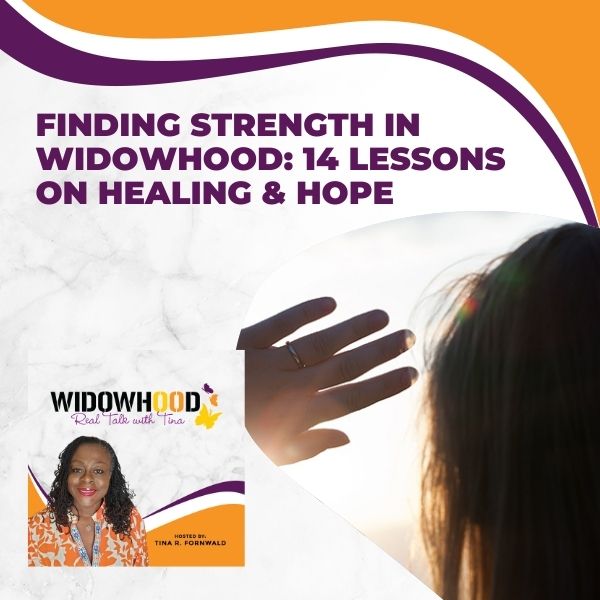
Finding Strength In Widowhood: 14 Lessons On Healing & Hope

Widowhood Real Talk with Tina | Widowhood Journey

  Grief can feel isolating, but the truth is, you’re not alone. In this episode, Tina Fornwald shares her widowhood journey, opening up about the 14 lessons she learned across struggles and surprising moments of healing after loss. From the power of community to embracing new purpose, Tina explores the realities of life after losing a spouse. She reflects on the emotions, memories, and unexpected challenges, offering heartfelt insights for those walking a similar path. Whether you’re grieving, supporting a loved one, or searching for hope, this conversation provides comfort and understanding. I am sharing my experience of loving the same man for 32 years, a mother to two adult children, a retired military officer, a breast cancer survivor, and my connections with others. Anyone experiencing suicidal thoughts should reach out to a suicide hotline or local emergency number in their country: Psychology Today Suicide Hotlines and Prevention Resources Around the World — Watch the episode here   Listen to the podcast here   Finding Strength In Widowhood: 14 Lessons On Healing & Hope This is a conversation that I’m having with you. Many of you have asked me what are some things that I have learned along this journey of widowhood. I have a list right here and I’ll go over them one by one. Also, please email me at WidowhoodRealTalk@gmail.com. I would love to hear from you. I would love to hear the things that you have learned on this widow’s journey or your grief journey in particular. If you’re supporting someone who is grieving, please share the things that you have learned about them, because it will be able to help others. #1: I Am Not Alone Number one, I am not alone. The thing about this grief journey is the head chatter, the things that will come into your head that, “No one else could be in this much pain. No one else could have this much suffering. No one else could be living this difficult life.” That is not true. I learned I was not alone. I learned that there are thousands more widows and widowers daily. #2: Community Knowing that wasn’t a trauma bonding type of situation, but it told me, “Tina, you are not the first person to endure this nor will you be the last,” which means it is something that I can live through, move forward, and I will at one point in time be okay. When I learned that, it changed my mindset from, “I don’t know if I can do this. This will never work out,” to, “Though it is painful, I have the capacity inside of me to be able to keep living.” It was important for me to know I was not alone. That circled into the idea of how powerful number two is, which is community. When I realized I was not alone, I reached out to every widow and widower that I knew. I made time to be in their presence, whether it was in person or on the phone. I had so many questions and they were so willing to answer. That community created for me was so important. It gave me the ability to be able to keep living, to know that I was not alone, and that other people would encourage me. They would share their journey with me. They would let me know that this is something that they experienced. They shared their version of it. It allowed me to take their pieces of this journey and create my own. #3: Memories, Good & Bad Number three, memories are good and memories are bad. What that looked like for me is I had to take my time when I wanted to see the memories. Sometimes, it was all at once, and then it was that I didn’t want to see them at all. I had to be honest with myself about what that looked like. I remember one time when I was looking at pictures of Mark and listening to voice messages in particular because hearing his voice made it feel so good.     I fell asleep with my phone in hand. When I woke up, all the messages were gone. I was devastated. I went to the phone store, standing there crying profusely and unhinged. I feel so sorry for whoever was at that Verizon store and had to help me that day. I probably left them shaken, but I was devastated. There was nothing they could do to get those phone messages back, and that was bad. I reached out to my children and I asked them to share with me the messages that they had with their dad’s voice and they sent them to me. It is a precious thing to have. I encourage you, if possible, to please take the pictures. Please create the memories. Please cement them with audio and videos because one day, you won’t be able to. The good part is there are tons of pictures of Mark and tons of memories with him and the children that I will cherish as long as I can breathe. #4: Music And Smells Number four, music and smells. I remember the songs that we danced to and the songs that Mark played. Mark was a hard-rock kind of guy. I learned the Eagles and so much music that I never thought of before by being with him and being married to him. I remember the smell of chili. Mark used to make chili from scratch at home. He’d have a big pot in putting it together. When I’m having chili and rice, I think of him. The smell of a bonfire, because our family had a bonfire every year, and the smell of wood burning brings back so many memories of him. Also, his cologne. He wore a gray flannel. When he passed away and I was moving from Pennsylvania to Virginia, I packed up so much stuff. Some things I got rid of,

Finding Strength In Widowhood: 14 Lessons On Healing & Hope Read More »

Finding Freedom: Overcoming Limiting Beliefs After Loss With Tina Kadish

Widowhood Real Talk with Tina | Tina Kadish | Freedom

  Freedom is a word that takes on new meaning after loss. In this episode, I sit down with Tina Kadish, author of From Pain to Peace: A Mother’s Heartbreaking Journey Through Losing a Child and F.R.E.E.D.O.M.: 7 Steps to Thrive in Life and Business. She bravely shares her story of navigating the shattering loss of her daughter, revealing how she redefined freedom in the face of unimaginable pain. Prepare to be inspired as we delve into the potent alchemy of faith, mindset shifts, and the unwavering pursuit of purpose that propelled her forward. Join us for this heartfelt conversation on loss, legacy, and the strength to keep going. I am sharing my experience of loving the same man for 32 years, a mother to two adult children, a retired military officer, a breast cancer survivor, and my connections with others. Anyone experiencing suicidal thoughts should reach out to a suicide hotline or local emergency number in their country: Psychology Today Suicide Hotlines and Prevention Resources Around the World — Watch the episode here   Listen to the podcast here   Finding Freedom: Overcoming Limiting Beliefs After Loss With Tina Kadish My guest is another Tina, and she is going to share some information with you that is going to be helpful. In the process of writing two books, F.R.E.E.D.O.M.: 7 Steps to Thrive in Life and Business and From Pain to Peace: A Mother’s Heartbreaking Journey Through Losing a Child. In this conversation with Tina, she is going to share some very practical tips on keeping the memory of our loved ones alive. She’s also going to talk about the mindset that we have in life, the ability to lean into our faith, and other things that you’re going to find helpful. Let’s get into this conversation now.     Tina, welcome to the Widowhood. I don’t think I’ve ever welcomed another Tina to say that. I know this is so awesome to be connected with another Tina. There aren’t enough Tina’s in the world. Tina is my official birth name. Is that your full name also? No, it isn’t. That is interesting. My full name is Constantina. I’m so glad I asked you that. I love that that is your full name. It is. It’s interesting because my late husband’s first name was Mark and it was four letters. We always like the continuity of both having four letters in our first name. I love that. That’s great. I love that necklace. Sit back so we can see a little bit more of that. Do you recall where you picked that piece up from? I don’t. I’ve had this necklace for such a long time and I totally forgot where I bought it. It could have been like a Macy’s type of store. I don’t think it was a boutique type of store. I used to wear it a lot more when I was working in my corporate career. Now that I work from home, I don’t put on a lot of jewelry. Girl, sometimes we don’t even put on clothes. I know. That commercial about what are you wearing below? What did you think when you hear, “Welcome to the Widowhood?” When we first connected Welcome to the Widowhood, it touched my heart because you have had a loss. I’ve had a loss with the loss of my daughter and you lost your spouse. There was that connection. Thank you for mentioning that. I am sorry about the loss of your daughter. It’s interesting because the loss is different and the loss is also the same. Do you find that people want to compare losses ever? Yes. What do you think of that? People will say to me have said to me, “I’ve lost a sibling or lost a spouse,” but it’s never the same as losing a daughter. When I first thought of that, I was like, “Is losing a child more painful than losing a spouse?” There is no comparison. It’s different. I think that that is the best. Some people ask me, “What is the worst?” I say, “Whatever thing you’re grieving is probably the worst.” Your current pain is probably exasperated to such a level that you’re wondering if you can endure this. That grief could be your help. When I went through breast cancer, I thought that was the worst thing I was ever going to experience. I didn’t know literally a year or so later what is now the worst thing that I would have ever experienced. I don’t find value in the comparison because I don’t think anybody wins. The idea is just to hold a space for someone in their pain, know that their pain is valid, and be able to do that. Very true. Honor the space, respect the person, honor them, and not say, I’ll be honest here, stupid things that people say, “She’s in a better place. She’s at peace right now.” My daughter was 37 and I’ll share that more, but they don’t know what to say. People mean well. They just don’t know what to say to you. Inspiration Behind Writing F.R.E.E.D.O.M. I see your two books there and I have two of them here that we’re going to cover. Do you mind if I start with the seven steps to thrive in life and business? No. Absolutely. No problem. Thank you. I want to share that I thought this conversation would be beneficial to our audience and our community because of some of the principles in the Seven Steps to Thrive in Life and Business, I think they can relate to your personal life as well as business practices. For twofolds, there are people in my community that are recently widowed or widower and their financial situation is different and they may need to be reentering the workspace. They may need to start a business and they’re looking for some encouragement. They’re looking for some motivation. They’re looking for a way to

Finding Freedom: Overcoming Limiting Beliefs After Loss With Tina Kadish Read More »

Grief Transformation: Actively Healing From Unresolved Grief With Ghulam Fernandes

Widowhood Real Talk with Tina | Ghulam Fernandes | Unresolved Grief

  Oftentimes, people are stuck in grief and don’t know how to get out of it. And that sucks because most of the time, the other parts of our lives are perfectly fine but we aren’t present enough to enjoy them. Healing from unresolved grief is an active process, not a passive one, as today’s guest explains. Ghulam Fernandes is a grief transformation coach who specializes in unresolved grief. Ghulam has had multiple bereavements, something that she draws upon a lot when working with her clients. Ghulam believes that you can and should take active steps to heal yourself from grief and live your life fuller. She shares some of the resources that will help you do just that. Tune in to learn more about her transformative work and how it can make all the difference in your grief and rebirth journey! — Watch the episode here   Listen to the podcast here   Grief Transformation: Actively Healing From Unresolved Grief With Ghulam Fernandes Our guest is Mrs. Ghulam Fernandes. She is a grief transformation coach. She has had multiple bereavements growing up. Without the right knowledge, tools, and processes was stuck for years in pain and therapy. She is now passionate and training others in how to deal with unresolved grief, so they can move forward and get their life back. She had extensive personal experience with grief and training for over two years with the Grief Recovery Institute and also with Edu-Therapy UK in January 2022. She started her handling grief practice and has been working with individuals who are stuck in the pain of their grief to teach them the knowledge, tools, and processes that they can use to identify the process of all past, present, and future grief. She loves seeing lives transformed. Let’s get into this conversation now.     Ghulam, thank you for joining me. It’s my pleasure. Thank you so much for the invitation. I’m so excited to be able to be here and for us to have a conversation that can be a light to people who may be struggling in the dark. Same here. What would you like to share about yourself initially? I just became a grandmother, which has revolutionized my life. Are you a good grandmother or are you one of those grandmothers that maybe get away with everything?  It’s still early days. I’m trying to be a good grandmother because I know that without a lot of love, but also clear boundaries, children can grow up a bit wild. That doesn’t serve anybody. She makes me laugh so much. We live in a world that is full of challenges at the moment. Everywhere you look, there’s bad and sad news or even sadder and worse news. I’ve created a little file of my granddaughter, and all the different pictures and videos that my son sends me. Now and then, I think, “I need some granddaughter time.” I go in there and I’ll just laugh and smile until I feel restored, and then I’m back to being able to cope with the reality of the world that we live in. We all need something that brightens our hearts and brings a smile to our faces. She’s my first granddaughter, so that’s made it special. She has your heart in a different way. My youngest sister’s daughter and her husband who is in the Navy, your reaction is the same reaction I see from my sister when she talks about her grandson and how it bubbles her up inside. It’s that newness of life, the freshness, and the innocence of it all. It’s all so good and pure before they’ve been bombarded with things in life. It’s that purity of expressing themselves by saying, “If she’s not happy, you’ll know about it. If she’s smiling, you’ll know about it.” We get into, “Should I say this? Shouldn’t I say this? What will people think?” Monitoring and censoring ourselves and not being ourselves is not helpful to anybody. She’s extra special. We’ll talk about that in a little while. In my brief journey where I had multiple losses growing up, one of the things that happened was I had three miscarriages, and we don’t know about the first because the baby never really started forming. The second two were little girls. I had two sons and my husband. I always felt outnumbered. I was very excited when I thought I was going to have a little girl. After the miscarriage, that didn’t happen. It felt really special now that we have got a little girl in the family. Thank you for sharing that part because what we don’t know oftentimes is the backstory of a situation. Having this authentic, real talk brings some of those things to light that we generally may not be able to have a conversation with someone. I know that sometimes people’s friends will listen to a podcast and find out something about their friend that they didn’t know because the conversation didn’t come up or there wasn’t a safe space to have it. I appreciate you sharing that. Unfortunately, I also have experienced having a miscarriage. The first trimester was right around my late husband’s birthday, and that was my first introduction to grief. As you and I know, grief is surrounded by a lot of different things. Oftentimes when people hear grief, they dive towards someone who has lost a loved one, which is absolutely grief, but it does expand further than that, which is what complicates life because we don’t realize by the time we’re dealing with the death of a loved one, it’s compounding from 6 or 7 other different things that we handle. This was the one that may have broken us or put us in a place where we can never pay attention to everything else because it’s not only the death of that loved one, but it’s a compounding of other grief experiences that we’ve had. Now, everything crumbles

Grief Transformation: Actively Healing From Unresolved Grief With Ghulam Fernandes Read More »

Widowhood Secret Santa Program Application

Step 1 of 2

Bringing Joy & Support to Widowed Families

This application is open to all widows and widowers with children between the ages of newborn to 18 years old. Special needs children over the Age of 18 are also eligible.

Parent/Guardian Information

Address(Required)

Child(ren) Information

Do you have a special needs child over the Age of 18?(Required)
Click the plus (+) icon to add more names.(Required)
Child's Name
Age
 
Click the plus (+) icon to add more names.

Please share a little about your situation, what this program would mean to you, and any special circumstances.
What Type of Support Would Be Most Helpful?(Required)
  • All gifts will be handled through your Amazon Wish List link.
  • A completed consent form must be submitted for consideration with this application.
  • Nominations will be announced on September 1st.

Walk For Love 2025

Support grief awareness and Walk For Love in style. Proceeds help fund free grief support programs. Merchandise is available now, with new batches printing every 15 days — so order early to ensure you receive your items before the August kickoff on August 3,  2025

🛍️ How It Works

- Order anytime — Bonfire prints new merchandise every 15 days

- First shipping window: Orders placed by July 11 ship between July 1–11

- All items ship directly from Bonfire

- Order early to wear your gear for Walk For Love in August!

👕 Apparel – T-Shirts, Sweatshirts & Hoodies

🛒 Order here: https://www.bonfire.com/walk-for-love-2025-1

💲 Price: $23–$42

📏 Sizes: Youth to 3XL

Over 20 different colors

📝 Notebook

🛒 Order here: https://bonfire.com/walk-for-love-2025-notebook-1

💲 Price: $22.99

Great for journaling, writing affirmations, or gift-giving.

☕ Mug

🛒 Order here: https://bonfire.com/walk-for-love-2025-mug

💲 Price: $19.99

Sip your morning coffee with a message of love and remembrance.

🚶‍♀️ Travel Mug

🛒 Order here: https://bonfire.com/walk-for-love-2025-travel-mug-1

💲 Price: $24.99

Keep your drinks hot or cold while walking for love.

💧 Water Bottle

🛒 Order here: https://bonfire.com/walk-for-love-2025-water-bottle-2

💲 Price: $29.99

Hydration meets heart — perfect for walkers everywhere.

📣 Additional Notes

At checkout, encourage shoppers to select your board member's name from the referral dropdown to help us track outreach.

Use and promote hashtags: #WFL2025 and #WRTWT

Perfect for walking during the event or repping all year long.

Mental Health Walkathon to provide encouragement and inspiration for the grieving struggling with depression and isolation.

During the Walkathon, we walk together, united in our mission to support mental health. From August 3 - 9, 2025 we encourage you to walk one mile daily. Share your journey by posting a picture on your favorite social media platform with #WRTWT #WALKFORLOVE, and let’s inspire others to join us.

Funds from the Walkathon will allow Widowhood Real Talk With Tina to conduct an Annual Grief Garden and a Butterfly release ceremony and provide participants journals & pens.

Three ways to participate

Purchase merchandise ~ In Development

Donate: https://app.99pledges.com/fund/walkforlov

Make your pledge, 1-mile daily day August 4 – 10, and post #WRTWT #WALKFORLOVE: https://app.99pledges.com/fund/walkforlov

To Start your pledge team, email widowhoodrealtalk@gmail.com for details.

Register on Eventbrite: https://www.eventbrite.com/e/1223004923649?aff=oddtdtcreator