Grief Recovery

How To Dream Again After Losing Your Spouse: Finding Hope, Healing & Purpose With Chanoa Inez

Widowhood Real Talk with Tina | Chanoa Inez | Dream Again After Grief

  In this inspiring episode of Widowhood Real Talk with Dr. Tina, Dr. Tina welcomes Chanoa Inez, author of Dream On: How to Create the New Life of Your Dreams After Upheaval or Loss. Chanoa shares her remarkable journey after the sudden loss of her partner while traveling abroad and the long road of healing that followed. Together, they discuss what it takes to move beyond survival mode, rediscover hope, and intentionally create a meaningful life after devastating loss. Whether you’re newly widowed or years into your grief journey, this conversation offers practical strategies, heartfelt encouragement, and the reminder that while grief changes your life forever, it doesn’t have to end your dreams. If you’ve been wondering whether joy, purpose, and hope are still possible, this episode is for you. I am sharing my experience of loving the same man for 32 years, a mother to two adult children, a retired military officer, a breast cancer survivor, and my connections with others.  Anyone experiencing suicidal thoughts should reach out to a suicide hotline or local emergency number in their country: Psychology Today Suicide Hotlines and Prevention Resources Around the World. — Watch the episode here   Listen to the podcast here     How To Dream Again After Losing Your Spouse: Finding Hope, Healing & Purpose With Chanoa Inez Our conversation with Chanoa Inez is going to be something you will remember for quite a while. Chanoa talks about being stuck in a cloud of grief and feeling like she can never get herself out of it. There was the moment where she realized she deserved more, and she realized she could and deserved and had the capacity to dream on. Let’s get into this conversation now.       Chanoa, welcome to the Widowhood. Thank you, Dr. Tina. When you hear Welcome to The Widowhood, what do you think? Rethinking the Definition of Widowhood To Widowhood, even though technically a part of it, I’ve never used that word. I guess first because I was not married, but second because I always think of it more like someone who’s maybe in the last chapter in their life, or they feel like they’re the last chapter of their lives, and they decided I’m never going to try. I’m never going to grow for love again. That was it. Now I will be alone forever. That is never something I’ve heard in the context of this show, but there are a lot of people that feel like that in widowhood. That word makes you feel like I’m done. I do not have anything to hope for. That life has completed itself. That’s because widowhood is often connected to someone older, someone who is way past in their life and has done all the different things, but yet they’re not done. It’s never. People do not feel like it’s connected to someone younger. Now you mentioned you’re part of it, but not part of it. Can you elaborate on that a little bit more? I would say because, when my boyfriend passed away, we had plans to get married. He even wanted to start having children shortly before he passed away. I delayed it because I said, “We’re moving to another country.” Obviously I had some guilt about that, as you can imagine. It would not have, it was not supposed to be that way. We were not married. Everyone considered us like, that’s it. I was the stepmother basically to his son, and we lived together. I would say technically, I think they usually reserve it for people who are married. Do you think that’s unfair considering the level of commitment that you had and how invested you were, and people are not seeing what you’ve lost for what you have because of a term? Yes, thankfully, like family and friends, nobody looked at it that way. They knew how we were. They were inseparable, and everyone knew our commitment to each other. It was complicated, in some ways, like, for example, we pulled our funds and moved to a foreign country, and he passed away within 24 hours. We were not married. I had no access to the funds. Thankfully, I had friends who helped me out. Protecting Assets in Unmarried Relationships Eventually, his family was able to get that money out. It was just able to be like, let that be for his son. Those are the kinds of things you do not think about. You’re like young people, and you’re like, “We’re moving and we need a foreign bank account,” and all these things. There are so many technical ways, like even if somebody ends up in a hospital and they have not passed away, where if you’re not married, then it’s very difficult because technically that paperwork, they’re going to see things differently and you’ll lose access to certain privileges, I’d say. I did not think about this when we had our pre-episode conversation, but hearing you talk about it now, what advice would you give to someone who’s in between? We’re married, and we’re in this committed relationship that would be a good safeguard for them and their partner. It really depends on the nuances of what they need to protect. I would definitely say some paperwork, for example, us deciding, “Let’s put our money together and put it in this account. My name should have been on the account. There should have been some there.” We’re just thinking. We’re young, of course. We’re waking up tomorrow, and everything’s fine. There’s nothing to do there. Just that, like, see what nuances you have together. You live together, and one of you owns the house? If something happened, would you want the other person to have that house? This is paperwork that needs to be taken care of because you’re completely shut out if anything happens, regardless of family’s efforts. Thank you for that. That is going to ring true to people because people that are tuning in

How To Dream Again After Losing Your Spouse: Finding Hope, Healing & Purpose With Chanoa Inez Read More »

The Wise Widow: Finding Hope, Healing, And Identity After Losing Your Spouse With Yulonda Hill

Widowhood Real Talk with Tina | Yulonda Hill | Healing After Loss

  In this heartfelt episode of Widowhood Real Talk with Dr. Tina, Dr. Tina welcomes Yulonda Hurst Hill—speaker, author, storyteller, life coach, and Director of The Widowed Well. Together, they explore the emotional, spiritual, and practical decisions widows face after loss, how to rediscover identity, and what it means to build a meaningful life while honoring the love that came before. Yulonda shares insights from her digital guide, The Wise Widow: The First 7 Decisions After Loss, along with her passion for helping widows heal through storytelling, faith, and legacy. This conversation offers compassionate encouragement, practical guidance, and hope for anyone navigating grief after the death of a spouse. I am sharing my experience of loving the same man for 32 years, a mother to two adult children, a retired military officer, a breast cancer survivor, and my connections with others.  Anyone experiencing suicidal thoughts should reach out to a suicide hotline or local emergency number in their country: Psychology Today Suicide Hotlines and Prevention Resources Around the World. — Watch the episode here   Listen to the podcast here   The Wise Widow: Finding Hope, Healing, And Identity After Losing Your Spouse With Yulonda Hill What happens when purpose slowly creeps in where all you thought you had was pain? What happens when your pain is so intense and someone thinks that they’re giving you comforting words and all they’re doing is adding to your pain? What happens when your grief shows up in church and you’re not sure if this is the place where you can say it out loud, but your pastor notices what’s going on? This conversation is what we’re going to talk about with Yulonda Hill. Let’s get into the discussion now.     Yulonda, welcome to widowhood. Thank you so much. I’m excited to be here. Thank you for having me and asking me. Redefining Your Space After Sudden Loss You are welcome. When you hear, “Welcome to the widowhood,” what’s the ticker tape in the back of your mind? If someone were to look and say, “Welcome to the widowhood,” what’s in there? Hearing, “Welcome to the widowhood,” is a group that you never necessarily wanted to be in. I had this conversation with someone. This is the person. This is the thing on the other side of the room. Initially, it was rough. Welcoming to widowhood says to me, “Welcome to the other side of what was devastating and what was horrible.” It no longer has that meaning and that connotation behind it. I know it’s to help other people who are going through a dark night of the soul as well because we walk that path. You say walk that path. Let’s begin with your story. Who was Yulonda before widowhood? Who is this incredible man that you shared your life with? Unforeseen Love And Surrendering Control I love to have this conversation about this man anytime I get a chance to talk about him. Yulonda was the person who she knew at twelve years old, she didn’t want to be married. She didn’t want children. She wanted to live in New Zealand. The twelve-year-old, in the seventh grade. Mr. Stuart Nelson asked what we wanted to do. I said, “I want to live in New Zealand, and I want to be the first Supreme Court justice at about 27. When I walk in a room, they’ll say, “There she is.” He said, “Really?” That’s how vivid. It sounds like it could have been a detailed plan, but go ahead. That’s what I wanted. When I was a kid, I never did play with Barbie and Ken. I never did play house. I always thought about what was I going to do to make the world know who I was. Getting married was never in the plan. Having children was never in the plan. I never thought about it. When I met James and we started talking about life with a partner. He said, “Marriage can be beautiful if you have the right person.” I was thinking, “Okay.” She’s not me. The more that I talked with him and one day, I realized that I was in love with him. I did not know that God could love me in such a way that he freed me to relax. He freed me to love. I tell people this when I’m teaching on talking to women about submitting to their husbands. I said, “When the Bible talks about husbands and wives, wives submit to your husband and husbands to love your wife like Christ loved the church. You realize that if I can trust Him the way I can trust him, if He frees me up to love him the way I want to love him.” I got married at 35. I was older when I got married and I had bought my house already. I was paying bills already. I was in a corporate job. I was doing well. Things were great, but then this man. It was amazing. I could not imagine waiting so long after I found out what love could be. We finally got married and it was great. I was looking forward to getting up and cooking. The day after the wedding, I said to my friend, “I can’t wait to cook breakfast for him.” She said, “Is that what you’re looking forward to?” I said, “It is.” This man was amazing. He was brilliant. He was very articulate. He was over this program called SARE, or Sustainable Agriculture and Research Education. He was the director of it. He was over thirteen Southeastern states, Puerto Rico and the Virgin Islands. Out of 100% of his job, he traveled for about 70% and he loved it. He loved working and he loved me. That life we had was beautiful. I never thought that we’d be in this place. We’re trying to hear the love story. I want to hear about this story. It takes so long to

The Wise Widow: Finding Hope, Healing, And Identity After Losing Your Spouse With Yulonda Hill Read More »

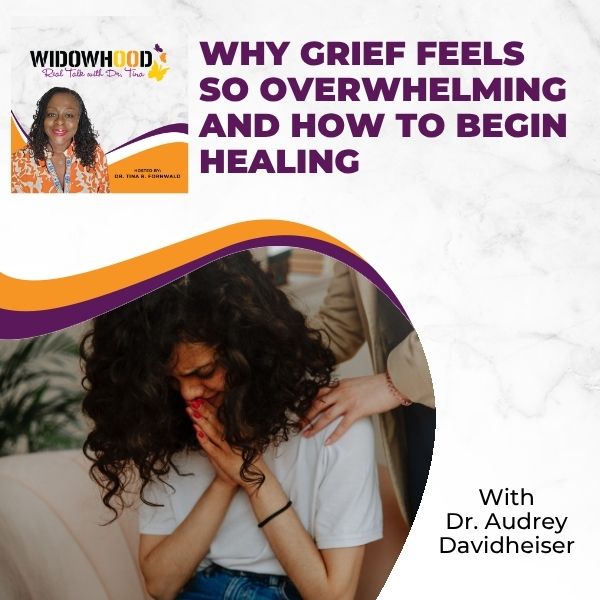
Why Grief Feels So Overwhelming And How To Begin Healing With Dr. Audrey Davidheiser

Widowhood Real Talk with Tina | Dr. Audrey Davidheiser | Grieving Wholeheartedly

  In this episode of Widowhood Real Talk with Dr. Tina, Dr. Tina welcomes Dr. Audrey Davidheiser, licensed clinical psychologist and author of Grieving Wholeheartedly: Bringing Healing to Every Part of Your Soul. Together, they explore why grief can feel so overwhelming, how emotions deserve compassion rather than suppression, and practical ways widows can begin healing after the death of a spouse. Dr. Audrey combines psychological expertise with a deeply compassionate approach to help grieving people navigate loss with greater understanding and hope. Whether you’re newly widowed, years into your grief journey, or supporting someone through loss, this conversation offers practical insight, emotional validation, and evidence-based tools for moving toward healing one wholehearted step at a time. I am sharing my experience of loving the same man for 32 years, a mother to two adult children, a retired military officer, a breast cancer survivor, and my connections with others. Anyone experiencing suicidal thoughts should reach out to a suicide hotline or local emergency number in their country: Psychology Today Suicide Hotlines and Prevention Resources Around the World. — Watch the episode here

Why Grief Feels So Overwhelming And How To Begin Healing With Dr. Audrey Davidheiser Read More »

Through Grief-Colored Glasses: Finding Hope After The Unthinkable With Vicky Edgerly

  In this moving episode of Widowhood Real Talk with Dr. Tina, Dr. Tina welcomes grief educator, author, and speaker Vicky Edgerly, whose life was forever changed by the loss of her son to suicide, her daughter to cancer, and her husband to suicide. Rather than allowing grief to define her future, Vicky discovered a path toward healing that transformed her pain into purpose. Today, she helps others navigate life’s most difficult losses with compassion, wisdom, and hope. Together, Dr. Tina and Vicky discuss surviving complex grief, supporting widows and bereaved parents, finding meaning after unimaginable heartbreak, and why healing doesn’t mean forgetting; it means learning to carry love forward. Vicky also shares insights from her memoir, Through Grief-Colored Glasses: A Life Reinvented by Devastating Loss, and the lessons that continue to inspire grieving families worldwide. I am sharing my experience of loving the same man for 32 years, a mother to two adult children, a retired military officer, a breast cancer survivor, and my connections with others. Anyone experiencing suicidal thoughts should reach out to a suicide hotline or local emergency number in their country: Psychology Today Suicide Hotlines and Prevention Resources Around the World. — Watch the episode here   Listen to the podcast here   Through Grief-Colored Glasses: Finding Hope After The Unthinkable With Vicky Edgerly Widowhood, our conversation with Vicky, she is going to share about suicide. That’s the conversation that people try to shy away from. They do not know what to do when we have no choice but to talk about it, but to experience it and to give you hope of what life can look like. In Vicky’s words, if you choose to, Vicky has dealt with the suicide of her son, her husband, and the cancer death of her daughter. Yet she has found a way to have hope and provide encouragement and support to other grievers. Let’s get into this conversation now.     Vicky, welcome to widowhood. Tina, thanks for having me. I’m grateful and humbled to be here. Your story, your life has a lot of layers. When you hear, “Welcome to the Widowhood,” what’s the backstory? What are you thinking about when you hear that? To be honest with you, Tina, I pushed back against that title when it first was applied to me. I want to say maybe 2 or 3 months after my husband Leo died, I went to attend his mother’s funeral. She passed away. I was surrounded by his family members, and one of his sisters started walking me around the room, introducing me as Leo’s widow. I hadn’t had that experience yet. It slammed into me. I wasn’t sure what I felt about it. I cried about it in my hotel room that night. I wore it like one of his old shimmy shirts that I used to put on just so I could smell the wood smoke from our fire pit, the forest that he always walked in. Evolving Beyond The Identity Of Loss I wore the title, Widowhood, as a warm blanket for a while until there came a time and a chapter in my life, about right after the second year, at the end of the second year, that there was an occurrence in my life that made me realize I had to let go of the marital relationship. I dropped the name Widow at that point as well. It still applies to me. I’m not Leo’s wife. I am his widow, but I am no longer approaching the world wearing that title upfront. It just comes out naturally in organic conversation. Thank you for sharing the evolution of that. I know for myself, when someone identified me for the first time, it was shocking. It took my breath away. Someone who has not become a widow, I think it’s hard to understand. It’s just a word. Why does it matter? It’s just like everything encompassing in that. I was like, “That’s where I am. That’s my life right now.” I can appreciate how you shared that over time your connection with that word changed. For someone tuning into this conversation, to realize the way you feel now versus the way it may change later, it has the potential to shift. That is important because some people feel like their death is final, but the way in which we engage it has the opportunity to adjust over time.     That is correct. Absolutely true. Your life is layered, and we have an amazing book, Through Grief-Colored Glasses: A Life Reinvented by Devastating Loss, and devastating loss indeed. Before we dive into the book, can you tell us about all three of the people in your life that have brought you to this place? Reframing Devastating Heartbreak Into Love It was a crazy ride for sure. Devastating in the beginning, but by the time I traveled through it all, I learned to actually love my story. It is, I think, a romantic story. Think about movies like The Notebook, which is centered around death. Is it not? However, it celebrates all of life. We all come away with tears, but our hearts are cracked wide open after witnessing such a beautiful story. I feel, just as a caveat to the readers or the audiences, that my story is beautiful. This is the place I’ve come to at this point in my life. It didn’t start out that way. In 2002, my eighteen-year-old son, Adam, took his own life. Unfortunately, twenty minutes after wishing me a happy Mother’s Day on the phone and telling me he loved me, he was gone. That was devastating. I will not get too deep into it, because we could be here all day with that particular story, but it rocked my world. I had no inner compass. I had no guidance for how to deal with grief, pain, and loss. Growing up, religion was just something we dabbled in on Easter and Christmas. It wasn’t

Through Grief-Colored Glasses: Finding Hope After The Unthinkable With Vicky Edgerly Read More »

Navigating Widowhood: Updates And The 2026 Retreat

Widowhood Real Talk with Tina | Widowhood Community

  This episode provides vital updates for the widowhood community as we progress through 2026. Dr. Tina shares details about the Children of Widowhood Secret Santa program and the upcoming Walk for Love initiative designed to foster connection. Listeners will hear about the exclusive Real Widowhood Weekend #NextYou retreat taking place in Virginia Beach this December. We discuss the success of the Hope Grows Here 2026 event and how it supports our new educational scholarship fund. Dr. Tina also outlines the upcoming annual butterfly release ceremony and the men’s grief support group led by James Price. Tune in to learn how you can participate, donate, or find the support you need today. I am sharing my experience of loving the same man for 32 years, a mother to two adult children, a retired military officer, a breast cancer survivor, and my connections with others.  Anyone experiencing suicidal thoughts should reach out to a suicide hotline or local emergency number in their country: Psychology Today Suicide Hotlines and Prevention Resources Around the World. — Watch the episode here   Listen to the podcast here   Navigating Widowhood: Updates And The 2026 Retreat Introduction to Widowhood Updates One of the things I hear often in this widowhood community is, who am I now that my spouse has died? What should I do next? Have I been grieving so long that I’m stuck and I can’t get out of this? Those questions are going to be answered at a retreat that we are hosting. December 3rd through the 6th here at Virginia Beach, Virginia. Let’s get into this episode so I can share those details with you. — Children of Widowhood Secret Santa Widowhood, I have a lot to catch you up on. This is a conversation between the two of us. The first thing that I want to do, and mostly part of this conversation, is give you an update of all the things that’s happening in widowhood. First of all, I want to let that our Children of Widowhood Secret Santa program. We took our last application on June 30th. In 2026, we received 42 applications. That’s doubled in the first year than we did Children of Widowhood Secret Santa. If you’re saying, “What is it anyway?” Let me give you some details. Children of Widowhood Secret Santa is an opportunity for the nonprofit Widowhood Real Talk with Tina to help children who have lost one or both of their parents receive gifts for the Christmas holiday. You may have been reading this show, but let me roll it back and remind you. This show is part of the nonprofit 501(c)(3 Widowhood Real Talk with Tina, registered here in the State of Virginia. This show is often the gateway where people find out about the nonprofit and get involved. Children of Widowhood Secret Santa is managed by two widows, Lisa and Tiffany. They manage the program. I do a little bit to help them out, but they are doing the heavy lifting. The program allows us to work with parents or guardians of children who have lost one or both of their parents. Lisa and Tiffany work with these people to create an anonymous Amazon wish list where each child gets to select one to five gifts. Those gifts are under $50 or less. When I say anonymous, those Amazon wish lists will only show the city and the state for the recipient. On our website, starting October 1st, all those items will be listed and we’re looking for you, other sponsors, churches, places of faith, works, organizations where you work, civic clubs, and all sorts of organizations like funeral homes or hospice to come together to help make sure that these children receive Christmas gifts. Individuals, too. You can sponsor one gift. You may sponsor a child for all five gifts, or maybe a family. Maybe you’re like me, who doesn’t like shopping. The idea of being able to just donate to the program is enough for you. We have that option available also. The application process for Children of Widowhood Secret Santa closed on June 30th, and starting on October 1st, the list of all the gifts will be available on our website, but on August 1st, we will reach out and let all the applicants that were approved know that they are in the program. Lisa and Tiffany will start working with them. Walk For Love Details I am excited. Of those 42 applications, I don’t particularly know how many children are in total, but I’m sure it will be more than what we did for 2026. Also, I want you to know that Walk for Love is coming up soon. In fact, it is August 2nd through the 8th of 2026. You may be saying, “What is Walk for Love?” It is an opportunity for you to get involved with the widowhood community and what that looks like is, we’re asking people from August 2nd to August 8th to walk one mile a day. Only one mile. You may walk it outside. You may walk it inside. You may have a medical device. I have my right knee replaced, so I’m probably going to be using my walker to scoot down the road and accomplish my one mile a day. Depending on your situation, but before you do it, please check with your health provider to make sure that you’re in a good place to go for a walk every day. We specifically chose one mile a day because maybe you’ve been thinking about returning to exercise. One of the things that we know that can happen when we are dealing with grief. We don’t take care of ourselves as much as we want to. We don’t exercise. We’re sad. We’re sitting back and we’re disassociated from a lot of things around us. Being able to walk one mile a day can often get us back outside, getting into the sun, connecting with nature, and being

Navigating Widowhood: Updates And The 2026 Retreat Read More »

When Grief Never Fully Leaves: Eileen Bellew On Widowhood, Trauma & Healing

Widowhood Real Talk with Tina | Eileen Bellew | Grief

  What happens when the ‘before’ and ‘after’ of your life is separated by a single, catastrophic moment? Today, we sit down with Eileen Bellew, author of After John Jumped, to talk about the raw, unfiltered reality of losing a spouse in the line of duty. Eileen opens up about the sudden transition from FDNY wife to widow, the struggle of raising four children while navigating her own PTSD, and the difficult, necessary journey of healing when grief feels like a permanent resident. We discuss: The ‘Scarlet Letter’ of Widowhood: How social dynamics and support systems shift instantly after a tragedy. Defining Trauma, Not Just Loss: Why Eileen had to face the specific, painful details of her husband’s death to move forward. Finding Humor in the Hardest Places: How laughter and hope can exist alongside deep, lingering grief. Parenting Through Tragedy: How to hold space for children’s trauma when you are trying to survive your own. Eileen’s journey is a testament to the resilience of the human spirit. Whether you are walking this path yourself or supporting someone who is, this conversation is a reminder that you don’t have to carry it alone. Tune in to hear why—even twenty years later—there is value in the struggle, and why healing is never about ‘moving on,’ but moving forward. I am sharing my experience of loving the same man for 32 years, a mother to two adult children, a retired military officer, a breast cancer survivor, and my connections with others.   Anyone experiencing suicidal thoughts should reach out to a suicide hotline or local emergency number in their country: Psychology Today Suicide Hotlines and Prevention Resources Around the World. — Watch the episode here   Listen to the podcast here   When Grief Never Fully Leaves: Eileen Bellew On Widowhood, Trauma & Healing Widowhood Real Talk with Dr. Tina is more than a show. We are an entire 501(c)(3) non-profit. One of our favorite programs is Children of Widowhood Secret Santa. This allows us to help children who have lost one or both of their parents. That process is done by the remaining parent or guardian applying on their behalf. Go to our website, Widowhood-RealTalkWithTina.org, select Events in the drop-down menu, and then select Children Widowhood Secret Santa. Apply between June 1st and June 30th, 2026. This allows us to help and sponsor you. If you are an individual, organization, book club, or group that would like to sponsor a child or entire family, please email me at WidowhoodRealTalk@gmail.com. This is our opportunity to take this show on an individual basis to people who need to know we are here, and you are not on this journey alone.  ‐‐‐ What happens when your husband has to jump four floors to save his own life, only to die? To think after twenty years, you would say what grief has taught you, what you have learned, and how you have grown. What would you tell yourself the day after John jumped? That’s the conversation we’re going to have with Eileen. Let’s get into this conversation.     Eileen, welcome to the Widowhood. Thank you for having me. “Thank you for having me to the Widowhood,” the ticker tape in the back of your mind. What does it say? We know this is a club no one wants to be in, so what’s the real thought of, “Welcome to the Widowhood,” when you hear that? Defining The “Widowhood Club” And Societal Stigma You’re right. It’s not anything that I ever thought I would be in. Sometimes, I think to myself that I’m not. I don’t know. I sometimes think that I’m not part of that club, but I guess I am. It’s always in the back of my mind that I don’t want to be part of this club. I know. When you think of a widow, do you think your own face represents that? When society speaks of widows, what do you think they’re thinking of? It’s like that Scarlet Letter feeling. Especially in the firehouse, because my husband died in the line of duty, you went from the wife to a widow. The whole dynamic changes. They walk on eggshells around you. They don’t want to upset you. When you went into the firehouse a week earlier, you were joking and razzing with them. You walk in a week later, and even twenty years later, I don’t know what to say that there is a greater respect, but put on a different pedestal. With that, you lose that friendship and the funness of it. You’re the widow. Would you want the funness? Do you think that they need to know? If someone from the firehouse were reading this conversation, what would you want them to know from your perspective? My perspective is that when I lost John, I lost a whole other family, the firehouse family. John was an FDNY. FDNY stands for? The Loss Of The Firehouse Family Dynamic The Fire Department of New York. You live with everybody for 24 hours. You have 24-hour shifts. They know everything about each other, and they know everything about each other’s families because you are with them for so long. He would come home, and I would know who was pregnant or who was getting married. In one instant, I lost all of those families. I lost all of the knowledge about everything that was going on in that firehouse. When you come into the firehouse, they’re not discussing those things with you. They’re like, “How are you doing? How are the kids?” With the voice change. With the head tilt. I appreciate that. One of the things John was on was the firehouse softball team. I was a pretty good athlete in my younger days. They used to say, “Do you want her to get up for you?” They used to razz him. That’s all gone. It’s almost as if you wouldn’t dare speak poorly of John, but I still make fun of

When Grief Never Fully Leaves: Eileen Bellew On Widowhood, Trauma & Healing Read More »

From Heartbreak to Healing: Life After Loss With AJ Coleman

  What does it really mean to move forward—not just move on—after unimaginable loss?” In this heartfelt continuation of last week’s episode, AJ Coleman returns to The Widowhood to open up about his journey as a single father after the devastating loss of his wife, Cory. With rare vulnerability, he shares the quiet strength it took to raise his daughter alone, the moment he found his voice, and the surprising way writing a book helped him heal. We talk about grief, growth, and the pressure to find purpose too soon. If you’ve ever questioned how to start again, this episode reminds us: healing isn’t linear—and you don’t have to rush your way through it. Let’s dive in. I am sharing my experience of loving the same man for 32 years, a mother to two adult children, a retired military officer, a breast cancer survivor, and my connections with others.  Anyone experiencing suicidal thoughts should reach out to a suicide hotline or local emergency number in their country: Psychology Today Suicide Hotlines and Prevention Resources Around the World. — Watch the episode here   Listen to the podcast here   From Heartbreak to Healing: Life After Loss With AJ Coleman Our guest for part two is AJ. We are talking about his journey of being a single parent, how to determine the right time for dating, and his concept between moving forward and moving on, and a book he’s written. Let’s get into this conversation now.         AJ, welcome to the show. I should say, welcome back to the show. Yes, great to be back, and thank you for this wonderful opportunity. Thank you. The conversation we had. They’ll listen to it, but they understood like all the knowledge you had from the catfish and everything else. This conversation is focused on your journey, which has made what you do and how you show up so passionate. Thank you for taking the time twice to get together and have this conversation. I want to start with something we were talking about a little bit in the pre-conversation. I want to just say thank you for bringing your voice to this conversation because I believe, and tell me your thoughts, it’s really hard for men to make themselves vulnerable and just transparent and share something as personal as this. What are your thoughts on that? The Challenge Of Opening Up About Grief & Loss I agree. At the time, it’s very rare when I first started speaking about my grief loss and being a widower at such a young age, with my wife’s passing, the brain cancer, and raising my daughter as a single dad. Many people just didn’t talk about it, especially men, because we have that idea that we’re supposed to be macho, we’re supposed to have all the answers, we’re supposed to have these even-toned feelings. We learned over time. Perception changes that the social media with the amount of resources becoming available where men, like myself, that find it’s okay to talk about the feeling, it’s okay to talk about the losses and join different groups of people to help each other through these tough times. Back when my father was little, this was never a discussion point. It was not even a thought. It just became part of society. That generation as they continue to mature and eventually into the adulthood is they would carry that same notion that we don’t talk about anything. It’s not proper. Today, I think it’s healthy. I think it’s a very important attribute that everybody talks about the feelings. Right or wrong, different or not, it’s important because that’s how you heal, especially during a grief loss. That rings so true to me. My question is, how did you go from the mindset that you were raised under to that first time that you started talking about this? What was that pivotal point? What did that look like for you, starting to articulate this? At the time of my wife’s passing, I did not know that I was pretty much preparing my whole life to handle different grief losses. Only it wasn’t a grief loss of a loved one. It could be a loss of companionship, could be a loss of an ability. It could be a loss of just having anxiety or something like that. How I prepare is just internally, is that sometimes you don’t know what you’re made of until the unthinkable happens. That’s where you start building up that self-esteem, that confidence. Sometimes you just throw everything out the window and say, “I need to talk about this.” As I continued on my journey to self-healing, I realized it’s not necessarily about me anymore. It’s about helping others overcome and cope, and eventually take steps forward within their lives so they can influence others. When we go through these types of unthinkable losses, there’s just something alive that comes in within you. I think a lot of that’s just personality-driven experience, but also being comfortable in who you are and where you want to go with it. Thank you for sharing that, and your wife’s name if you don’t mind us honoring her. Sure. My wife’s name is Cory. Have you always been comfortable with who AJ is? No. I had lived a very sheltered life about who I was. In a sense, I had grown up with a loss of an ability, which is a hearing impairment, not understanding how it would impact me not only as a child, but as a young adult in the workforce, and who I am. I chose to keep my entire life private. One of the things Cory taught me over time was that nobody cares. Nobody thinks that we are our own worst credit of ourselves. We get it into our mindset that everybody’s talking about it. Have you ever go to a room and you walk in and people are engaged in conversation, and

From Heartbreak to Healing: Life After Loss With AJ Coleman Read More »

The Miracle Of Marrying My Heart: A Journey From Heartbreak To Hope With Susan Peters

Widowhood Real Talk with Tina | Susan Peters | Reconnecting With The Heart

  Imagine being thrown into the depths of grief and coming out the other side with a heart that’s not just healed, but stronger than ever. Today’s guest, Susan Peters, shares her transformative journey from heartbreak to hope. After the sudden loss of her beloved husband, Susan embarked on a path that not only helped her reconnect with her heart but also led her to embrace new dreams and a deeper purpose. In this heartfelt conversation, she shares lessons on how heartbreak can be a gateway to greater strength, resilience, and authenticity. Whether you’re navigating grief or simply seeking a fresh perspective on life’s challenges, Susan’s wisdom and courage will guide you toward embracing your own heart’s journey. Stay tuned for an enlightening discussion on how to transform loss into an opportunity for profound personal growth. I am sharing my experience of loving the same man for 32 years, a mother to two adult children, a retired military officer, a breast cancer survivor, and my connections with others.  Anyone experiencing suicidal thoughts should reach out to a suicide hotline or local emergency number in their country: Psychology Today Suicide Hotlines and Prevention Resources Around the World. — Watch the episode here   Listen to the podcast here   The Miracle Of Marrying My Heart: A Journey From Heartbreak To Hope With Susan Peters Hello, Widowhood. Our guest is Ms. Susan Peters. She is going to share with you from her heart. The lessons that she has learned are going to be vital to your own healing journey. The ability to go from someone who may have been shy to brave, the steps in healing, and the interesting facts of how our heart breaks and light coming in make us stronger. Allow me to share a little bit of Susan’s bio with you. After an unexpected and devastating loss of her beloved husband, John, Susan began a transformational journey of the heart to move through her grief. She discovered how creating new dreams, helping bring her heart back into wholeness, and authentic connections allowed her to embrace the fullness of life. She hopes to inspire others to reconnect more deeply with their own heart and loss, thus giving them a chance to discover their new identity by opening up to the possibilities of new dreams so they will be able to live out their authentic purpose. She is in love with the life she has chosen and truly believes that connecting with the depths of her own heart and each other will transform the world. Let’s get into this conversation, and you can purchase Susan’s book. Hello, Susan. Welcome to the Widowhood. Thanks, Tina. I’m so glad to be here with you. When you hear, “Welcome to the Widowhood,” what’s the first thing that comes to your mind? Reframing Widowhood As Bravery To tell you the truth, when I first heard the term widow, I did not like it at all. If you had said to me, “Welcome to the widowhood,” when I was first in loss, I would have been like, “I don’t like that.” I learned from Emily Tanner in the Brave Widow that widow is a brave word. Widows are brave. Widows step forward. They have to step into a lot of different things that they didn’t want to and didn’t have a choice to. Once she said that, it switched something in my brain to say that being a widow is honorable. It’s not fun, and it’s not where you want to be. You don’t wish it upon anybody, but it’s also honorable. It also gives us a chance to step forward and share with others to see that we can help and support each other through something very difficult, and we can get through it together.     There’s a lot there. Thank you for sharing that. I don’t know anybody who liked hearing the word widow. I remember we were taking care of some paperwork shortly after my husband passed, and the person that I was working with had this big computer screen. They shifted it and said “Marital status” and clicked “Widow.” I don’t know if it had been 48 hours. It felt like somebody had ripped my heart out. It was like, “That’s what I am now.” I wanted to tell him, “Don’t check that,” but he had to. Your brain is just settling. I would agree with the concept of the brave widow. I would also go so far as to say that I believe widows should be celebrated. We completed our marriage vows. The amount of knowledge and wisdom. No matter if the marriage was good or bad, you learn something from sticking to that and could benefit other people who are newly married or maybe have been married for a while. It is difficult. It is sad, but there is something very powerful about who we have become in this process. You talked about the Brave Widow. I think you and Emily’s podcast is going to air very close to each other. Tell us about your connection with Emily in the Brave Widow community.     Emily was on a summit with someone else whom I had become friends with because she was in Canada, and her husband had died. She started creating summits to help people get over their grief. Emily happened to be her guest. I joined in some of her Brave Widow things. One of the very early ones is when she had told me that being a widow is brave. Ever since then, I was like, “I love this woman.” She was the one who gave me my chance to be on my first podcast. She got me started on that. It’s interesting because our story connected between our meetings, and we got to share a lot online and share our stories. Somehow, we connected. She gave me opportunities to step forward. I was grateful for those opportunities to share my voice and to share

The Miracle Of Marrying My Heart: A Journey From Heartbreak To Hope With Susan Peters Read More »

The Brave Widow’s Guide To Healing And Hope With Emily Tanner

  This episode is dedicated to empowering brave widows to find hope and healing after loss. Join Emily Tanner, founder of the Brave Widow community, as she shares her powerful journey through grief. She offers practical strategies and insights on rebuilding your life and finding joy again. Discover the importance of community, self-care, and emotional healing as you navigate the challenges of widowhood. Emily’s inspiring story will empower you to embrace your future with courage and create a life you truly love. I am sharing my experience of loving the same man for 32 years, a mother to two adult children, a retired military officer, a breast cancer survivor, and my connections with others. Anyone experiencing suicidal thoughts should reach out to a suicide hotline or local emergency number in their country: Psychology Today Suicide Hotlines and Prevention Resources Around the World — Watch the episode here   Listen to the podcast here   The Brave Widow’s Guide To Healing And Hope With Emily Tanner Emily, welcome to the Widowhood. Thank you, Tina. I’m grateful that you invited me to come. Are you serious? After this lovely winter solstice you allowed me to participate in? Before I read your bio, can you talk about the winter solstice, what that means, and how you came about with that project? I don’t even remember where I got the idea from, and nobody will claim credit. We’re just going to say it was a divine moment. The meaning behind the winter solstice event is an event where we host a panel of widows, and Tina graciously served on our panel. We asked them some tough questions and tried to get their insights. We have giveaways. We play music and have activities. It’s one of the most popular events that I participate in throughout the year. The concept behind the winter solstice is that it is the longest night of the year. We come together as widows knowing that even though our days may feel dark and the nights feel long, every day going forward is going to be a little bit brighter and a little bit brighter.     That is beautiful. Now that you have a bit of a sense of her heart, I want to read her bio. One month shy of their twentieth wedding anniversary, Emily was widowed unexpectedly at the age of 37. She and Nathan have four children, who were the ages of 10 through 19 at the time. She founded Brave Widow, a membership community, to help other widows navigate grief, heal their hearts, and create a life they love again. She is certified by the accredited Faith Coaching Academy and the Grief Recovery Method Institute. How Personal Grief Led To Creating Brave Widow Prior to Brave Widow, Emily served as a Senior Vice President for renew cycle in the healthcare industry, leading teams of 4,000 associates in 100-plus hospitals across the US. She earned her MBA at John Brown University with an emphasis on leadership and ethics. Her passion for servant leadership, collaboration, helping people, and bridging gaps is the driving force behind why Brave Widow exists. Her website is BraveWidow.com, and you can email Emily at Emily@BraveWidow.com. When I read your bio, it gives me the sense that in some bigger-than-life way, you were prepared to lead Brave Widow. It’s an interesting observation. I think that I have always been the person that is ready to help, step up, and lead sometimes to my own detriment because I can overcommit or allow myself to feel taken advantage of after a certain point. I felt compelled. Shortly after Nathan died, I had several employees or co-workers who were either widowed themselves or knew someone who was widowed asking me, “What can I do? How do I help them? What are the next steps?” Naturally, in those first few months, I started putting together a checklist, ideas, and suggestions. It just came very naturally to me. Months into Nathan no longer breathing in this world, you are now setting up the genesis for Brave Widow. When you look back at that, how do you see that being helpful or impactful to your grief journey? For me, I approach it from a very tactical standpoint. I didn’t found Brave Widow until probably a year later, but the founding pieces were there. A very tangible checklist of, “Here are specific things that widows want and need, but they’re too ashamed to ask for. They don’t even know what they need, or they struggle asking for help. Here’s a way that you can talk to a widow. Here are things that you can say that are helpful or things you should avoid saying.” For me, in those first few months in that first year, it was what I wish I had known or what I wish people around me had known, and what resources I wish I could have found but just couldn’t seem to find anywhere. The Impact Of Loss: What To Avoid And What To Do Right That is a good point, because there are so many people, I believe, that mean well, and they’re trying to say what they think is helpful or do different things, but they are landing badly. There are some people that know how to just do it right. Unfortunately, I believe the people that learn how to do it right do so because of a significant loss that they’ve learned from experience. I’ll ask the question that people always want to know, what are some things people should not do? Instead of starting with what they shouldn’t do, when people ask, “What should I say? What can I say?” sometimes I’ll respond tongue-in-cheek and say, “The best thing you can say is listen. It’s just to be there.” What we tend to want to do, it’s very much in our nature, is we want to help people. We see someone that’s hurting, they’re struggling, or down in the mud, we want

The Brave Widow’s Guide To Healing And Hope With Emily Tanner Read More »

Awaken & Renew Grief Coaching With Emily Curtis

Widowhood Real Talk with Tina | Emily Curtis | Grief Coaching

  Join Emily Curtis, as she shares her journey as a widow and how she transformed her challenges into hope and purpose through grief coaching. Emily shares her raw journey of loss, revealing the unique bond forged among those who have lost their partners. They explore the realities of widowhood, the challenges of discussing loss, and the community’s role in navigating grief. Discover how Emily’s grief coaching business, Awaken & Renew Grief Coaching, empowers others to find their way through loss, honor their loved ones, and embrace new beginnings. This episode is a testament to resilience and the transformative power of shared experiences in overcoming loss. I am sharing my experience of loving the same man for 32 years, a mother to two adult children, a retired military officer, a breast cancer survivor, and my connections with others. Anyone experiencing suicidal thoughts should reach out to a suicide hotline or local emergency number in their country: https://www.psychologytoday.com/us/basics/suicide/suicide-prevention-hotlines-resources-worldwide — Watch the episode here   Listen to the podcast here   Awaken & Renew Grief Coaching With Emily Curtis Widowhood Emily Curtis, welcome to the widowhood. Thanks for having me, Tina. You’re welcome. When you hear, “Welcome to widowhood,” what comes to your mind first? That’s a great question. I think what comes to my mind is probably a band or a group of people who are going through a similar situation. The widowhood are all widows and we’re a club that we never wanted to join. A lot of people say that as well, not just myself, but a club we never wanted to join, but here we are. We are trying to figure out how to move forward and how to make the best of a terrible situation. I think widowhood is a group of people who understand each other’s pain and are able to hopefully support each other through podcasts like this and other things like that. Thank you. I’ve heard that term that it’s a club nobody wanted to join, but I believe we did because we took vows to want to join this club.     It’s a good way of thinking about it. I think it’s interesting. It is, in a way, a gift, the partner, the spouse that passes first. They never have to grieve the other. Falling in love, you open your heart to others and you open your heart to being hurt. I think I feel like maybe it’s a club I never wanted to join because I lost my husband when I was 45 years old. I was not ready to be in that club at 45 years old. I felt like we still had a lifetime to live together. Certainly, none of my friends were widowed or were widowed at the time. It was a challenging place to be. I definitely can see that. I’m learning the duality of we fulfilled our wedding vows, but the cost of that is paying. It’s interesting to me that it seems like people who are widows are shunned, but people who are divorced are celebrated. It seems as if you’ll have those, “I got a divorce party and they’re out there celebrating that.” I feel like, where’s our party? I feel like it’s a difference between maybe somebody, a professional athlete, versus a teacher. A teacher is doing something different, but the pay disparity is obvious to me. I feel like that way. It’s a good point. What I have felt as a widow is that it’s not okay for me to talk about my late husband. When you get divorced, you don’t start dating. When you’re dating, you’re not talking about your ex-husband. You’re not going to parties with your new partner, talking about your ex-husband. I find myself still talking about my late husband. I do have a new partner in my life. He’s fine. Emily & Brad’s Story You cannot skip that real quick. No, slow down. Let me start navigating this conversation. What is your late husband’s name? My late husband’s name was Brad. His name is still Brad. What was Brad’s favorite color? Red. What did he have that was red? He liked a lot of colors. His mother was Korean. Red, in Korean culture, is good luck. It was always a symbol of good luck in terms of red items in our household and things of that nature. He was a very bold character. Red certainly fits him. I see the way you light up just by saying and thinking about him. How did you and Brad meet? Brad and I met in 1998 and I had just moved to Colorado and he had been living here for about four years and I met him through work. About a month after, I moved to Colorado and we started dating right away. We took our time. It took us nine years to get married. We were married for fifteen years when he passed. We had been together for a total of 24 years. You literally had a lifetime with Brad. I had a lifetime with Brad. Yes, I was young when I met him. At the time, I didn’t think I was young, but looking back, I realize that I was definitely young. We went through a lot. We moved, and we had a period of time when we were waiting for a home to be built, or we lived in our camper for nine months because we had nowhere to live with two of our dogs. We went through a lot. It’s cliche, but it’s true, he really was my best friend and we just really enjoyed life together. We really enjoyed the same activities and the same experiences and he was everything. He was everything to me. When you think of relationships, people say, “We’re having a hard time.” What did you learn in your relationship with Brad about enduring hard times in a relationship? I mean, great question. Certainly, we, as any couple, had hard

Awaken & Renew Grief Coaching With Emily Curtis Read More »

Widowhood Secret Santa Program Application

Step 1 of 2

Bringing Joy & Support to Widowed Families

This application is open to all widows and widowers with children between the ages of newborn to 18 years old. Special needs children over the Age of 18 are also eligible.

Parent/Guardian Information

Address(Required)

Child(ren) Information

Do you have a special needs child over the Age of 18?(Required)
Click the plus (+) icon to add more names.(Required)
Child's Name
Age
 
Click the plus (+) icon to add more names.

Please share a little about your situation, what this program would mean to you, and any special circumstances.
What Type of Support Would Be Most Helpful?(Required)
  • All gifts will be handled through your Amazon Wish List link.
  • A completed consent form must be submitted for consideration with this application.
  • Nominations will be announced on September 1st.

Walk For Love 2025

Support grief awareness and Walk For Love in style. Proceeds help fund free grief support programs. Merchandise is available now, with new batches printing every 15 days — so order early to ensure you receive your items before the August kickoff on August 3,  2025

🛍️ How It Works

- Order anytime — Bonfire prints new merchandise every 15 days

- First shipping window: Orders placed by July 11 ship between July 1–11

- All items ship directly from Bonfire

- Order early to wear your gear for Walk For Love in August!

👕 Apparel – T-Shirts, Sweatshirts & Hoodies

🛒 Order here: https://www.bonfire.com/walk-for-love-2025-1

💲 Price: $23–$42

📏 Sizes: Youth to 3XL

Over 20 different colors

📝 Notebook

🛒 Order here: https://bonfire.com/walk-for-love-2025-notebook-1

💲 Price: $22.99

Great for journaling, writing affirmations, or gift-giving.

☕ Mug

🛒 Order here: https://bonfire.com/walk-for-love-2025-mug

💲 Price: $19.99

Sip your morning coffee with a message of love and remembrance.

🚶‍♀️ Travel Mug

🛒 Order here: https://bonfire.com/walk-for-love-2025-travel-mug-1

💲 Price: $24.99

Keep your drinks hot or cold while walking for love.

💧 Water Bottle

🛒 Order here: https://bonfire.com/walk-for-love-2025-water-bottle-2

💲 Price: $29.99

Hydration meets heart — perfect for walkers everywhere.

📣 Additional Notes

At checkout, encourage shoppers to select your board member's name from the referral dropdown to help us track outreach.

Use and promote hashtags: #WFL2025 and #WRTWT

Perfect for walking during the event or repping all year long.

Mental Health Walkathon to provide encouragement and inspiration for the grieving struggling with depression and isolation.

During the Walkathon, we walk together, united in our mission to support mental health. From August 3 - 9, 2025 we encourage you to walk one mile daily. Share your journey by posting a picture on your favorite social media platform with #WRTWT #WALKFORLOVE, and let’s inspire others to join us.

Funds from the Walkathon will allow Widowhood Real Talk With Tina to conduct an Annual Grief Garden and a Butterfly release ceremony and provide participants journals & pens.

Three ways to participate

Purchase merchandise ~ In Development

Donate: https://app.99pledges.com/fund/walkforlov

Make your pledge, 1-mile daily day August 4 – 10, and post #WRTWT #WALKFORLOVE: https://app.99pledges.com/fund/walkforlov

To Start your pledge team, email widowhoodrealtalk@gmail.com for details.

Register on Eventbrite: https://www.eventbrite.com/e/1223004923649?aff=oddtdtcreator