Grief

The Silent Burden: Understanding Grief Through The Eyes Of Black Women With Natasha Smith

Widowhood Real Talk with Tina | Natasha Smith | Black Woman Grief

Β  Host Dr. Tina Fornwald welcomes author and grief educator Natasha Smith to discuss how loss impacts individuals through a distinct cultural lens. Why is grief experienced differently by Black women, and what do we need to understand that we’ve been missing. Natasha Smith shares her personal story of carrying decades of unspoken loss, including family deaths, pregnancy loss, and silent caregiving. Together, they break down the cultural expectations of being the strong Black woman and explore how faith communities can create safer places for emotional healing. This powerful conversation offers practical guidance for releasing internal pressure and giving yourself full permission to feel seen. I am sharing my experience of loving the same man for 32 years, a mother to two adult children, a retired military officer, a breast cancer survivor, and my connections with others.Β  Anyone experiencing suicidal thoughts should reach out to a suicide hotline or local emergency number in their country: Psychology Today Suicide Hotlines and Prevention Resources Around the World. — Watch the episode here Β  Β  Listen to the podcast here Β  The Silent Burden: Understanding Grief Through The Eyes Of Black Women With Natasha Smith Welcome to the show. This show features a conversation, practical tools, and inspiring stories to help you understand where grief gets stuck and how to move forward with hope. This conversation is one I believe everyone needs to hear. Grief is universal, but isn’t it always experienced the same way? Culture, race, community, expectations, faith, and life experience all shape how we grieve and whether we feel safe enough to express our grief. Joining me is the author and grief advocate, Natasha Smith, whose work shines a light on the unique grief experience of Black women through her own story, including profound loss, including the death of several loved ones, pregnancy loss, and years of caring for grief silently. She is helping others understand that grief begins when we finally give ourselves permission to be seen. Welcome, Natasha, to the Widowhood. Β  Β Β  Natasha, welcome to the Widowhood. Thank you so much for having me. Thank you. If you would think of like the ticker tape that is in your head, like Welcome to The Widowhood. What would be the thing that really comes to mind when you hear that? That a loss has occurred to hold that highly. Now, a loss has occurred. I love how you phrased that, because you have been experiencing loss, my sister, over decades of different things. What made you finally say, β€œI cannot do this quietly?” Confronting Unprocessed Loss 2020 happened literally up until that moment. Up to that point, I was holding it all, stuffing it, just trying to outrun and run from grief. Primarily because I didn’t know how to process it and didn’t know what to do with it. 2020, we were shut in our homes with ourselves to deal with ourselves. That was really the pivotal point for me. Really saying I have to do something with this. Every time you turn on the news, death is staring everyone in the face. We were all experiencing loss at that time. It was really so in our faces, like death, loss, dying. There was so much chaos in the world, a political year on top of a lot of racial things that were going on. It was like, I couldn’t hide from grief even though I was running from it. That was my time to confront it. You say all of the things, when you think of your grief, what are all those things that you were trying to run from, the experiences you had? Exactly. The loss of half of my immediate family. The death of my dad and two of my older sisters. My older sister passed away when I was a sophomore in college. It was at a young age, or still in my teenage years. Also in my teenage years, I had a teen pregnancy that I placed the child for adoption. That was a loss that I really never talked about, that I stuffed away and really didn’t process at all. That was a loss that I had started to begin to unravel and process in 2020, along with miscarriages and the death of babies by stillbirth. A lot of loss that they came and they went, and I did not deal with them at all. I wrote this down because I want to make sure I say this correctly. You often say that while grief is universal, Black women experience it differently. What do most people outside of that experience understand versus what it is? That’s a beautiful question because often when I’m asked about Black Woman Grief, it comes from one of two places. One from curiosity and then another place of offense. To answer your question, someone outside of it, it may seem as if our grief is being compared to everyone else’s, and that it demeans or diminishes other people’s experience. However, that’s really not the case. Black Woman Grief is not about anyone else. It’s about us and our experiences. Pause right there. Say that again a little bit slower. Honoring Distinct Grief Experiences For Black Woman Grief, it is about us and not other people’s experiences. It is about what we experience. It’s not about them, but it’s about us. It does not diminish or take away from other people’s experiences. Instead, it makes space for ours. That right there is something people need to sit with. It’s not about comparison. My bad English has got nothing to do with anybody else but the person that’s dealing with it. It would be like having a conversation about people who are amputees. It has nothing to do with a conversation about people who have legs. This is the amputee experience. I cannot say anything that they’re going to say about that because I have both of my legs. I can choose to listen. I can choose to
The Silent Burden: Understanding Grief Through The Eyes Of Black Women With Natasha Smith Read More Β»

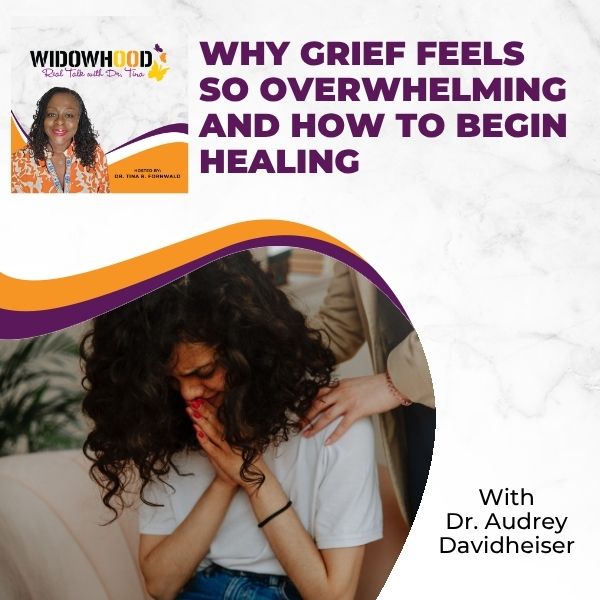
Why Grief Feels So Overwhelming And How To Begin Healing With Dr. Audrey Davidheiser

Widowhood Real Talk with Tina | Dr. Audrey Davidheiser | Grieving Wholeheartedly

  In this episode of Widowhood Real Talk with Dr. Tina, Dr. Tina welcomes Dr. Audrey Davidheiser, licensed clinical psychologist and author of Grieving Wholeheartedly: Bringing Healing to Every Part of Your Soul. Together, they explore why grief can feel so overwhelming, how emotions deserve compassion rather than suppression, and practical ways widows can begin healing after the death of a spouse. Dr. Audrey combines psychological expertise with a deeply compassionate approach to help grieving people navigate loss with greater understanding and hope. Whether you’re newly widowed, years into your grief journey, or supporting someone through loss, this conversation offers practical insight, emotional validation, and evidence-based tools for moving toward healing one wholehearted step at a time. I am sharing my experience of loving the same man for 32 years, a mother to two adult children, a retired military officer, a breast cancer survivor, and my connections with others. Anyone experiencing suicidal thoughts should reach out to a suicide hotline or local emergency number in their country: Psychology Today Suicide Hotlines and Prevention Resources Around the World. — Watch the episode here

Why Grief Feels So Overwhelming And How To Begin Healing With Dr. Audrey Davidheiser Read More Β»

Healing Traumatic Loss And Death Scenes With Kelly Daugherty

Widowhood Real Talk with Tina | Kelly Daugherty | Traumatic Grief Recovery

  Navigating spousal loss often exposes deep emotional wounds that require practical tools and a genuine community. Dr. Tina Fornwald connects with licensed clinical social worker, grief specialist, and one of the hosts of GRIEF Ladies, Kelly Daugherty, to discuss traumatic grief recovery and effective healing modalities. Many grieving individuals find themselves stuck on the painful death scene of their loved one, which prevents them from accessing fond memories. Processing trauma first allows you to clear the emotional roadblocks that keep you trapped in survival mode. Kelly shares her personal story of losing her mother at fourteen, navigating life with an alcoholic parent, and finding her calling as a grief therapist. Together, they explore how modalities like EMDR and progressive counting help reframe painful memories so you can move forward with love rather than pain. I am sharing my experience of loving the same man for 32 years, a mother to two adult children, a retired military officer, a breast cancer survivor, and my connections with others. Anyone experiencing suicidal thoughts should reach out to a suicide hotline or local emergency number in their country:Β Psychology Today Suicide Hotlines and Prevention Resources Around the World. — Watch the episode here Listen to the podcast here Healing Traumatic Loss And Death Scenes With Kelly Daugherty Welcome back to the show. Our conversation with Kelly is going to open your mind to the idea you don’t have to stay stuck at the moment the person you love died. Hear me again. Sometimes your memories, sometimes what you’re thinking has kept you in the place in the moment in which they died. The memories of the love and the experience and everything you have are so hard to reach. This conversation with Kelly is going to empower you to think beyond that moment in what is possible for you. Let’s get into this discussion now.     Kelly, welcome to widowhood. Thank you so much for having me. β€œThank you for having me to the widowhood.” What’s the backstory when you think about it deeply? What comes to mind? A lot of my clients. That’s what I think about. I think about what I’ve witnessed with them, what I’ve seen them go through, but also the transformations that I’ve seen with them. The ups and downs of grief are not linear and predictable. It’s a bit of a hot mess. That’s true. Going from there, let’s start with your story and your personal experience as it relates to grief. Overcoming Early Loss and Unspoken Family Struggles My mom died when I was fourteen. She died from breast cancer and I was struggling a great deal after that. My sisters moved out shortly after my mom died, so it was just my dad and I. My dad was an alcoholic at the time, so things were not good at home. My mom did it all and my dad just worked. I didn’t have a relationship with my dad to be completely honest. The good news is, my dad recognized I was having a hard time. He basically forced me to go to a hospice grief group for teens. The way he got me there was, I went to an all-girls Catholic High School and fifteen years old, being a little boy crazy. All it took was him saying there would be boys in the group. That’s what got me to go, but I walked into that room and my life changed. I met an amazing social worker. I knew I wasn’t alone in my grief anymore, and that’s how I had felt up into that point. Doing work with the hospice social worker and then also doing a lot of family with my dad. My dad did get sober. I threatened to run away and told him if he didn’t get sober, that’s what I was going to do. I was very determined to do that and he did. He didn’t get into AA for about two years after that, but he did. My dad died a few years ago. At the time of his death, he had been sober for almost 30 years and in AA for almost 28 years. Because of that, and because of his push, I’m talking to you. If he hadn’t had me go to that group and hadn’t had me meet Renee, the social worker, I would have never even known what to expect, and what to understand about grief. Renee, after a while, asked me to start volunteering with the Children’s Program. Slow down. We need to circle back a little bit. Growing up with a father, your mom passed. Was your dad an alcoholic before your mom died? Yes, for my entire childhood. That’s something to grieve along with everything else. Absolutely. When I talked with my sisters about it, they were 7 and 9 years older. The oldest has the most memories. My mom sheltered me a lot. I was still young enough that I didn’t realize what it was all. There were some memories that I’ve worked on in therapy. I’m grateful I have because they were difficult and hard. Especially the last Christmas with my mom. My dad was drunk. There was a situation with the Christmas tree. It was something that always eat and bothered me. When I got trained to EMDR, I was like, β€œI’m going to work on this memory,” and I did. I’m grateful I did that work because I was able to have a very different relationship with my dad because of doing that. Thank you. You mentioned EMDR. Can you share a little bit? I don’t want to make an assumption that everyone reading knows different acronyms, modalities and things. I want to always make sure we slow down and unpack. Reprocessing Traumatic Death Scenes With Clinical Modalities EMDR is eye movement desensitization and reprocessing. It’s like the gold standard of trauma therapy. It’s been around since the early 1990s. Francine Shapiro developed it. It uses bilateral

Healing Traumatic Loss And Death Scenes With Kelly Daugherty Read More Β»

How To Give Yourself The Permission To Live After Loss With Kelley Raleigh

Widowhood Real Talk with Tina | Kelley Raleigh | Permission To Live

Β  Giving yourself permission to live again after loss can feel unfamiliar and even uncomfortable, and in this conversation with Kelley Raleigh, that tension is explored with honesty, depth, and care. Kelley reflects on becoming a widow at 46 and the disorienting experience of grieving a life that changed in an instant while still choosing to move forward. Her story moves through identity shifts, evolving relationships, and the deeply personal choices that come with rebuilding, including moments that felt messy, unexpected, and real. What unfolds is a thoughtful reflection on grief that makes space for both sorrow and growth, gently challenging the belief that there is only one way to mourn. Through her lived experience, Kelley offers a grounded reminder that even in the midst of profound loss, it is possible to reconnect with yourself and begin shaping a life that still feels meaningful. I am sharing my experience of loving the same man for 32 years, a mother to two adult children, a retired military officer, a breast cancer survivor, and my connections with others.Β  Anyone experiencing suicidal thoughts should reach out to a suicide hotline or local emergency number in their country: Psychology Today Suicide Hotlines and Prevention Resources Around the World. — Watch the episode here Β  Listen to the podcast here Β  How To Give Yourself The Permission To Live After Loss With Kelley Raleigh Thank you for every episode that you’ve tuned into over the years. I want to tell you that I am inviting you personally to join me for Hope Grows Here on May 16, 2026, in Norfolk, Virginia. We are celebrating my 60th birthday, and we’re celebrating Widowhood. This is an opportunity for us all to get together and celebrate. Dancing, comedians, photo booths, and so much more fun. Did I mention it’s a β€˜60s costume? I hope to see you there. For details, email me at WidowhoodRealTalk@gmail.com. ‐‐‐ Have you ever wondered what life would look like if you gave yourself permission to make change, or if you gave yourself permission to grieve and also laugh? This conversation with Kelley is going to challenge you and probably give you permission to live a life that you enjoy. Let’s get into this conversation. Β  Β  Kelley, welcome to the Widowhood. Thank you so much for having me. I’m so happy to be here. A Clean Slate At Forty-Six If I were to look at the ticker tape in your head, which is like, β€œThank you. Welcome to the Widowhood,” what’s the backdrop when you think of that? I go to the label of a widow. I still feel like I’m 30. Old people are widows in their 80s. Not people our age. It makes me chuckle a little bit. It makes me like, β€œI guess that’s me.” That’s what I think. That’s fair. Age is relevant in this community. Do you mind sharing when you entered into the Widowhood? I was 46. It’ll be 5 years in May 2026. I was 46, and he was about to turn 52. He was two weeks away from turning 52. What is his name? Can you share with us? His name was Eric. A lot of things I hear people talk about in this experience is that they’re not the same person. When you hear that, what do you think now compared to that moment when Eric left this world? I said this not long ago to somebody. It feels like it was a week ago and 100 years ago. It’s still a bit discombobulating sometimes. I’m a vastly different person, and I’ve been a vastly different person probably three different times in the last couple of years. I was a stay-at-home mom when he died. That was a completely different project for me because I’ve always worked. I’ve always been the go-getter. I’ve always been the type A, and then I was a stay-at-home mom with my kid. That shifted me. I wanted to shift when we were towards the last year of our marriage, and then he died. It dawned on me that I can be however I want. It was almost like a clean slate in a lot of ways. I’d been doing personal growth work for many years. It wasn’t new to me to be like, β€œI know I need to date and rise from the Phoenix,” as much as I didn’t want to. I feel like I’ve been a handful of different people. I’ve tried things. I’m going to say my dark side, but my dark side is not a dark side. I even embraced some things that I thought I would never do. I got to leave it at that. We’re not. This is called real talk. You don’t get to go, β€œI did some things.” We’re going to need 2 or 3 of those things. We need to know if it was a little fire. Let me go get my tea cup because you need to talk. Come on. Widow Fire And Social Permission It was taking risks with money, number one, which is not that juicy. Number two was with men. It was dating men that I would never date before. Even taking a lover and not having any expectations, and doing that. I have been in a relationship since I was fourteen. Relationship, then relationship, then marriage, and then I got a divorce, which was amicable. I was with Eric for seventeen years. She’s over here blushing. She’s like, β€œI didn’t know we were going to go this way.” For the women who are reading this and are going, β€œThe widow fire is real.” Some people feel shame. Some people feel like, β€œI was a good wife, and I loved my husband.” Can they both exist? Can you talk to them about that? Yes. To give context, every single relationship I was in, I was completely faithful. I never once had that like, β€œI need to go have an affair.” Nothing like that. I embraced

How To Give Yourself The Permission To Live After Loss With Kelley Raleigh Read More Β»

Remembering Who You Were To Me Before You Became A Memory With Dr. Tina Fornwald

Widowhood Real Talk with Tina | Dr. Tina Fornwald | Remembering

Β  How do you hold the expansive story of a life when all people want to ask about is the ending? Dr. Tina Fornwald dedicates the month of March to remembering the whole person in grief, honoring her late husband, Mark Fornwald, nine years after his passing. In this raw and deeply personal conversation, she speaks directly to Mark, allowing listeners into a 32-year love that shaped her into the woman she is todayβ€”a relationship built on mutual strength, laughter, and raising their two children. She shares cherished, untold memories and explains why choosing to continue loving and living with his presence is more important than finding resolution. This is an invitation to witness a love that continues out loud and know you are not alone in your own journey. I am sharing my experience of loving the same man for 32 years, a mother to two adult children, a retired military officer, a breast cancer survivor, and my connections with others.Β  Anyone experiencing suicidal thoughts should reach out to a suicide hotline or local emergency number in their country: Psychology Today Suicide Hotlines and Prevention Resources Around the World. — Watch the episode here Β  Listen to the podcast here Β  Remembering Who You Were To Me Before You Became A Memory With Dr. Tina Fornwald A Love Story Continues Out Loud: March Dedication Before we begin, I want to name what this month is. For March, I am dedicating this show to my late husband, Mark Fornwald. Years ago, on March 11th, 2017, my life changed forever when he left this world. Rather than letting that date pass quietly or privately, I’ve chosen to honor him, my grief, and my love here in this space across March. This is going to feel a little different than my usual episodes. Some of what you’ll read this month will be spoken directly to Mark. Some of it will be spoken to you. Sometimes, you’ll simply be reading as love continues out loud. I’m not here this month to teach grief, analyze it, or package it into something tidy. I’m here to honor a relationship, what remains after loss, how love changes and shapes, and how we become when someone we love is no longer physically here. Β Β  Reclaiming His Story: How People Talk About Mark Now If this is your first time tuning in, you don’t need to catch up or prepare. You’re welcome to tune in quietly, emotionally, or in pieces. There was no right way to be here. Mark, I’m talking to you, allowing others to read along. My first question, Mark, do you know how people talk about you now? They talk about you as my late husband, this man that I loved in person for 32 years, and the man who is no longer here. They talk about you as Tina’s late husband and Catherine and Alexander’s dad, who has died. They talk about you as the man who was a great hunter, the man who is the inspiration for that tattoo on my right thigh, the man who has taught me how to love, and the man who is the inspiration for Widowhood Real Talk with Tina, a nonprofit that I started to support other people who are grieving. People talk about you and laugh. Kim and Lionel have a joke about when they’re in their house, and they pull out a chair, and they find it, they say, β€œMark left it there.” Kim and Lionel are my children’s godparents. Mark stayed with them one time when he was traveling for work. He would always leave the chair out. He would never scoot it underneath the table. To this day, Kim and Lionel will say, β€œMark, did you do that?” because that means that one of them left the chair out. Those are some of the ways that people talk about you, my love. Beyond The Ending: Honoring How He Lived, Not How He Died Do you know how often you are remembered through the lenses of how you died, not how you lived? People I will meet, Mark, will say, β€œHe died?” Instantly, they will ask how you died. I go into the long story about how I was supposed to have a work trip, but then I felt God pressing me not to go. I called you and asked you, β€œDid you want to get together?” You said yes because we hadn’t seen each other in a couple of months. We got together, and we got lost. We went to the movies. You had Chinese food for your last dinner. In my mind, I was thinking, β€œI know he wishes he had had steak and potatoes.” I can envision you. I’m telling them this long story. The next day, you weren’t feeling well. You went to have breakfast, and then you had a heart attack in our hotel room and never got up from that. I was at the end of the hallway, screaming into the phone to my sister and saying, β€œI love you. How can you no longer? How can this be? How is this possible?” That’s the thing that people want to know. Not how you were an amazing husband and not the things that you did, but how you died. I don’t know the fascination or curiosity. I do it myself. I ask people, β€œHow did they pass?” I guess it’s something we do, but when I’m having this conversation with you and looking at these questions, it seems irrelevant. You died, and that is the most important part. 32 Years Of Love: Who You Were To Me Before Grief Entered The Room Do you know who you were to me before grief entered the room? I remember after you passed, Mark, and asking the kids, β€œDo you think Daddy knows how much I loved him?” In my mind, I wanted to know the answer was that you knew, but I wasn’t 1000% certain. I want you to

Remembering Who You Were To Me Before You Became A Memory With Dr. Tina Fornwald Read More Β»

Grief As A Stepping Stone: How To Start Rebuilding Yourself After Life Falls Apart With Arthur J. Rutledge

Widowhood Real Talk with Tina | Arthur J. Rutledge | Rebuild After Grief

Β  Rebuilding yourself after life falls apart is a challenging, yet necessary, journey, especially when navigating grief during the holiday season and facing self-doubt. Arthur J. Rutledge, a servant leader, speaker, and author of 11 Pillars of Confidence: Build & Lead an Empowered YOU, shares his profound personal experiences with lossβ€”from his pet to close familyβ€”and offers constructive steps to consciously move toward the light. He discusses the power of “stringing” good memories to work through the darkness, the importance of forgiving the unspoken, and how overcoming “low-frequency ideas” like shame and blame is crucial to becoming the ‘Victor versus the victim’ in your own life story. Arthur emphasizes that strengthening the trifecta of self-esteem, self-worth, and self-value is key to seeing grief not as a tombstone, but as a stepping stone to a renewed life. I am sharing my experience of loving the same man for 32 years, a mother to two adult children, a retired military officer, a breast cancer survivor, and my connections with others.Β  Anyone experiencing suicidal thoughts should reach out to a suicide hotline or local emergency number in their country: Psychology Today Suicide Hotlines and Prevention Resources Around the World. — Watch the episode here Β  Listen to the podcast here Β  Β  Grief As A Stepping Stone: How To Start Rebuilding Yourself After Life Falls Apart With Arthur J. Rutledge Voices Of Widowhood Healing Through The Holidays Has grief impacted your confidence? Has grief taken away your self-worth, your self-value, your self-esteem? If so, this conversation with Arthur is just for you. Let’s get into this conversation now. Β Β  Β Β  Arthur, welcome to the Widowhood. I’m happy to be here. Thank you for having me. Β I always ask people like, β€œWelcome to the Widowhood. Thank you for having me,” is that the ticker tape? If we were to see the invisible ticker tape in your mind, what would that look like? I’m an avid servant leader. The first thing I learned as I’m going through my life is to always edify the person before you edify yourself. I always want to give it back, and I’ve made that the precursor to all the things that I’ve added up to the successes that I’ve obtained in my life so far. Just that little piece, just letting that person know that they’re seen and they’re valued in my eyes. That appreciation always gets received. At least I believe it gets received well, and it just opens the vulnerability, the trust up between the two that’s, or a room of people who are looking for what that can be for them. That’s the long of it. Servant Leader In Action: How To Live With Integrity And Kindness Actually, I want to dive in and be a little bit more specific. The servant leader, the giving back. How do those show up in actions? A lot of times, we use these words to become buzzwords, but how does that show up in your everyday? I always say leadership is just a big word for us leading ourselves. The hardest thing that any leader will ever tell you are the ones who are being truly honest is that process. It is very easy to give instructions or tell somebody how to go about, how they should live, where they should go, how they can be or should be. It’s always best shown by emulating what that looks like by the actions. If I’m being a good person to myself, if I’m being kind to myself, if I’m being a person of integrity with myself, if I’m following through on the things that I see for myself and I want for myself, and I’m living that every day. If I’m telling someone one thing, and then the next day I’m waking up to a smile on my face, which I’m always telling people to get that going, and their chemical imbalance that might be there to start their day or hugging themselves or taking deep, long breaths to step into who they are, and what they’re becoming, then that’s going to, like I said, trickle forward. It’s going to echo in a way that’s what’s being expected of me. If I can give what I’m expecting out of myself, then the other person can receive that on their side and say, β€œThis is the formula to have that smile, to have that good frequency, to have that good energy.” I’m a God-fearing person. At the end of the day, God says, β€œPut this in your space.” A person who is good at following and serving leader means that for me you can’t be a good leader if you’re not a good follower first. Jesus, and my Lord and Savior and God, and or whatever that looks like for people who are stepping into, I emulate in a good way, in a good, healthy, kind, generous, respectful, loyal noble type of way. We are all kings and queens, so that’s the same thing that I think people can expect from themselves at the end of the day. I don’t think it’s one without the other. I always tell people the first learning prowess, the first way we step into learning is imitation. Now we don’t have to follow people the same way we did from a young age, but to get good at that is the foundation for critical and creative thinking, standing on our own two feet and being able to give that back. Paying forward what we’re able to give lets us understand that we are interdependent in a world that maybe doesn’t make us feel like we are such at, at different points in our lives. Navigating Grief & The Holidays: Finding Your Way Through Loss Speaking of those different points of being in our lives, this conversation around widowhood, grieving holidays, once I was that person. I was this man who showed up in life that way. Now I feel that grief has taken that

Grief As A Stepping Stone: How To Start Rebuilding Yourself After Life Falls Apart With Arthur J. Rutledge Read More Β»

The Grief 2 Growth Journey: Finding Meaning After The Unimaginable With Brian D. Smith

Widowhood Real Talk with Tina | Brian D. Smith | Grief 2 Growth

Β  The emotional turmoil of loss requires more than just time; it demands the intentional “work” of navigating grief. Certified grief educator and certified life coach Brian D. Smith, host of the Grief 2 Growth podcast, joins the conversation to share how he transformed his own pain after the sudden loss of his daughter, Shayna, into a calling to help others. Brian details his practical GEMS methodβ€”Gratitude, Exercise, Mindfulness, and Self-careβ€”as a foundational daily practice for healing and discusses why the expectation of happiness during the holidays can be so difficult, the power of forgiveness to release emotional ties, and how to offer genuine support to those who are grieving without unintentionally minimizing their experience. I am sharing my experience of loving the same man for 32 years, a mother to two adult children, a retired military officer, a breast cancer survivor, and my connections with others.Β  Anyone experiencing suicidal thoughts should reach out to a suicide hotline or local emergency number in their country: Psychology Today Suicide Hotlines and Prevention Resources Around the World. — Watch the episode here Β  Listen to the podcast here Β  The Grief 2 Growth Journey: Finding Meaning After The Unimaginable With Brian D. Smith Voices Of Widowhood Healing Through The Holiday Welcome to the special series of Voices of Widowhood: Healing Through the Holidays, a space where we share honest and healing conversations about love, loss, and the unique challenges the holiday seasons bring. I’m honored to welcome our very first guest in this series, Brian Smith. Brian is going to share with you some interesting ideas about GEMS, moving forward versus moving on, and things to say and not to say to people who are grieving. For those who are holding space for others who are grieving, he has special tips for you on how to support someone who is grieving during the holidays. Let’s get into this conversation now. Β  Β  Hello, Brian, welcome to the Widowhood. Thank you. It’s good to be here. When you hear, β€œWelcome to the Widowhood,” what ticker tape runs across your mind when you hear a statement like that? It’s weird. In my work, I’ve been running across a lot of widows lately, a lot of people who have lost their spouses. It’s men and women, but mostly women. It’s different for me now than a few months ago. At the age that I am now, a lot of people are losing their spouses. It has become fairly common in my life. Brian D. Smith’s Essential Grief Work: Navigating Loss & Shayna’s Story Speaking of the work, before we dive into this rich and meaningful conversation, I would like to allow you to introduce yourself and to share the work that you do, how you serve those navigating in grief, and why your work is such an essential part of this conversation. Brian, thank you so much for joining me in taking these moments to share with our readers who you are and the heartfelt meaning behind your work. Thank you. What I do is I try to help people navigate loss in life, particularly the loss of a person. My story is that my daughter Shayna passed away suddenly at age fifteen. It was June 24, 2015. My personal experience with loss made me dive deep, do this work for myself, and find things that worked for me. I thought after a few years of doing that, after probably four or five years into my journey, maybe I could help somebody else. There were people who inspired me early in my journey and helped me get to where I finally got. I wanted to be able to help people get there. I work a lot with parents who have lost children. I’m part of an organization called Helping Parents Heal. I’m on the board with Helping Parents Heal. We’ve been doing that and working with parents for about nine years or so. I became a certified grief educator and certified life coach several years ago. My work is expanding now, working with people who have lost spouses, parents, and pets. Grief is not just a matter of losing a person. They could be losing a job. It could be getting a divorce. There are lots of different things that can trigger grief events. What I try to do is help people. What do I do? How do I navigate this? You feel like your life is over. How do I continue my life? How do I honor my loved one? How do I honor the pain that I’m going through, but also maybe transform this in a certain way? What I try to do is help people get to that point. The Effort Of Healing & “Grief 2 Growth” Podcast Thank you for sharing that. Thank you for sharing about Shayna. We may share our story every day. It may sound like rote to people. I believe there’s still a little bit of a price to pay when we share about them. We may have learned how to manage that grief. It’s not just a carefree conversation that our emotions and who we are are not connected to. What would you say to that statement? Yes, absolutely true. It’s interesting because I do a lot of podcasts. I have my own podcast, but I also do a lot of speaking events and stuff. People might think, β€œTen years. He’s over it. He has moved on. He’s passed it.” That’s not true. I believe that the grief always stays with us. It might change in form. It might affect us differently, but I will always miss my daughter. It’s still the tenth anniversary that came up. Those anniversaries, birthdays, etc., still hit hard. I appreciate you saying that this is not something like it’s over, it’s past, and we move on. I don’t think we ever do that. I know that I won’t. As long as I love my daughter, which I always will,

The Grief 2 Growth Journey: Finding Meaning After The Unimaginable With Brian D. Smith Read More Β»

The Five Widows Club: Stories Of Love, Loss, And Living Again

Widowhood Real Talk with Tina | The Five Widows Club

Β  Grief changes everything, but storytelling can help us find our way back to ourselves. Dr. Tina Fornwald opens her heart to share the journey behind The Five Widows Club, her upcoming book that explores love, loss, and the raw reality of grief. Drawing from her own story of widowhood and the collective experiences of five womenβ€”Monique, Carmen, Ava, Trish, and Joyceβ€”Tina reveals how storytelling helps us see ourselves in others’ pain and find light in the darkness. Through these women’s intertwined paths, she reflects on what it means to grieve honestly, love deeply, and continue living with hope. More than a book, The Five Widows Club is a testament to community, compassion, and the power of sharing our stories so no one has to heal alone. I am sharing my experience of loving the same man for 32 years, a mother to two adult children, a retired military officer, a breast cancer survivor, and my connections with others.Β  Anyone experiencing suicidal thoughts should reach out to a suicide hotline or local emergency number in their country: Psychology Today Suicide Hotlines and Prevention Resources Around the World. — Watch the episode here Β  Listen to the podcast here The Five Widows Club: Stories Of Love, Loss, And Living Again Voices Of Widowhood: Healing Through The Holiday Unveiling The Five Widows Club: A Deep Dive Into Grief and Healing Last week, you heard that I wrote a book, and I know you want more details and a little bit of information that I shared last week. This conversation is the deep dive into The Five Widows Club. You are going to enjoy this conversation. If you have more questions that I didn’t answer, please email me so I can give you the rest of the tea. Let’s get into this conversation now. — Widowhood, I promised you monologue conversations, and here’s one that I owe you. Last week, in my conversation with Romana, she mentioned that I have written a book. Our conversation is to give you some more details on the book, my how, my why, and yada yada. I have notes here, so pretending like these are you asking me questions, but some of these came from conversations that I had with the advanced readers. Number one, what inspired me to write The Five Widows Club? I lost my husband. My husband Mark died on March 11, 2017, and my world was altered forever. I was in the military for 21 years. I have survived breast cancer. Oftentimes, when I hear books speaking to these different topics, it’s very clinical, or it’s so high in the sky. Everybody’s happy, and no one’s living the real reality. I felt like that type of story needed to be shared with the Widowhood. There are resources. There are clinical books, but a story. A story that you can relate to, a story that you could share with family and friends, that they could read, that book in some way, understand how you are experiencing and what you are going through. I am pretty certain that when you read The Five Widows Club, you will see yourself in these whittles and you will say, β€œI am seen. My story is validated, and what I’m going through is real.” Meet the Widows: Monique, Carmen, Ava, Trish, and Joyce’s Journeys This is not a happy-go-lucky, everyone-ends-up-like-life-is-ending for so many of us. It is continuing. It is still going on. These stories are real. They are gritty. They are raw. They are happy. They are crying. They are everything that we experience in this widowhood journey. Who are the women in this story, and how did they shape their journey? I’m going to go over what I have here, which is a summary of the book, and then give you some information on each of the widows. When the unthinkable happens and their worlds fall apart, five women from very different walks of life find themselves in the same grief support group, united not by choice, but by loss. What begins as an awkward circle of strangers slowly transforms into a sacred space of honesty, healing, and unexpected sisterhood. Meet Monique, Carmen, Ava, Trish, and Joyce, five widows, navigating a jagged terrain of grief. Each woman carries a story, a secret, a weight she never expected to bear. Through shared silence, passes of stones, and reluctant cups of tea, they confront love, loss, and the truth that healing isn’t linear, but it is possible. Raw, poetic, anchoring real life. The Five Widows Club doesn’t sanitize grief. It holds space forward for the forgotten voices, for the private aches, and for the moment you whisper, β€œI’m still here.” Monique, the perfectionist who found how to breathe. A boutique owner, a checklist queen, always in control until the morning she found Darnell’s body. She didn’t cry at the funeral. She made sure the jazz band played his favorite and smiled through the condolences like a hostess. Behind closed doors, she crumbled in her stilettos on the living room floor. Monique’s journey from performance to presence, from pretending to participation, she’s learning that being strong doesn’t mean being silent. β€œI burned the dinner again, but I still ate it, and I laughed because he would have teased me.” Allow me to read something. The fact that this is my first printed copy. As you can see, there are a lot of tabs. There’s a lot of editing that I’m making right now. I’m recording this. My goal is to finish going through all of the edits and then clean it up on my soft copy. I have an editor to whom I’m sending it. We have a timeline. From there, I’m going to move forward to publishing. The goal is to have the book in print and available for our event, Hope Grows Here, on May 16th, 2026, here in Norfolk, Virginia. Hope Grows Here is a 60s theme event because, yes, we are celebrating my 60th birthday.

The Five Widows Club: Stories Of Love, Loss, And Living Again Read More Β»

Rivers In The Desert: Healing Hearts And Broken Places With Katherine E. ST.

Widowhood Real Talk with Tina | Katherine E. ST. | Rivers In The Desert

Β  Grief touches every life, but in the midst of loss there are often unexpected glimmers of hope–rivers in the desert. In this heartfelt conversation, authorΒ Katherine E. ST.Β joins Tina Fornwald to share the journey behind her book Rivers in the Desert: Glimmers of Hope in Impossible Times. Together, they explore the many faces of grief β€” from the loss of loved ones to broken relationships, health challenges, and financial struggles β€” and the ways faith, forgiveness, and community can bring light into the darkest seasons. With deeply personal stories, poetry, and even the healing power of music, Katherine invites listeners to see that even in life’s deserts, rivers of hope still flow. I am sharing my experience of loving the same man for 32 years, a mother to two adult children, a retired military officer, a breast cancer survivor, and my connections with others. Β  Anyone experiencing suicidal thoughts should reach out to a suicide hotline or local emergency number in their country: Psychology Today Suicide Hotlines and Prevention Resources Around the World. — Watch the episode here Β  Listen to the podcast here Β  Rivers In The Desert: Healing Hearts And Broken Places With Katherine E. ST. Hello, Widowhood. Our guest is younger than normal, but wisdom is large. We’re going to talk about something being too much and being a lot. The revelation was profound. In the conversation about how to support the grieving, she asked some good questions. This conversation about Katherine’s book, Rivers in the Desert: Glimmers of Hope in Impossible Times, is something that’s going to benefit you, encourage you in your moment of desert, and bring the glimmer of hope that is the spark and the start to know that life will have meaning. Let’s get into this conversation. Β  Β  Welcome To Widowhood: Beyond The Obvious Grief Hello, Katherine. Welcome to the Widowhood. Hello. Thank you for having me. When you hear, β€œWelcome to the Widowhood,” what are you thinking? Initially, I think, β€œI’m not a widow. I don’t know what that is.” Not that I don’t know what it is, but I haven’t had that experience in life. You always explain to me that it’s beyond being a widow. It’s that everybody experiences grief. People can relate to that feeling. When I hear that, I hear welcome to the community that you’re building and encouraging those who have gone through situations of grief. Thank you. Rivers In The Desert: A Young Author’s Journey Through Impossible Times You’re welcome. You nailed it. It is a conversation of grief and loss. With my husband’s time in this world ending, I haven’t felt like he’s lost. That is a profound level of grief, but in that we experienced a lot of pain. There are similarities in that process as far as how we manage pain. We’re going to talk about the obvious. You wrote a book, Rivers in the Desert: Glimmers of Hope in Impossible Times. Tell us. What are we talking about, impossible times at 28? I need the community to understand. β€œI’m going to listen to the 28-year-old in the book. What hard times does she have?” Break it down. There are so many different things and aspects. I know we’ll get into some of them inside the book. I may not have experienced what some people would call obvious grief, but there have been so many different situations and times in my life where I have felt lost and my world falling apart. There are family relationships and situations not working out, where you would think that they would be working out, friendship relationships breaking, or even my relationship with myself in believing who I am, and then finding out, β€œNo, that’s not who you are. This is not what you’re supposed to be doing. You’re not as good as what you thought you were.” There are all kinds of realizations smacking you left and right. Impossible times came when it was all of those different aspects happening at one time. It is feeling, β€œWhat is my life right now? I want to be doing what I should be doing, but I’m in this place. This person is leaving me. I thought this person would stand by me.” It’s one thing to grieve when somebody has left the world. It’s another thing feeling left when they are still here. The painful part of it is that we are here. We could be doing well together, but there are things in the way. Now I feel alone and even feel at times that God has left. It is all kinds of grief, turmoil, and frustrations that I was dealing with, growing pains, I guess you could say at some points, and just humanity in life. Thank you. That was a very good overview. I’m going to warn you or prepare you. I let you give a topical overview. It’s called real talk. We want some real situations, some real tea. You don’t have to use the person’s name. The people leaving you, I want more of that situation. I want to hear about what that loneliness is. When you write a book talking about glimmers of hope, that hope is further illuminated when the reader understands what your impossible times were, because now they can grasp that. Another level of transparency is going to be required. I’m preparing you now. You can change the names to protect the innocence, but the description, so you can start thinking about what that’s going to look like. That’s hard. It is, but that’s why I’m preparing you. The dedication is, β€œFor every soul that has ever found themselves in an impossible season.” What came to mind for you when you thought about impossible seasons and your readers who would take this book in those very difficult moments? It is friendships that I thought would last forever, and did not. I see a mother or father who has suffered a miscarriage. I see someone who was

Rivers In The Desert: Healing Hearts And Broken Places With Katherine E. ST. Read More Β»

The Complexities Of Grief: Finding Strength After Loss With Amy Shaw

Widowhood Real Talk with Tina | Amy Shaw | Grief

Β  Grief is a powerful and transformative experience that touches us all in different ways. In this poignant episode, Amy Shaw shares her journey through profound love and the depths of grief following the loss of her husband. Married for nearly 25 years and having built a large family, Amy faced the unimaginable when her husband received a devastating diagnosis. This conversation explores the many facets of grief, from the initial shock and pain to the ongoing process of healing and finding strength. Amy’s story offers insights into navigating grief, honoring loved ones, and discovering resilience in the face of loss. It’s a testament to the enduring power of love and the human spirit’s capacity to find meaning even amidst profound grief. I am sharing my experience of loving the same man for 32 years, a mother to two adult children, a retired military officer, a breast cancer survivor, and my connections with others. Anyone experiencing suicidal thoughts should reach out to a suicide hotline or local emergency number in their country: Psychology Today Suicide Hotlines and Prevention Resources Around the World — Watch the episode here Β  Listen to the podcast here Β  The Complexities Of Grief: Finding Strength After Loss With Amy Shaw Our conversation with Ms. Amy Shaw is going to be so insightful. We’re going to talk about how to navigate your personal grief along with ten children, leaving a legacy for your husband and the impact that your grief journey can make in the world. Let’s get into this conversation now. Β  Β  Amy, welcome to the widowhood. Thank you. Thanks for having me. You are welcome. When you hear, β€œWelcome to the widowhood,” what comes to mind to you? Belonging to a club that no one ever chooses to come into, but life circumstances bring you there and here we are. Entering Widowhood: Amy’s Story & Early Grief I would agree. If you would, in saying that, would you give us a little bit about how you became a part of the widowhood? Yeah. My husband and I were married for 24 and a half years. Our plan was to make it to 50 and that was not the plan that the Lord had, but we lived a wonderful life. He was the love of my life. I was the love of his. We ministered together overseas and we built a large family together of ten children. We were very surprised that he, at age 43, was diagnosed with the most aggressive possible brain cancer, glioblastoma. He was given 6 to 12 months to live. It was a real shock for us. We actively celebrated his life and he was given a wonderful 37 months after that diagnosis. We celebrated, we lived well, we made memories. He left an amazing legacy and he is now with the Lord. That is a lot that you said in a very short period of time and thank you for being willing to share that. How long did it take you to be able to share that in that manner? I think we were very open with our friends and our supporters because we had been missionaries. We’d been seen by people. The whole time that we were going through cancer, we had people involved. I think being able to see it in a nice little package like that certainly has come later. Yeah, we involved people all the way through. Involving people in being able to say that, there are people reading this conversation whose spouse literally may have died this month. The idea of mentioning their death elicits so many different emotions and they’re wanting to know how were you able to have these conversations and not act in that way? I think we had this perspective that death was a doorway between this earthly life and our eternal life. We spent a lot of time talking with our children, talking together as a couple that as much as we hated the fact that he was being taken out early, he died at age 47, we knew that if this was the plan of God, that we couldn’t really fight against it. We prayed and we had people all around the world praying for total healing. I really believe that he did get that for about sixteen months where he had no treatment. I think our whole perspective on death was this is going to be a temporary separation, that I will eventually join him in eternity and that the Lord’s plan is for him to go off early and that he has more work for me to do. I think having that perspective all the way through, I’m not saying that it made the pain any less, but I think even when we had the burial service, I remember it was raining and there were people standing there and at the end of it all, people were crying. I was like, β€œGuys, this isn’t the end of the story. He’s not staying in the grave. He is getting up out of this grave. This isn’t the end.” I think having this way backed up per perspective on it helps me not lose hope and helps me remember that like where I am on the big timeline and I have this little window of time that I don’t know when my time is, but I have this little window of time that I can make impacts and influence the world. I don’t know. I see it in a different way, maybe. Faith, Grief, And Finding Strength In Loss I love that for you and I want to spend a little bit of time here, if we may. There are oftentimes I speak with people and the passing of their loved one actually pulls them away from God. They are mad, they are discouraged and they feel like their relationship with God failed them because this happened to them. What about your relationship with God did

The Complexities Of Grief: Finding Strength After Loss With Amy Shaw Read More Β»

Widowhood Secret Santa Program Application

Step 1 of 2

Bringing Joy & Support to Widowed Families

This application is open to all widows and widowers with children between the ages of newborn to 18 years old. Special needs children over the Age of 18 are also eligible.

Parent/Guardian Information

Address(Required)

Child(ren) Information

Do you have a special needs child over the Age of 18?(Required)
Click the plus (+) icon to add more names.(Required)
Child's Name
Age
 
Click the plus (+) icon to add more names.

Please share a little about your situation, what this program would mean to you, and any special circumstances.
What Type of Support Would Be Most Helpful?(Required)
  • All gifts will be handled through your Amazon Wish List link.
  • A completed consent form must be submitted for consideration with this application.
  • Nominations will be announced on September 1st.

Walk For Love 2025

Support grief awareness and Walk For Love in style. Proceeds help fund free grief support programs. Merchandise is available now, with new batches printing every 15 days β€” so order early to ensure you receive your items before the August kickoff on August 3,  2025

πŸ›οΈ How It Works

- Order anytime β€” Bonfire prints new merchandise every 15 days

- First shipping window: Orders placed by July 11 ship between July 1–11

- All items ship directly from Bonfire

- Order early to wear your gear for Walk For Love in August!

πŸ‘• Apparel – T-Shirts, Sweatshirts & Hoodies

πŸ›’ Order here: https://www.bonfire.com/walk-for-love-2025-1

πŸ’² Price: $23–$42

πŸ“ Sizes: Youth to 3XL

Over 20 different colors

πŸ“ Notebook

πŸ›’ Order here: https://bonfire.com/walk-for-love-2025-notebook-1

πŸ’² Price: $22.99

Great for journaling, writing affirmations, or gift-giving.

β˜• Mug

πŸ›’ Order here: https://bonfire.com/walk-for-love-2025-mug

πŸ’² Price: $19.99

Sip your morning coffee with a message of love and remembrance.

πŸšΆβ€β™€οΈ Travel Mug

πŸ›’ Order here: https://bonfire.com/walk-for-love-2025-travel-mug-1

πŸ’² Price: $24.99

Keep your drinks hot or cold while walking for love.

πŸ’§ Water Bottle

πŸ›’ Order here: https://bonfire.com/walk-for-love-2025-water-bottle-2

πŸ’² Price: $29.99

Hydration meets heart β€” perfect for walkers everywhere.

πŸ“£ Additional Notes

At checkout, encourage shoppers to select your board member's name from the referral dropdown to help us track outreach.

Use and promote hashtags: #WFL2025 and #WRTWT

Perfect for walking during the event or repping all year long.

Mental Health Walkathon to provide encouragement and inspiration for the grieving struggling with depression and isolation.

During the Walkathon, we walk together, united in our mission to support mental health. From August 3 - 9, 2025 we encourage you to walk one mile daily. Share your journey by posting a picture on your favorite social media platform with #WRTWT #WALKFORLOVE, and let’s inspire others to join us.

Funds from the Walkathon will allow Widowhood Real Talk With Tina to conduct an Annual Grief Garden and a Butterfly release ceremony and provide participants journals & pens.

Three ways to participate

Purchase merchandise ~ In Development

Donate: https://app.99pledges.com/fund/walkforlov

Make your pledge, 1-mile daily day August 4 – 10, and post #WRTWT #WALKFORLOVE: https://app.99pledges.com/fund/walkforlov

To Start your pledge team, email widowhoodrealtalk@gmail.com for details.

Register on Eventbrite: https://www.eventbrite.com/e/1223004923649?aff=oddtdtcreator

Welcome to our first-time visitor!

Please complete your details below and receive β€œFirst 90 Days Grief Guide.”

Name