widow grief

What A Hospice Chaplain Wants Every Widow To Know About Grief With Phil Allen

Widowhood Real Talk with Tina | Phil Allen | Grief And Faith

  In this episode of Widowhood Real Talk with Dr. Tina, Dr. Tina welcomes Phil Allen, a hospice chaplain and author who has spent more than three decades walking alongside people facing loss, death, and life’s most difficult seasons. Together, they discuss what grief really looks like, why healing cannot be rushed, and how faith can become a source of comfort rather than pressure during widowhood. Drawing from his book, The Ache in the Ordinary, Phil shares gentle wisdom about finding God’s presence in everyday moments, embracing honest conversations about pain, and discovering hope even when answers are hard to find. Whether you’re newly widowed, supporting someone who is grieving, or seeking encouragement in your own journey, this conversation offers compassionate insight and practical hope. I am sharing my experience of loving the same man for 32 years, a mother to two adult children, a retired military officer, a breast cancer survivor, and my connections with others.   Anyone experiencing suicidal thoughts should reach out to a suicide hotline or local emergency number in their country: Psychology Today Suicide Hotlines and Prevention Resources Around the World. — Watch the episode here   Listen to the podcast here   What A Hospice Chaplain Wants Every Widow To Know About Grief With Phil Allen Our guest is Mr. Phil Allen. He’s worked as a lawyer, a pastor, a counselor, and now as a hospice chaplain. His book grew out of that winding path. Let’s get into this conversation now.     Philip, welcome to widowhood. Thank you. It is an honor for me to be here. Honor, thank you, welcome. People usually don’t gravitate that way towards the whole grief thing. Why is that an honor for you in welcome? Naming The Reality Of Universal Pain It’s because we all have it. Often, we think of people in the major seasons of life where it’s just horrible. Certainly, a lot of your readers are in that or have come through that, going through it. The reality is, whether we’re in one of those huge losses or it’s just the pain of life, we all have it. There’s part of me that wonders if somehow culturally, we’re trying to condition ourselves to not admit pain. Probably many years ago, I would not have said if it’s an honor to be on a grief show, but now I do just because so many of us are experiencing it. Having the freedom to talk about it and name it is an honor. What if the world was more welcoming to reality? Life and pain go together. Instead, my life is only amazing when it looks fabulous and airbrushed. Everything is perfect. Can perfection be part of pain in grief? Pain and grief lead to perfection. I suppose that I’d probably need to condition that by saying, I think that so much of perfection is connection. It’s ultimately through connection to God, but connection to each other as well. We most fully become the people we were intended to be. Yes, certainly in this life. Grief is part of perfection. A path to perfection. What a great question. What if the world were open to it? I feel like we’d all be more complete. We’d all be more whole human beings. We’d have space for each other and for ourselves that we don’t always have. For the person that heard everything you said, and was like, “Yes,” and then you said that God word. That’s the part that they wrestle with and feel like, “I’m not sure if that’s part of my story.” Do I understand that? To give you a little bit of my background. I was a pastor for a church for 30 years. I got burned out entirely and it was a spot where I didn’t think I believed anything. I didn’t honestly care if I believed anything or not. I went through a process where the only thing I can say is, from my vantage point, God gradually reintroduced himself to me. Finding Acceptance Through Spiritual Wrestling As he did that, I found a freedom, an acceptance, and an invitation in him that I hadn’t before. I’m a hospice chaplain now. One of the things that I will talk about with patients who don’t believe, but who will let me visit still is, “It’s okay to wrestle with whether you believe, what you believe, or how you believe. God’s bigger than that.” There’s a freedom also in just allowing ourselves the questions and the doubt and saying, “That doesn’t disqualify me from anything.” It can be a place of greater intimacy. Other clergy that are reading and can resonate with the words that you said but they’ve yet to say it out loud or share even come to terms in their own mind that they are there. What would you share with them? On one hand, I’d shared with them a caution because that was part of my burnout. I do have the sense that there are times and places where the church demands an unfair certainty from the clergy. Clergy are expected to have the answers, for their belief to be solid, their family to be healthy, and not to have doubts. I would caution them in maybe recognizing that in themselves that there are probably doubts there. Removing The Burden Of Certainty For Caregivers There’s probably anger and uncertainty. It’s okay. I was a human being 30 years ago, 20 years ago, 10 years ago, but I didn’t let myself be. I didn’t let myself have doubts, anger, and uncertainty that I was so willing to affirm and embrace in other people but not in me. I’m something greater. I’d just like to say it’s okay for you to genuinely feel lost at times, angry at times, mad and uncertain. It’s okay. What is the difference between being a hospice chaplain and a pastor? Someone looking from the outside is like, “Clergy is the same thing.” Share and help educate the

What A Hospice Chaplain Wants Every Widow To Know About Grief With Phil Allen Read More »
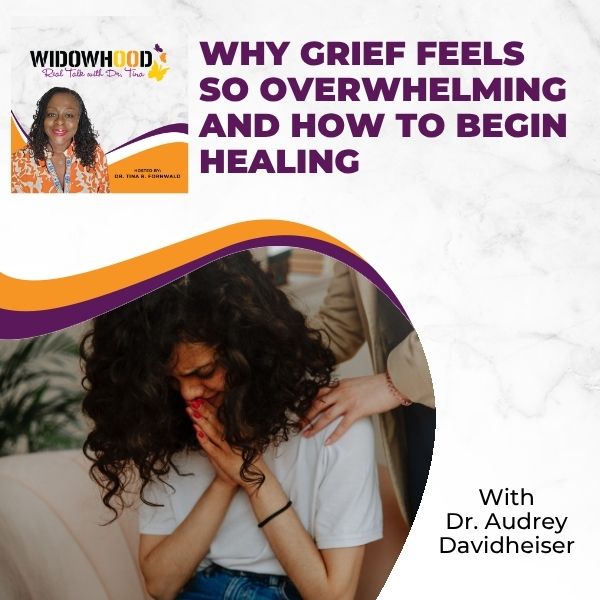
Why Grief Feels So Overwhelming And How To Begin Healing With Dr. Audrey Davidheiser

Widowhood Real Talk with Tina | Dr. Audrey Davidheiser | Grieving Wholeheartedly

  In this episode of Widowhood Real Talk with Dr. Tina, Dr. Tina welcomes Dr. Audrey Davidheiser, licensed clinical psychologist and author of Grieving Wholeheartedly: Bringing Healing to Every Part of Your Soul. Together, they explore why grief can feel so overwhelming, how emotions deserve compassion rather than suppression, and practical ways widows can begin healing after the death of a spouse. Dr. Audrey combines psychological expertise with a deeply compassionate approach to help grieving people navigate loss with greater understanding and hope. Whether you’re newly widowed, years into your grief journey, or supporting someone through loss, this conversation offers practical insight, emotional validation, and evidence-based tools for moving toward healing one wholehearted step at a time. I am sharing my experience of loving the same man for 32 years, a mother to two adult children, a retired military officer, a breast cancer survivor, and my connections with others. Anyone experiencing suicidal thoughts should reach out to a suicide hotline or local emergency number in their country: Psychology Today Suicide Hotlines and Prevention Resources Around the World. — Watch the episode here

Why Grief Feels So Overwhelming And How To Begin Healing With Dr. Audrey Davidheiser Read More »

Through Grief-Colored Glasses: Finding Hope After The Unthinkable With Vicky Edgerly

  In this moving episode of Widowhood Real Talk with Dr. Tina, Dr. Tina welcomes grief educator, author, and speaker Vicky Edgerly, whose life was forever changed by the loss of her son to suicide, her daughter to cancer, and her husband to suicide. Rather than allowing grief to define her future, Vicky discovered a path toward healing that transformed her pain into purpose. Today, she helps others navigate life’s most difficult losses with compassion, wisdom, and hope. Together, Dr. Tina and Vicky discuss surviving complex grief, supporting widows and bereaved parents, finding meaning after unimaginable heartbreak, and why healing doesn’t mean forgetting; it means learning to carry love forward. Vicky also shares insights from her memoir, Through Grief-Colored Glasses: A Life Reinvented by Devastating Loss, and the lessons that continue to inspire grieving families worldwide. I am sharing my experience of loving the same man for 32 years, a mother to two adult children, a retired military officer, a breast cancer survivor, and my connections with others. Anyone experiencing suicidal thoughts should reach out to a suicide hotline or local emergency number in their country: Psychology Today Suicide Hotlines and Prevention Resources Around the World. — Watch the episode here   Listen to the podcast here   Through Grief-Colored Glasses: Finding Hope After The Unthinkable With Vicky Edgerly Widowhood, our conversation with Vicky, she is going to share about suicide. That’s the conversation that people try to shy away from. They do not know what to do when we have no choice but to talk about it, but to experience it and to give you hope of what life can look like. In Vicky’s words, if you choose to, Vicky has dealt with the suicide of her son, her husband, and the cancer death of her daughter. Yet she has found a way to have hope and provide encouragement and support to other grievers. Let’s get into this conversation now.     Vicky, welcome to widowhood. Tina, thanks for having me. I’m grateful and humbled to be here. Your story, your life has a lot of layers. When you hear, “Welcome to the Widowhood,” what’s the backstory? What are you thinking about when you hear that? To be honest with you, Tina, I pushed back against that title when it first was applied to me. I want to say maybe 2 or 3 months after my husband Leo died, I went to attend his mother’s funeral. She passed away. I was surrounded by his family members, and one of his sisters started walking me around the room, introducing me as Leo’s widow. I hadn’t had that experience yet. It slammed into me. I wasn’t sure what I felt about it. I cried about it in my hotel room that night. I wore it like one of his old shimmy shirts that I used to put on just so I could smell the wood smoke from our fire pit, the forest that he always walked in. Evolving Beyond The Identity Of Loss I wore the title, Widowhood, as a warm blanket for a while until there came a time and a chapter in my life, about right after the second year, at the end of the second year, that there was an occurrence in my life that made me realize I had to let go of the marital relationship. I dropped the name Widow at that point as well. It still applies to me. I’m not Leo’s wife. I am his widow, but I am no longer approaching the world wearing that title upfront. It just comes out naturally in organic conversation. Thank you for sharing the evolution of that. I know for myself, when someone identified me for the first time, it was shocking. It took my breath away. Someone who has not become a widow, I think it’s hard to understand. It’s just a word. Why does it matter? It’s just like everything encompassing in that. I was like, “That’s where I am. That’s my life right now.” I can appreciate how you shared that over time your connection with that word changed. For someone tuning into this conversation, to realize the way you feel now versus the way it may change later, it has the potential to shift. That is important because some people feel like their death is final, but the way in which we engage it has the opportunity to adjust over time.     That is correct. Absolutely true. Your life is layered, and we have an amazing book, Through Grief-Colored Glasses: A Life Reinvented by Devastating Loss, and devastating loss indeed. Before we dive into the book, can you tell us about all three of the people in your life that have brought you to this place? Reframing Devastating Heartbreak Into Love It was a crazy ride for sure. Devastating in the beginning, but by the time I traveled through it all, I learned to actually love my story. It is, I think, a romantic story. Think about movies like The Notebook, which is centered around death. Is it not? However, it celebrates all of life. We all come away with tears, but our hearts are cracked wide open after witnessing such a beautiful story. I feel, just as a caveat to the readers or the audiences, that my story is beautiful. This is the place I’ve come to at this point in my life. It didn’t start out that way. In 2002, my eighteen-year-old son, Adam, took his own life. Unfortunately, twenty minutes after wishing me a happy Mother’s Day on the phone and telling me he loved me, he was gone. That was devastating. I will not get too deep into it, because we could be here all day with that particular story, but it rocked my world. I had no inner compass. I had no guidance for how to deal with grief, pain, and loss. Growing up, religion was just something we dabbled in on Easter and Christmas. It wasn’t

Through Grief-Colored Glasses: Finding Hope After The Unthinkable With Vicky Edgerly Read More »

Can Grief Become Your Friend? Finding Hope After Loss With Patricia J. Williams

Widowhood Real Talk with Tina | Patricia J. Williams | Faith After Loss

  Dr. Tina Fornwald welcomes author, minister, and prophetess Patricia J. Williams to explore faith after loss and navigating the deepest seasons of grief. Walking through devastating bereavement requires immense spiritual strength, community, and trusting that God meets us in our pain. Together, they discuss Patricia’s book, How to Flourish in Spiritual Seasons of Your Life, and how widows can discover renewed hope, healing, and purpose. Patricia’s ministry focuses on helping people experience spiritual freedom and breakthrough through God’s Word. Whether you’re newly widowed, supporting a grieving loved one, or searching for encouragement, this powerful conversation provides practical guidance and biblical wisdom for taking the next step forward. I am sharing my experience of loving the same man for 32 years, a mother to two adult children, a retired military officer, a breast cancer survivor, and my connections with others.  Anyone experiencing suicidal thoughts should reach out to a suicide hotline or local emergency number in their country: Psychology Today Suicide Hotlines and Prevention Resources Around the World. — Watch the episode here   Listen to the podcast here   Can Grief Become Your Friend? Finding Hope After Loss With Patricia J. Williams Redefining Widowhood And Community Support Our guest is Patricia J. Williams, a minister of the gospel, psalmist, and motivational speaker. She writes to inspire, encourage, and motivate. Let us get into this conversation now. Patricia is going to share with us from her book, How to Flourish in Spiritual Seasons of Your Life.     Patricia, welcome to The Widowhood. Thank you for having me on. When you hear, Welcome to the Widowhood, what is the first thing that comes to mind for you? A deceased spouse. The one who has lost a spouse and they are trying to get more encouragement any way they can. Just forming a group with, per se, other people that are widows as well. You really do not have to be a widow, but just trying to find someone else that will share the same thing. You went through, or that you all happened to go through? I like that you made the point of not having to be a widow. I’m from Chicago, so hood means family to me. Widowhood is that community. Oftentimes, what the widow or widower is missing are the people that were in their community before their spouse died. They need them now more than ever to be entrenched in their life. That’s a worthy conversation. It’s not that you have your spouse’s past, but if this is your family member, your friend, someone that you care about, they are suffering, and they’re needing that community to embrace them Even not a person per se, it could be like a loss of a marriage, a job. Something you were married to, because people are married to their job, their careers. Something can just come in, and just, everything just lost. You just wipe it out. It goes in many forms. That would be the broader scope of grief itself. The widowhood itself would be the direct loss of your spouse. You’re correct that when you think of grief on a broader spectrum, it’s dealing with your own body suffering, having to relocate unexpectedly, problems with your children, loss. The thing that I have seen, and tell me about your experience, people may have some of those lower losses that they may say, “My pet is important,” and then you may have lost the job, your health. The passing of a loved one has a different implication than that of some of these other things because we feel like those are fixable. Those are things that we can adjust, but your child passes, your mom passes, a close cousin or neighbor. Those are not fixable. Learning To Adjust To Life Without Physical Presence They are not fixable because we are learning how to live without them being here. Even though they have passed on, we are trying to adjust how to live without the physical being. Even though we have the memories and everything we used to do with them, we love them unto death. Now we are trying to fix our hearts to say, “They are not here no more.” How do we adjust when we see every little thing, say, like you are in Walmart and you just passed by something they like to eat, and then bam. Here comes the memory again. How do we adjust to that? That’s what we’re going through day by day. How to live without it, without them. I would also add that we love them currently. Oftentimes people go, “loved one,” ED, as if it’s a past tense. Some of the conflict or trauma. We love them currently. The love does not stop because they stop breathing.     It’s just a continuation. It’s just how do we adjust to love them without seeing their physical being? That’s why we have to learn how to get past that stage. As you said, it would never stop. You say we, so that leads me to believe you have a personal experience with grief or someone no longer being here. Would you mind sharing about that? Moving Beyond Titles To Acknowledge Personal Pain I had gone through a season where I lost my mother, my sister, actually two siblings, two first cousins within a three-year span, and my dad too. Me being a minister of the gospel, we tend to always encourage someone else, and we give them like they are in a better place or something like that. I had to learn how to, per se, take off a title and be like, “God, how do I hear?” We have a tight-knit family. I had to learn how to adjust to them leaving me, just going on because I didn’t know how to handle grief because I was in a place where grief wanted to succumb to me. Just wanted me to be in the house, not talk

Can Grief Become Your Friend? Finding Hope After Loss With Patricia J. Williams Read More »

Widowhood Secret Santa Program Application

Step 1 of 2

Bringing Joy & Support to Widowed Families

This application is open to all widows and widowers with children between the ages of newborn to 18 years old. Special needs children over the Age of 18 are also eligible.

Parent/Guardian Information

Address(Required)

Child(ren) Information

Do you have a special needs child over the Age of 18?(Required)
Click the plus (+) icon to add more names.(Required)
Child's Name
Age
 
Click the plus (+) icon to add more names.

Please share a little about your situation, what this program would mean to you, and any special circumstances.
What Type of Support Would Be Most Helpful?(Required)
  • All gifts will be handled through your Amazon Wish List link.
  • A completed consent form must be submitted for consideration with this application.
  • Nominations will be announced on September 1st.

Walk For Love 2025

Support grief awareness and Walk For Love in style. Proceeds help fund free grief support programs. Merchandise is available now, with new batches printing every 15 days — so order early to ensure you receive your items before the August kickoff on August 3,  2025

🛍️ How It Works

- Order anytime — Bonfire prints new merchandise every 15 days

- First shipping window: Orders placed by July 11 ship between July 1–11

- All items ship directly from Bonfire

- Order early to wear your gear for Walk For Love in August!

👕 Apparel – T-Shirts, Sweatshirts & Hoodies

🛒 Order here: https://www.bonfire.com/walk-for-love-2025-1

💲 Price: $23–$42

📏 Sizes: Youth to 3XL

Over 20 different colors

📝 Notebook

🛒 Order here: https://bonfire.com/walk-for-love-2025-notebook-1

💲 Price: $22.99

Great for journaling, writing affirmations, or gift-giving.

☕ Mug

🛒 Order here: https://bonfire.com/walk-for-love-2025-mug

💲 Price: $19.99

Sip your morning coffee with a message of love and remembrance.

🚶‍♀️ Travel Mug

🛒 Order here: https://bonfire.com/walk-for-love-2025-travel-mug-1

💲 Price: $24.99

Keep your drinks hot or cold while walking for love.

💧 Water Bottle

🛒 Order here: https://bonfire.com/walk-for-love-2025-water-bottle-2

💲 Price: $29.99

Hydration meets heart — perfect for walkers everywhere.

📣 Additional Notes

At checkout, encourage shoppers to select your board member's name from the referral dropdown to help us track outreach.

Use and promote hashtags: #WFL2025 and #WRTWT

Perfect for walking during the event or repping all year long.

Mental Health Walkathon to provide encouragement and inspiration for the grieving struggling with depression and isolation.

During the Walkathon, we walk together, united in our mission to support mental health. From August 3 - 9, 2025 we encourage you to walk one mile daily. Share your journey by posting a picture on your favorite social media platform with #WRTWT #WALKFORLOVE, and let’s inspire others to join us.

Funds from the Walkathon will allow Widowhood Real Talk With Tina to conduct an Annual Grief Garden and a Butterfly release ceremony and provide participants journals & pens.

Three ways to participate

Purchase merchandise ~ In Development

Donate: https://app.99pledges.com/fund/walkforlov

Make your pledge, 1-mile daily day August 4 – 10, and post #WRTWT #WALKFORLOVE: https://app.99pledges.com/fund/walkforlov

To Start your pledge team, email widowhoodrealtalk@gmail.com for details.

Register on Eventbrite: https://www.eventbrite.com/e/1223004923649?aff=oddtdtcreator