Widowhood Journey

Grief, Love, Moving Forward After Loving Larry With Dannie D.

Widowhood Real Talk with Tina | Dannie D. | Grief

  When people go through grief, they often handle it so self-consciously that it becomes a performance-based experience. They tend to “check off boxes” of how the grieving journey is supposed to look. Tina Fornwald discusses the importance of honoring one’s own timeline for release and healing with Dannie D. He reflects on how he addresses the stigma around Black males crying and showing emotions when grieving, as well as the negative perspectives around going to therapy. Dannie D. also opened up about his experience as a widower after the death of his partner Dale, who passed away from a heart attack at age 50. I am sharing my experience of loving the same man for 32 years, a mother to two adult children, a retired military officer, a breast cancer survivor, and my connections with others.   Anyone experiencing suicidal thoughts should reach out to a suicide hotline or local emergency number in their country: Psychology Today Suicide Hotlines and Prevention Resources Around the World. — Watch the episode here   Listen to the podcast here     Grief, Love, Moving Forward After Loving Larry With Dannie D. Widowhood, what do you do when you are a trained mental health professional, and your person dies? How do you manage the mental health side and the I am the griever side? How do they work together? This conversation and more are going to be answered in this conversation with Dannie D as he talks about the love of his life and what life looks like now. Let us get into this discussion.       Dannie, welcome to the Widowhood. I am surprised. When you hear, “Welcome to the Widowhood,” what comes to mind first? Like no bars, no holding back, no social media, no bad words to not say. What comes to your mind when you hear that? I like just the sound of it. It makes me feel like I am in this environment where there are flowers and dewdrops and falls and springs. All of these wonderful things make me feel comfortable. I hear community and connection, and I am not alone. Most people may not understand why you feel that way when you hear that word. Why does it bring you comfort? I am at a place in my life where I have done all the things that I wanted to do, or I should say set out to do. I was a professional dancer. I said I wanted to be a professional dancer when I was about 2 or 3 or 4. I was a little bit older, maybe like four. I did that. I became a choreographer. I became a teacher. I became a clinician. I am licensed, and I bought property. I have done all the things. It allows me time to really settle into who I am and identify what is around me. I am a big proponent of mindfulness and implementing self-care practices within your daily routine. I find myself in this present moment a lot of times in life. Let me ask a different question. Who is not here in your life that has brought us to this conversation? Dale. You will respect me calling him Dale. I like Larry. Larry is a much better name for me. We are going to get into that. I need to know, so now you got me with my nose hat out. Dale Miller. It was very interesting because I was not in a place to actually meet anybody. I was just not mentally or physically prepared. I was going through some illnesses and just transitions in general. This was prior to my injury, and I was still trying to figure out who I am, as a person, as an individual, my identity. All of those different things because I was a dancer, and that is who I was, that was it. Hold on for a second. Not just a dancer, I mean, drop some of these things that you have done, the places you went to school. Dancing would be like Tina saying, “She was dancing.” No. As a professional, can you elaborate on that for the scholars in the dance world so they can understand who you are and what you have done? I always say that Debbie Allen is my unofficial first dance teacher because I started watching Fame, the TV series. I had not seen the movie yet. I started watching Fame, the TV series. I saw Leroy, and I was like, “Wait a minute,” because I had seen dance before. I had not seen dance with people who looked like me, which is a good reason why presentation matters. I saw Leroy, and I was like, “I can do that.” I was like, “Wait, no, I want to do that.” For years, I just sort of watched Fame, put on my sister’s leg warmers. I was just emulating, mimicking what was going on on TV. I would sit in what we call the center splits, which is your legs wide open in a second position. I would just sit there and watch the show. Eventually, I went to a performing arts school called San Diego School of Creative and Performing Arts. I met my dance mentor there, Mr. Donald Robinson, who is still my mentor to this day. I call him my dance dad, and he pushed me in directions that I had no idea I was capable of going in. From there, I graduated, and I went to the Alvin Ailey Academy, or Alvin Ailey Dance School, and then I got bumped up into a position where I was able to actually perform. I had a little bit of a nervous breakdown just because of the culture shock moving from California to New York. It is a completely different experience. I ended up coming back home for a little bit. I went to Colorado and danced with Cleo Parker Robinson, and traveled a lot with that company around the

Grief, Love, Moving Forward After Loving Larry With Dannie D. Read More »

Actively Grieving: Choosing Joy After Loss With Kari Driskell

Widowhood Real Talk with Tina | Kari Driskell | Actively Grieving

  Actively grieving is often described as a heavy shackle, yet Kari Driskell joins us to share the profound realization that while grief is lifelong, the state of active devastation does not have to be. As a widow who turned her personal loss into a “Heart Work” methodology, Kari discusses the vital distinction between the permanent presence of grief and the choice to move toward a sense of aliveness again. We explore the “messy and ugly” reality of parenting through acute loss, the importance of witnessing a friend’s sadness without trying to “fix” it with a tissue, and how to nurture that tiny flame of hope that says life can be beautiful again. It is a raw, honest look at the “buffalo” mentality—running straight into the storm of healing to find the calm on the other side. I am sharing my experience of loving the same man for 32 years, a mother to two adult children, a retired military officer, a breast cancer survivor, and my connections with others.  Anyone experiencing suicidal thoughts should reach out to a suicide hotline or local emergency number in their country: Psychology Today Suicide Hotlines and Prevention Resources Around the World. — Watch the episode here   Listen to the podcast here   Actively Grieving: Choosing Joy After Loss With Kari Driskell Choosing Joy: The Difference Between Grief And Active Grieving Our conversation with Kari Driskell is going to challenge you. Have you ever wondered, “Could I choose to find joy? Could I choose to no longer be in a depressed state?” This conversation with Kari is going to allow you to think about whether it is a choice. What are the choices you are making daily? Let us get into this conversation now.     Kari, I am so grateful for you to be here. Before we get into the whole part of the conversation about how grief has shaped you, tell me about who you are today. I am grounded. I am sure. I am not afraid. I am happy. I am calmer. As people listen to this conversation, what is something important that you want them to take away from this discussion? My biggest message that I can share as a widow who has been through some s***. I can cuss. I probably should not have used that word. This is not TikTok, but be warned that on certain platforms, they do have to bleep it out if that is going to happen. It is up to you. This is your discussion. I am just guiding it. After having gone through some hard times of losing my own husband, I want people to know that there is a difference between grief and actively grieving. You do not have to actively grieve forever. You can choose not to. Actively grieving. What does that mean, the difference between the two, assuming that someone is listening to this conversation, and they are like, “Grief has different words? I’m grieving, what are you saying here?” After my husband, Eric, died, I had some girlfriends come over. Of course, I am at a low point. I am in acute grief. I am actively grieving. I remember people are witnessing me, they are listening to me, and they are validating me. Some of them are dismissive because sadness is hard to be around. One of my very good friends said, “Kari, you are going to grieve Eric forever.” When she said that, I was like, “The hell I will.” I was 38, because my kids were 18 and 11, and because of how I was feeling, I could not do that the rest of my life. That is a hard way to live. I was able to take a three-year sabbatical, and I just became a student of grief. I am a former teacher, and I have a Master’s in Education. I used to teach middle school math. I have always been a helper of people, and everything is figure-outable. I am going to figure this out. I became a student of grief, and I was like, “Listen, grief is something that we deal with our entire lives.” When we are born grieving, leaving the womb, we grieve small things, we grieve big things, we grieve inconveniences. We grieve significant losses.” Actively grieving is like when your grief is so big that it affects your everyday living ability, your sense of aliveness, and your ability to find happiness. You do not have to actively grieve a significant loss forever. You can choose not to. Does grief show up? Do I grieve Eric still, even nine years later? Sure. I am not constantly actively grieving him. Thank you. How does that relate to acute grief? You mentioned that term too. They consider acute grief to be in the first two years after a significant loss. Acute grief is actively grieving. I would say it is like the first year. They say statistically the second year is harder, and that is because the administrative part of death is usually finished, and now the reality of the loss has set in. Your brain is still rewiring all of the things. Acute grief generally lasts for the first two years. Yes, you are probably actively grieving consistently in acute grief. You said you had become a student of grief and everything is figure-outable. Is grief figure-outable? This is your new term. I am going to use it. After grief, we are going to go from the span of my first dog dying to someone close to me, because grief is beyond the death of a loved one. It is expensive. You talked about the different types of things that we grieve. I would dare say also the patterns in which we learn to manage those different griefs come up, and how we show up in life. Is it something that one can figure out?   Yes and no. It is something that we learn to live with. It is something

Actively Grieving: Choosing Joy After Loss With Kari Driskell Read More »

Unfiltered Moments Of Grief: Love, Loss, And Memory With Shundra Chamberliss

Widowhood Real Talk with Tina | Shundra Chamberliss | Moments Of Grief

  In a world where loss leaves echoes, how do we navigate the labyrinth of memory? Join us as Shundra Chamberliss bravely confronts the hidden corners of grief, where the past intertwines with the present in unexpected ways. Discover how life’s diverse experiences shape our sorrow and what happens when grief is complicated by more than just the absence of a loved one. Get ready for a candid conversation that will explore the power of unlocking buried memories and the profound impact of our moments of grief. This is widowhood, unfiltered. I am sharing my experience of loving the same man for 32 years, a mother to two adult children, a retired military officer, a breast cancer survivor, and my connections with others.  Anyone experiencing suicidal thoughts should reach out to a suicide hotline or local emergency number in their country: Psychology Today Suicide Hotlines and Prevention Resources Around the World. — Watch the episode here   Listen to the podcast here   Unfiltered Moments Of Grief: Love, Loss, And Memory With Shundra Chamberliss My guest, Shundra, has information to share that’s going to blow your mind. The idea that our memories can be hidden, and the desire to want to unlock them when we lean into our grief. How do different experiences in our lives impact our grief? What is a grief that’s complicated by more than just the passing of a loved one? Let’s get into this candid conversation.         Hello, Shundra. Welcome to the show. Thank you. What do you think about Welcome to the Widowhood? When you heard that, what was the ticker tape across your forehead that I couldn’t see? The Impact Of Grief & Loss The first thing that came to mind was family and community. When you say that, I feel relaxed. I feel like I’m at home. I love that. I’m going to share something you shared with me when I first started this show. I remember you asking me, “Is that for anybody that’s dealing with loss?” I said, “Absolutely,” because it is family. I’m glad that you picked up on that part because grief and loss are a universal experience. If we’re fortunate enough to have lived a life where we had someone we love, then that was a gift. Living life in their absence is a lot of work. Even to be able to talk about this, I feel the emotions come on because I need them. I need the release. Some things we hold are bottled up, and we don’t even know we are doing it. I feel tense. Thank you for sharing that, because that tension does arise when it comes to our loved ones. There’s also something very interesting that you talked about with that release, and knowing that the talking, the crying, and the release are on the other side of that. Can you remember a time when you cried or addressed something, and that weight was lifted? If so, can you share that with us? That’s hard because I haven’t talked about my grief with anyone. I’ve talked with people about their grief, and I was very supportive of their grief. When you talk to somebody about their grief, I personally don’t like to add my grief to theirs because I don’t want to downplay what’s going on with them. I never get a chance to talk about it. This is the first time that I’m able to get whatever is inside because I don’t even know what I’m going to say. I’m waiting for you to ask the question. You joined me on a live, and we had a bit of a conversation. You’ve got to share there. How was that for you? That was good. When somebody else is talking, it makes me remember. I don’t know if you have sporadic times when you don’t remember stuff. For me, it’s because of the trauma that I’ve learned to suppress. I’m having a hard time remembering my childhood and the times with my mom because I learned to push it down. We do learn to push it down, but it does not go away. It doesn’t go away, but I keep pushing it. I feel like it has piled up. What has made you decide you’re done with pushing it down? I am in the place of my life where I’m getting ready to step into a new level of my life, like another stepping stone. It was this one stepping stone in particular when my daughter was sixteen and pregnant. The first thing I did was pick up the phone to call my mother, only to find a man answering on the other side. It dawned on me that my mom is not here. This is another stepping stone. I’m thinking about her. I’m thinking about her advice. I’m thinking about what she would say about my decisions and where I’m going. I’m remembering the things that she said I would do. I wanted to celebrate and hear her congratulations for me. That makes a lot of sense. How old were you when your mother passed? I was 36, about to be 37. Thank you for sharing that. Your mom’s name? Ruth. When Ruth passed, somebody said, “At least you were an adult by the time your mom passed.” You hear different things people say to the bereaved. Someone said, “You were 36 when your mom passed. You should be okay.” What is your gut response to that if it were unfiltered? I’m not going to be mean. What is the real answer if it were unfiltered? You happen to bump into each other at the grocery store, and somebody goes, “Don’t you love the month of May?” You go, “My mom passed this month,” and they go, “How old were you when your mom passed?” You say, “36.” It’s like, “You should be fine already.” If you didn’t have to filter that, what would you say? I’d

Unfiltered Moments Of Grief: Love, Loss, And Memory With Shundra Chamberliss Read More »

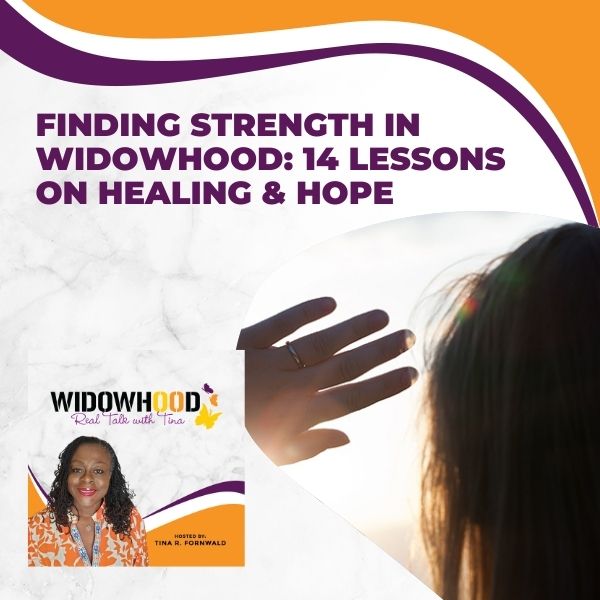
Finding Strength In Widowhood: 14 Lessons On Healing & Hope

Widowhood Real Talk with Tina | Widowhood Journey

  Grief can feel isolating, but the truth is, you’re not alone. In this episode, Tina Fornwald shares her widowhood journey, opening up about the 14 lessons she learned across struggles and surprising moments of healing after loss. From the power of community to embracing new purpose, Tina explores the realities of life after losing a spouse. She reflects on the emotions, memories, and unexpected challenges, offering heartfelt insights for those walking a similar path. Whether you’re grieving, supporting a loved one, or searching for hope, this conversation provides comfort and understanding. I am sharing my experience of loving the same man for 32 years, a mother to two adult children, a retired military officer, a breast cancer survivor, and my connections with others. Anyone experiencing suicidal thoughts should reach out to a suicide hotline or local emergency number in their country: Psychology Today Suicide Hotlines and Prevention Resources Around the World — Watch the episode here   Listen to the podcast here   Finding Strength In Widowhood: 14 Lessons On Healing & Hope This is a conversation that I’m having with you. Many of you have asked me what are some things that I have learned along this journey of widowhood. I have a list right here and I’ll go over them one by one. Also, please email me at WidowhoodRealTalk@gmail.com. I would love to hear from you. I would love to hear the things that you have learned on this widow’s journey or your grief journey in particular. If you’re supporting someone who is grieving, please share the things that you have learned about them, because it will be able to help others. #1: I Am Not Alone Number one, I am not alone. The thing about this grief journey is the head chatter, the things that will come into your head that, “No one else could be in this much pain. No one else could have this much suffering. No one else could be living this difficult life.” That is not true. I learned I was not alone. I learned that there are thousands more widows and widowers daily. #2: Community Knowing that wasn’t a trauma bonding type of situation, but it told me, “Tina, you are not the first person to endure this nor will you be the last,” which means it is something that I can live through, move forward, and I will at one point in time be okay. When I learned that, it changed my mindset from, “I don’t know if I can do this. This will never work out,” to, “Though it is painful, I have the capacity inside of me to be able to keep living.” It was important for me to know I was not alone. That circled into the idea of how powerful number two is, which is community. When I realized I was not alone, I reached out to every widow and widower that I knew. I made time to be in their presence, whether it was in person or on the phone. I had so many questions and they were so willing to answer. That community created for me was so important. It gave me the ability to be able to keep living, to know that I was not alone, and that other people would encourage me. They would share their journey with me. They would let me know that this is something that they experienced. They shared their version of it. It allowed me to take their pieces of this journey and create my own. #3: Memories, Good & Bad Number three, memories are good and memories are bad. What that looked like for me is I had to take my time when I wanted to see the memories. Sometimes, it was all at once, and then it was that I didn’t want to see them at all. I had to be honest with myself about what that looked like. I remember one time when I was looking at pictures of Mark and listening to voice messages in particular because hearing his voice made it feel so good.     I fell asleep with my phone in hand. When I woke up, all the messages were gone. I was devastated. I went to the phone store, standing there crying profusely and unhinged. I feel so sorry for whoever was at that Verizon store and had to help me that day. I probably left them shaken, but I was devastated. There was nothing they could do to get those phone messages back, and that was bad. I reached out to my children and I asked them to share with me the messages that they had with their dad’s voice and they sent them to me. It is a precious thing to have. I encourage you, if possible, to please take the pictures. Please create the memories. Please cement them with audio and videos because one day, you won’t be able to. The good part is there are tons of pictures of Mark and tons of memories with him and the children that I will cherish as long as I can breathe. #4: Music And Smells Number four, music and smells. I remember the songs that we danced to and the songs that Mark played. Mark was a hard-rock kind of guy. I learned the Eagles and so much music that I never thought of before by being with him and being married to him. I remember the smell of chili. Mark used to make chili from scratch at home. He’d have a big pot in putting it together. When I’m having chili and rice, I think of him. The smell of a bonfire, because our family had a bonfire every year, and the smell of wood burning brings back so many memories of him. Also, his cologne. He wore a gray flannel. When he passed away and I was moving from Pennsylvania to Virginia, I packed up so much stuff. Some things I got rid of,

Finding Strength In Widowhood: 14 Lessons On Healing & Hope Read More »

From Loss To Self-Discovery: A Widow’s 16-Year Path To Wellbeing With Laura Cross

Widowhood Real Talk with Tina | Laura Cross | Wellbeing

  Embark on a 16-year journey of healing and transformation with Laura Cross, a remarkable woman who has navigated the complexities of widowhood and emerged stronger than ever. In this episode, Laura shares her deeply personal story of loss, resilience, and self-discovery, offering a unique perspective on the long-term impact of grief and the ongoing process of healing. She discusses the challenges and triumphs she has experienced along the way, the importance of self-care, and the transformative power of community and connection. Tune in to discover how Laura’s journey can inspire hope and empower other widows to embrace their own paths toward well-being. I am sharing my experience of loving the same man for 32 years, a mother to two adult children, a retired military officer, a breast cancer survivor, and my connections with others. Anyone experiencing suicidal thoughts should reach out to a suicide hotline or local emergency number in their country: Psychology Today Suicide Hotlines and Prevention Resources Around the World — Watch the episode here   Listen to the podcast here   From Loss To Self-Discovery: A Widow’s 16-Year Path To Wellbeing With Laura Cross Our guest is Laura Cross, an Air Force veteran and dynamic owner of White Sands Premier Travel with an unwavering dedication to promotional self-care and personal growth. She Founded White Sand Self-Care and serves as the dedicated host of the popular TV show. Mindful Mondays with Laura Cross. Laura’s dedication lies in creating a vibrant self-care community that offers invaluable education, resources, connections, and opportunities for collaboration. At the helm of the White Sand Self-Care community group on Facebook, she empowers individuals to lead their best lives. Let’s get into this conversation.     Laura, welcome to the show. Thank you. Life’s Too Short: Redefining Priorities After Loss People say thank you, but what do you think when you hear welcome to the widowhood? I appreciate the opportunity of being able to be here and share my story or my experience and stuff with people. What of your experience made this seem like a good match for you when you heard about this conversation Widowhood Real Talk with Tina? Unfortunately, there are a lot of us who go through it and experience it, and it’s not always an easy challenge. Everybody thinks that you get a lot of those people that think that, “You should snap out of it or get over it,” or other people think you know that you take too long. It’s a conversation that we don’t normally talk about. It’s something we keep to ourselves, but it’s something that we should talk about because I am sure there are others out there who are struggling and trying to get on with their life or however you want to put it, reinvent your life. Start over for me. I felt like I was almost starting all over. That is very true and I like that there are different terms. People get hung up on “It’s not moving on, it’s moving forward. It’s not getting on with my life and continuing living.” Just as this grief journey is unique. The way we articulate it for ourselves is a unique experience. I have one widow, Andrea. She says Grief is similar and grief is different, and I believe that’s so true. Every time I have a conversation with someone, their spouse may have transitioned from this world, they may say transition, died, passed away. At the end of the road, they are no longer here and you are trying to continue to live. I feel like sometimes people get too wrapped up in argumentative about a word that means the same thing and we are trying to get to the same place. I love that you had different versions of that. Would you share your late husband’s name with us? It was Randy Cross and it all comes down to your beliefs, your background, cultures. I have found being more open-minded and listening to other people’s perspectives, sometimes you think about it. It gives you another way to look at things than the way I may have looked at it originally. I agree with you. My perspective of life changed so much when my husband passed. Life is short. We say this statement, but when someone close to you passes, the fragileness of life becomes very real. You realize how much you believe and how much you don’t know what happens, but what I have come to terms with how I show up now, the spaces I’m given with people are important, and if I don’t take what and do well with that, what am I doing with the life I have been given?     It took me a lot of years, but I was the same as you with the whole process. That’s my whole thing is life’s too short to be doing this. One of those things was like when I was working for someone and because of what I have gotten paid, I realized I didn’t have to go work and answer to somebody, but I used to be that person who would always be there no matter what snowstorm. They were the ones that I could count on. After he died, it was like, “No. I’m not risking my life to go if 10 million other people don’t show up. I’m not showing up.” You start putting value on different things and realizing that what you’ve been doing, although it may be admirable, it’s not always necessary. There are other things that are more important. You bring up a good point. The perspective of work, what we value, what we spend our time with. You said it took you some time to get there. When did your husband transition from this world and what was your journey like getting to the place of understanding that for you? That would be December 21st, 2004. Approximately 10:00 PM at night. We were laughing at lunch. He was

From Loss To Self-Discovery: A Widow’s 16-Year Path To Wellbeing With Laura Cross Read More »

Widowhood Secret Santa Program Application

Step 1 of 2

Bringing Joy & Support to Widowed Families

This application is open to all widows and widowers with children between the ages of newborn to 18 years old. Special needs children over the Age of 18 are also eligible.

Parent/Guardian Information

Address(Required)

Child(ren) Information

Do you have a special needs child over the Age of 18?(Required)
Click the plus (+) icon to add more names.(Required)
Child's Name
Age
 
Click the plus (+) icon to add more names.

Please share a little about your situation, what this program would mean to you, and any special circumstances.
What Type of Support Would Be Most Helpful?(Required)
  • All gifts will be handled through your Amazon Wish List link.
  • A completed consent form must be submitted for consideration with this application.
  • Nominations will be announced on September 1st.

Walk For Love 2025

Support grief awareness and Walk For Love in style. Proceeds help fund free grief support programs. Merchandise is available now, with new batches printing every 15 days — so order early to ensure you receive your items before the August kickoff on August 3,  2025

🛍️ How It Works

- Order anytime — Bonfire prints new merchandise every 15 days

- First shipping window: Orders placed by July 11 ship between July 1–11

- All items ship directly from Bonfire

- Order early to wear your gear for Walk For Love in August!

👕 Apparel – T-Shirts, Sweatshirts & Hoodies

🛒 Order here: https://www.bonfire.com/walk-for-love-2025-1

💲 Price: $23–$42

📏 Sizes: Youth to 3XL

Over 20 different colors

📝 Notebook

🛒 Order here: https://bonfire.com/walk-for-love-2025-notebook-1

💲 Price: $22.99

Great for journaling, writing affirmations, or gift-giving.

☕ Mug

🛒 Order here: https://bonfire.com/walk-for-love-2025-mug

💲 Price: $19.99

Sip your morning coffee with a message of love and remembrance.

🚶‍♀️ Travel Mug

🛒 Order here: https://bonfire.com/walk-for-love-2025-travel-mug-1

💲 Price: $24.99

Keep your drinks hot or cold while walking for love.

💧 Water Bottle

🛒 Order here: https://bonfire.com/walk-for-love-2025-water-bottle-2

💲 Price: $29.99

Hydration meets heart — perfect for walkers everywhere.

📣 Additional Notes

At checkout, encourage shoppers to select your board member's name from the referral dropdown to help us track outreach.

Use and promote hashtags: #WFL2025 and #WRTWT

Perfect for walking during the event or repping all year long.

Mental Health Walkathon to provide encouragement and inspiration for the grieving struggling with depression and isolation.

During the Walkathon, we walk together, united in our mission to support mental health. From August 3 - 9, 2025 we encourage you to walk one mile daily. Share your journey by posting a picture on your favorite social media platform with #WRTWT #WALKFORLOVE, and let’s inspire others to join us.

Funds from the Walkathon will allow Widowhood Real Talk With Tina to conduct an Annual Grief Garden and a Butterfly release ceremony and provide participants journals & pens.

Three ways to participate

Purchase merchandise ~ In Development

Donate: https://app.99pledges.com/fund/walkforlov

Make your pledge, 1-mile daily day August 4 – 10, and post #WRTWT #WALKFORLOVE: https://app.99pledges.com/fund/walkforlov

To Start your pledge team, email widowhoodrealtalk@gmail.com for details.

Register on Eventbrite: https://www.eventbrite.com/e/1223004923649?aff=oddtdtcreator